Kal Amir and Golbahar
Catalog details
- Artist
- Master Jalil Ziapour
- Date
- January–February 1959 (Bahman 1337 SH)dated on the work
- Medium
- Oil on canvas
- Dimensions
- 120 × 190 cm
- Style
- Ziapour’s national style
- Collection
- Tehran Museum of Contemporary Art
- Inscription
- A Gilaki song sung by the two characters, Kal Amir and Golbahar, is written on the lower part of the canvas (the Gilaki text is on the Persian page).
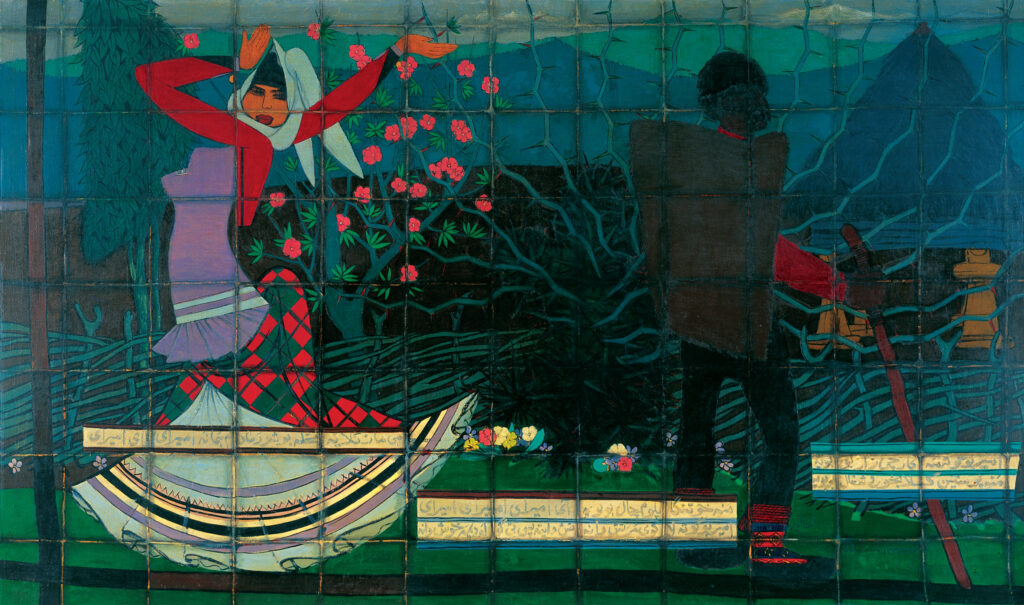
Kal Amir and Golbahar, oil on canvas, 1959, in Jalil Ziapour’s national style.
About this work
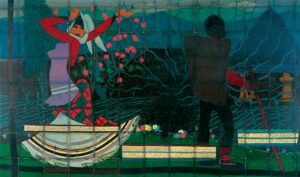
This painting is drawn from a local legend of Qasemabad, Gilan, and concerns two characters: “Kal Amir,” a symbol of winter, dryness and biting cold, and “Golbahar,” a symbol of spring, growth and joy, in a colourful local dress. Kal Amir has fallen in love with Golbahar and has come to her on the pretext of taking fire from her. He sings her a song and, because of his love and the circumstances he is in, laments his own state.
The song, which is written in Gilaki on the lower part of the painting, expresses the conversation between Kal Amir and Golbahar in this way.
In translation:
Amir said: How wretched my affairs have become, a jackal has carried off my sheepskin hat, my sleeping place, out of sheer misery, has ended up in the middle of a polum pit (1), ay Amiray, Amiray, Amiray
Amir said: Beautiful girl, I have come to take fire; once you have given me the fire, give me a kiss as well.
Golbahar:
My mother has gone to Kalayeh Mahalleh, she will be here any moment, Amiray, ay Amiray
(Out of worry that her mother would come, Golbahar wished that Kal Amir would leave the place as soon as possible.)
1. Polum (pilum, pilam): a plant that takes away the sting of nettles.