by
by Text of Master Jalil Ziapour’s speech at the Bahman Mohassess exhibition, published in the weekly publication “Niruy-e Sevom”, No. 15, 28 November 1952

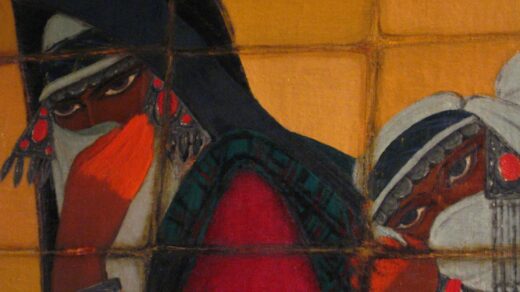
Master Jalil Ziapour; “Kol Amir and Gol Bahar”; 1955; national style (Legends of Qasemabad, Gilan); oil; 190 × 120 cm.
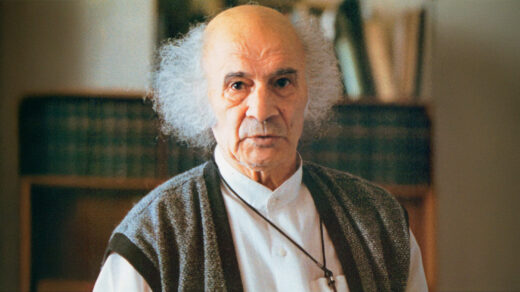
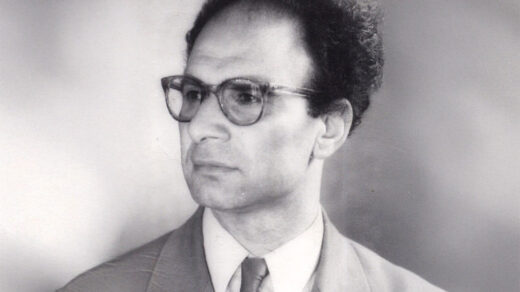
For some time, Bahman Mohassess had practiced Cubism under me to familiarize himself with new artistic matters. He organized an exhibition of his works, and on the opening day the organizers of the exhibition asked me to deliver a speech on new art. In this speech, I endeavored as much as possible to speak simply and make new art comprehensible to the invited guests:
For about four years now, the geometric style of painting has been prevalent, and you are aware of what opposition and struggles have arisen during this period. Some, on the grounds that this art is not social, and others, who were supporters of so-called natural paintings and perceived the Cubist style to be a foreign style, were always in opposition; and because they saw crooked and misshapen lines in it, they interpreted it, and still interpret it, as bad taste, and these oppositions continue to this day. I know that the people are not to blame. For they did not create that necessary artistic environment which ought to have been created by artists and responsible officials to elevate the level of the people’s taste. In truth, we have not had qualified artists who recognize their responsibility toward their art and their era, and who strive to raise the awareness and taste of the people of their milieu.
Artists have not realized their own position, how they ought to be, and have not made artistic manifestations; consequently, the people, too, have not become acquainted with different styles of art and the necessity of change and transformation. Thus, it does not seem unlikely that now no one should like geometric painting (which was the work of our own artists of the past), or that no one should be able to understand the purpose and concept of this style of painting. Now, there is no place for any expression of regret; the only expectation one must have of the milieu is that it should at least be prepared for artistic discussions. For when a style comes into being, that style does not approach public understanding without discussion, criticism, and analysis.
In art, the power of expression alone is not sufficient; rather, in essence, the manner of expression is always the fundamental condition. That is to say, how to say something is mostly the necessary condition. For how to express any subject is the artist’s task. This is why in my past speeches I have always said that how to think is distinct from showing what kind of thought it is. Now, one can turn attention to this view: it is for the sake of showing what kind of thought it is that different methods come into existence. When social conditions change due to events, because of this change, a fresh interpretation becomes necessary to express the nature of realities. Any kind of war brings with it a kind of violence. Any kind of invention brings about a kind of conception. Any kind of new social thought builds a kind of critical scene, and each of these also has its own special expression.
Our era is the era of the machine. The life of our era is coupled with economic and political struggles and new social ideas, and people are grappling with forms of violence; and since artists are in the flow of this way of life, naturally they all feel violence. Therefore, gentleness, or laxity and daydreaming, find no way into it, and this reality, whether nascent or mature, in any case presses its weight, first and foremost and more than anything, upon the minds of sensitive people. The most sensitive individuals in society are artists, and artists, too, interpret and explain realities in the necessary form. Artists display nascent and tangible perceptions and do not deal with ordinary perceptions and subjects of which everyone is aware. For the interpretation and explanation of ordinary themes is not a nascent perception. The artists who help elevate the level of artistic taste are those who always place a higher foothold at the disposal of the people’s thought and taste, so that through this path, the people are prompted to think and cultivate their taste.
The characteristic of the machine age affects the qualified artist, and the artist wishes to put on display this feature and reality, which brings along violent things to say. To express it, he cannot use the tools of his predecessors in the same form, because the tools of expression of the past are capable only of expressing the states of the past. If these tools of the past expressed peace and gentleness, they cannot also express a state of violence, unless the necessary conditions of violence come into being within them so that they can present the originating state.
In the paintings of the past, whose tools of expression were gentle and muted design and color and whose subjects were repetitive, if today those same designs, colors, and subjects are displayed in the same condition, they cannot be representative of today’s reality. For that kind of design and color shows the spirit of another time; and for today, where apathy and indifference have no place, it is obvious that designs must be expressive of a state, and colors must have vitality and exuberance, so that through this means they may be able to express the reality of their own era. Thus, with this groundwork, it is understood in general that the tools of expression of every period must, in principle, differ from those of the period before or after it. If you change the subject and choose the subject of the time, but do not change the manner of expression, you have performed a futile task. For it is like pouring fresh ideas into an old mold. (Mold and content must both be new).
Geometric painting, or Cubism, has a mold that is suitable and in accord with the requirements of the machine age. For its forms are geometric and resemble machine parts (or are derived from them). Therefore, they possess the best form for representing the characteristics of the life of their era. Now, if Cubist paintings do not please the taste of most or all of the people of a given milieu’s era, the blame lies with the artists who were not qualified, were not children of their time, did not understand the requirements of the era, and did not present those requirements to the people by means of artistic works. In this case, it is natural that regarding art, the people and those of taste will have the same judgment with which they are familiar, and will recognize the same beauty to which they are accustomed. A habit of such firmness, as if it would never accept change, must be considered as arising from the exposition of beauties that for many long years, pseudo-artists have created for our people.
If a habit, in fact mummified to this degree, had not taken hold of the people of this milieu, it would never have occurred to them to imagine that geometric painting is a foreign style, and this is very strange. Because this art in geometric form has existed in the land of Iran from several thousand years ago until now, and the Iranian artistic identity in the eyes of the world is based on the principles of geometric decorative art; and these paintings that have recently become customary in Europe in the styles of Fauvism, Cubism, or Surrealism, Iranian artists created from earlier eras, and they still continue. These very works of ours have today become a source of inspiration for the artists of other peoples. The truth of this statement becomes certain when a person follows the course of art in Iran’s different periods and knows how Iranian artists had traversed the so-called new European schools of painting long before them. From prehistory to the Qajar era – that is, from before the Achaemenid, Parthian, Sasanian, and the Islamic, Seljuk, Timurid, and Safavid periods – paintings were all created geometrically, albeit each in its own way. (This art in the Iranian plateau dealt with geometric patterns for two basic reasons, and it has been one of our environmental characteristics): one is the existence of clear weather and intense light, which created sharp chiaroscuro and made the geometric planes of the design legible; and the other is events, which brought about a violence mixed with forbearance, causing the manifestation of works such as the intricate patterns of the Islamic era, all of which are geometric.
It must be noted that not only should Cubism have been an outdated art for today’s Iranian artists, but also the precedents they have shown in various styles before others should, in principle, have made them pioneers in finding styles much more comprehensive and suitable than Cubism. Unfortunately, however, this is not the case; rather, they sometimes consider Cubist painting to be far above their own comprehension, and also imagine it to be a foreign method. (More strangely, they attribute this manner of painting to individuals who have poor taste and lack the ability to create natural works), and this is a weapon for those who never want to turn back from what they have incorrectly learned and understood.