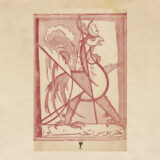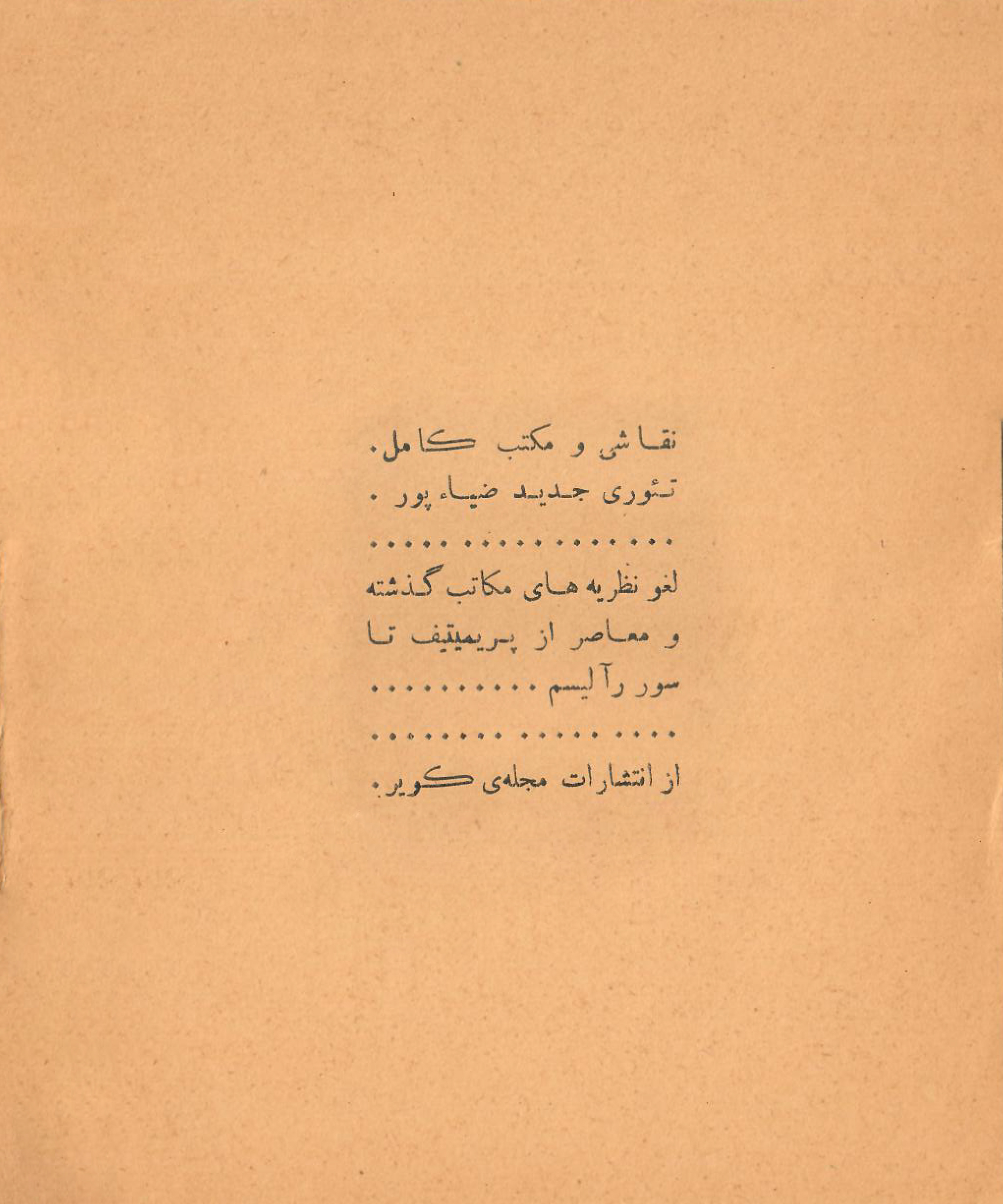
Cover of “Painting and the Complete School; Ziapour’s New Theory”, published by Kavir magazine, 1948
Master Ziapour, after obtaining his doctorate from Paris and returning to Iran, with abundant investigations and the necessary scrutiny, writes down his artistic theory and ideology under the title: “The Abolition of the Theories of Past and Contemporary Schools” and by doing so begins to enlighten minds.
Download the PDF file of the theory from here .
Painting and the Complete School
Ziapour’s New Theory in Painting.
The abolition of the theories of past and contemporary schools from Primitivism to Surrealism.
From the publications of Kavir magazine.
Natural forms: by this is meant familiar and ordinary shapes.
Near unnatural forms: by this is meant shapes that have a close resemblance to familiar forms.
Distant unnatural forms: by this is meant forms that can be likened to familiar forms or near unnatural forms, only in the imagination and by way of association of ideas.
It must not be forgotten that the majority of human actions and perceptions rest upon obligatory conventions, and then it is habit that turns the wheel of life. If an objection is raised against these conventions and experiences or habits, it is certainly because: they are not in accord with the demand of the day, “for satisfying necessary intentions.” This too is known, that each person has a kind of manner of expression, and each person strives to become more versed and stronger in his work, and in any case to be a specialist in his own craft. If a craft is incapable of expressing a purpose “as it should,” it will be a clear proof of the defect of that craft itself.
Surrealism’s dispute lies in this, that it demands a freedom vaster than the freedom of other schools of painting “to elucidate all kinds of subject matters: true or false, melancholic or rational, material or spiritual.” It wishes to manifest its ideas in any case, to secure its desires and repressions. It is not constrained by whether the work has the necessary connection “as it should” with its own discipline from the standpoint of specialisation and craft; therefore it lacks a specialised artistic method. This defect is not only related to Surrealism; rather, without exception, all schools of painting, especially some “despite the great effort they have made to free themselves from the grasp of parasites,” starting from the paintings of the early era (Primitif) up to today, which is the most resplendent era of painting (Supernaturalisme), suffer from it. Neither Classicism, nor Romanticism, nor Fauvism “except slightly Impressionism and Cubism,” none have given the right of the art of painting to painting, and have not taken into consideration its vast scope in the artistic arena, and for this very reason they have pushed painting back from its proper limits “due to its entanglement with parasites: which have been the fundamental cause of the lack of necessary progress in painting.”
The nature of this lack of progress in painting can be discerned by referring to the manner of the passing of the eras of the schools. To explain and demonstrate the parasites and to show the path and ultimate goal of painting “how it must progress within its own limits,” I will provide necessary elucidations, and I will express its general method in the previous world “as it has been,” and then for the present world “as it should be.”
During the era of illiteracy, painting bore the important duty of expressing communal realms “especially religious ones.” With the advent of script and writing: which was a practically faster and more disseminable means for describing various scenes, painting inevitably, sporadically at first and then gradually, steered attention away from defining collective subject matters toward expressing personal states. Thus, the constraint that the painter had in that era from the standpoint of communal duty was much more important than after the emergence of script and writing. In whatever proportion the power of dissemination by means of writing increases, in that same proportion the importance of the communal duty of painting decreases.
In this state, the painter finds more opportunity for elucidating his own intentions “which arise as a result of the conflicts and the quantity and quality of the realities of life.” This simple elucidation is a clear indicator of the nature of the transformation, namely the deprivation of the painter’s heavy and social duty from him, and his dealing with personal desires and tastes. In spite of this, it must be known that the painter can never altogether lose communal subject matters; because for him – not only him but any individual or any other artist living in an environment – escaping from the thoughts and the reactions of the thoughts of his society “due to mutual influences” is impossible. Hence, for the painter of that day as well, complete detachment from such realms seemed a difficult task, especially since human beings of that era were more inclined to the pictorial representation of their intentions “despite the existence of script and writing: which of course were not a more embodied expression than painting.” For the image, this external appearance of the entities being interacted with, coupled with their own specific states (Expression) “since it is familiar to human vision – is naturally an easy means for expressing a purpose.” As we know, even in the life of the cave eras, early man engaged in it. It is from right here that pictorial painting lays a firm foundation in achieving the representation of the artist’s desires; and it is from this era that the image acquires importance for expressing purpose in painting, and the painter strives to manifest communal or private purposes and subject matters in the best possible manner with completely natural and familiar images.
The requisite for a subject matter to come into being in a natural form “in which case events are shown more embodied” is to work correctly. Correctness of action, too, is to bring into being something natural and exact; that is, in the very state that is seen in nature with the ordinary gaze of people. Thus, for this task, precision in the factors: upon which the specific appearance and natural state of everything depend, becomes necessary. Hence, painters paid great attention to the factors of painting for this purpose. As a result, technical skill came into consideration. This skill varied in proportion to the power of talent and the demand of the schools. Classicism strove to compensate for the rawness and dryness of the works of the early era as much as possible with practicable skill. Romanticism, with this skill and the maturation of technical factors, engages in the representation of legendary subject matters.
Realism, although it had evolved from most aspects and from the standpoint of naturalness had reached the level of so-called “verisimilitude” “and in this state was considered the perfection of technical skill,” champions realities. Therefore, attention to the manner of representing perceptions by means of technical skill “which willy-nilly brought forth the subject of drawing, colouring, and giving state” caused the emergence of different schools as well, “while pictorial subject matters still remained in their own state.” These pictorial subject matters endured for a while, that is, as long as humans showed interest in figurative paintings (Figuratif) “which relate to communal purposes” more than decorative ones (Decoratif) “which relate to personal intentions,” or in both in a state of mixture; and to whatever extent social beliefs change, to that same extent pictorial subject matters change form. At one time the exigencies of life required that they create religious stories and make man fly in a state of ascension and soaring beyond the atmosphere, in the physical and spiritual realms, so that in this way they would have expressed their intentions; and at another time it requires that artists, instead of flying in the skies of imaginations and painting religious scenes, create bowls and jugs and doors and figures (that is, they deal more with the realities of life around them “as they have dealt with”). So in the midst of this, we see that for these representations, all of them, even the most avant-garde of them, with one commonality: namely showing subject matters pictorially – have engaged in expressing their intentions, not in any other kind; and later we also saw that since natural forms were incapable of accurately translating the artists’ perceptions and did not do justice to the matter as they should, painters, out of necessity, took refuge in adjusting, modifying, and increasing or decreasing forms so that they would express the purpose more comprehensively. From the adjustment and modification of these natural forms and their transformation into near unnatural images, it is realised that the painter is seeking the representation of things other than forms; and it shows that these forms are nothing more than a weak and inadequate excuse for representing his psychological states. Therefore, according to this account, since natural forms have thus far “for the reason that was mentioned” been unable to sufficiently express perceptions; and on the other hand, near unnatural images, in addition to lacking the necessary power in expressing more precise psychological states “which do exist,” have caused the deviation of attention from the goal and have diverted the mind from the principal purpose of painting “for reasons that will follow,” hence their existence is counted among the major parasites of painting; and for this very reason they must be eliminated from the midst. Certainly the answer to such questions: (What is the convincing reason that natural or near unnatural forms hinder the progress of painting and are parasites to the painter’s purposes? And in the event of the absence of pictorial subject matters, how is it possible to express the purpose and bring an artwork into being? And apart from pictorial subject matters “with which man is familiar,” what factors might replace these subject matters and their meanings?) is easy, and here is the answer: I said that attention to technical skill “for bringing into being canvases similar to nature” willy-nilly brought forth the subject of drawing, colouring, and giving state. In paying attention to different drawings and comparing them with one another “from the standpoint of skill,” and the eye’s familiarity with rough and smooth lines, and their fast and slow spiral and stretching and arching movements relative to each other, and the distant and close resemblance of these movements to some of the apparent movements of entities in nature, they result in innumerable associations of ideas, such that the viewer makes a specific inference from all these movements in every kind. Hence drawing, in proportion to the state of its movements, becomes the possessor of meanings; and every kind of its diverse movements takes a person to the memory of one of the fresh states and memories or old psychological tendencies; and over the passage of time this meaning takes a firm footing, and in painting undertakes a great duty “from the standpoint of helping the strength of the matter.” Drawing, which previously – without considering its importance and the manner of its application – was used merely with simplicity and without imparting meaning to it, only for the purpose of limiting the outward appearance of entities and objects, with the artist’s encounter and familiarity with the existence of animated drawings: the importance of which, through attention, only a few understand in different eras up to the time of Realism “to some extent gradually,” from here on out the meticulous painter strives so that drawings may possess spirit and meanings. These meanings are well evident in the works of discerning painters.
And I also said that for making a subject matter natural and true, besides drawing, colour was the principal factor, and in it precision had to be exercised. Precision in colouring roused the painter’s eye to see colours diversely. Up to the time of Realism, the field of seeing colour was confined to blue and green and yellow and red and their limited derivatives. This practice, based on the principles of conventions “as following the method of the masters,” limited the painters’ field of vision; except for some who “because they inferred the necessities and the altering of conventions based on obligation” stepped further and brought newer colourings into being. Impressionism and, following it, Fauvism utilised the combinations of primary colours and their vast derivatives; and they did not merely suffice themselves with the findings of past masters; and they did not apply their experiences as empirical originality and divine revelation; rather, they brought colouring out of the state of rigidity and monotony, and in this way gave an expansiveness to the vision of painting. From the existence of grey colours too “which rarely align with temperaments and tastes,” it was Fauvism and Cubism that benefited adequately and established a personality for it among other colours.
The cultivated eye, despite seeing diversely, when bringing into being a handful of harmonious colours, certainly goes more after those colours and likes them that it has had more familiarity and intimacy with during its lifetime. In this order, the choice of colour in painting is dependent upon the painter’s ordinary tendencies. These ordinary tendencies, over the course of years, in affective backgrounds, have come into being by way of the habituation of the painter’s vision to the distinct and penetrating colours of nature. Man, in prolonged eras, has had familiarity and obligatory contact with the colours of elements: “like the general colours of winter, autumn, spring, fire, thunder and lightning, the blue or turbid sky.” This obligatory and natural contact was the primary means for affecting their eyes in seeing colour and also differentiating them from each other. Winter for him is entirely snow and precipitation, and an embodiment of a vast covering of colours from generally white-grey backgrounds.
Spring for him is a covering of the vast colours of blossoms and greens, yellows and blues and purples. Autumn holds for him the memory of frostbitten red and yellow colours. Therefore, for man, every memory, in proportion to its connection to a time of the times of the season and year, possesses specific colours and associations of ideas; and since man’s mind, by way of prolonged habituation, carries every season together with its seasonal characteristics: “that is, the colour of winter coupled with cold, spring with cheerfulness and moderation, autumn with autumnal characteristics, and summer with heat” all at once in affective backgrounds, hence, seeing or imagining one of these two factors “for instance the colour of winter or cold” awakens the other in the form of association of ideas “coupled with pleasant or unpleasant memories” in the mind, and in this way, various associations “which never settle in the mind from the outside without colourful backgrounds,” through their accumulation, bring into being the deep backgrounds of colourful tendencies and temperaments; and from here, by means of composite colours taken from the association of ideas “without needing the existence of images,” backgrounds are obtained for perceiving the artist’s demands: what kind of associations and desires he is thinking of; and from this very path, cold and warm and mild colourful tendencies find reality regarding every individual, especially the painter, and become the introducer of his way of seeing and his desire. By this analogy, just as conventional feelings: coldness and warmth, sorrow and joy and their likes, have colourful backgrounds in the minds of individuals and, for their identification by way of the eye, possess colourful signs by means of various colours, each of the unconventional feelings and perceptions as well “which are more precise and subtler” are owners of colours that if those colours – while matching tendencies – are combined skillfully, can display the most precise and subtler psychological stages “which painters have hitherto very rarely, and even then defectively, managed to interpret.” The foundation of my theory, too, is laid from right here, that is, outside of natural and near unnatural forms, upon colours: which by way of association of ideas possess subject matters latent within themselves.
Considering the strong effects of food and environment in the cultivation of the eye and seeing colour, and adding them to the ordinary colourful tendencies of persons, yields convincing backgrounds of the nature of the complex accumulation of the painter’s colourful tendencies, which makes the comprehension and the intricate connection of matching the hues of an artwork with various psychological states easier. In addition to line and colour, giving state (Expression) also became one of the factors that became necessary for completing the expression of a purpose in a more interesting and effective form. This practice was drawn out in this same method to the point that deforming (Deformation) came into play and, as a result, brought novel form into being for creating specific pictorial subject matters in painting. Although, for escaping from stale and inadequate moulds: “which for a long time showed ordinary pictorial subject matters under different titles,” employing novel form in painting has been one of those courageous and usable steps in the garb of Cubism and Fauvism; yet these novel forms “which due to being pruned, have exited the natural form and inevitably brought about ambiguity (Abstraction)” have caused nothing but the deviation of attention from the principal purpose.
Successive public transformations brought the fine arts “which were continuously traversing shoulder-to-shoulder with environmental needs” to this conclusion that: to express themselves better, each must specify the goal and specialised discipline of their work “as they should”; hence, they successively cast themselves from one stage to another stage and from one school to another school. Up until now, what they have demanded from painting has been stories and everything else except painting; that is, by means of painting, they have paid attention to the appendages attached to it, not to itself. Even up to now, they do not recognize the factors of painting that possess a specific beauty latent within themselves, and they do not have direct attention to them. So, naturally, the beauties of these factors fall into the crucible of inattention. The bustling of all schools one after another “which rapidly drove themselves forward” has solely been for freeing their collars from the grasp of the appendages that had lost their personalities amidst their own personalities, but they have not succeeded; because fundamentally this action, with the forms and moulds of other arts being in the midst, was not and is not feasible. The painter, even up to now, considers himself compelled and obliged to use natural or near unnatural forms. To him and his supporters it seems unbelievable that they could not use these images on the pretext of a mould and a means of expressing purpose, and that they could throw these moulds away entirely. The most avant-garde schools, even Cubism and Surrealism with all that uproar, have merely engaged in deforming the images of ordinary subject matters and have not taken a fundamental and completely effective step to rescue painting from the fetters of borrowed moulds.
When artists, based on natural causes and necessity, inferred changes and stepped into the circle of tastes, and with the utmost intensity endeavoured to elevate pictorial paintings to the stage of decorative paintings and by mixing the two increase the beauty of their purpose, this striving was a very vast and effective and commendable step in painting; for in addition to showing ideas, by means of the manifestation of taste, they brought beauties into being that truly and entirely belonged to painting. Impressionism started this work and showed a correct and vast path to painters: it acted in such a way that colours were seen before the subject matter, and with this action, it made the personality of artistic factors related to the sense of sight stronger. Surrealism in painting engaged in storytelling and stimulating the mind for drawing out ideas and displaying its own subject matters and repressions and obligatory reactions, in a pictorial form. Therefore, in painting, it completely deviated from the road of specialised art. Cubism, although it strictly followed Impressionism by means of Fauvism and took vast steps in the arena of art and strove in introducing the personality of artistic factors; nevertheless, because it makes the viewer – who by perpetual habit seeks ordinary and natural images and subject matters in painting – “due to deforming the forms and consequently making them ambiguous, pay attention more than before to the natural shape and subject matter, namely his own ordinary and perpetual desire,” for this reason Cubism, despite being considered the most complete and necessary of schools in most aspects, nevertheless has defects from the standpoint of the artistic goal for the following reasons: A – Because in any case it possesses pictorial subject matters “natural or unnatural” and also possesses ordinary moulds that: can only elucidate limited sayable things and are incapable of elucidating the vaster and more precise psychological states “the need for which is currently palpable”; B – And because for specific intentions, it has been forced to deform natural and simple forms, and has made the mind curious “so that it can discover the original reality of unfamiliar forms” and as a result has deviated attention from the fundamental goal of painting “which is the perception of the beauty of its own specific manner of expression” more than before, hence, with all the merit of its precedence over other schools, it is an inadequate and defective school. The most avant-garde Cubists even, are still so fettered by these unnatural images that at first glance they compel the viewer to investigate the actual and natural appearance of the present unfamiliar images. Now, as we observe carefully, we see that the actions of past schools in hierarchy up to Impressionism “which, based on personal tastes born of necessity, for expressing more precise psychological states, have made changes by way of specialization in technical factors” have entirely been related to the specialized craft of painting and have been the only path of activity toward the purpose; but the subsequent schools, conversely, “although they could have made more direct and faster use of the existence of Impressionism in favor of advancing the specialized goal of painting, have been oblivious to this matter, and unknowingly and without intention, by means of the existence of their exaggerated state and form “in addition to delaying the arrival at the purpose of painting” brought about a great deviation in the general goal of painting. Of course, although the post-Impressionist schools, relative to the points of objection and their defects, possess in return extraordinarily valuable advantages and brought into being a much more expressive path of expression relative to previous schools and have been explicit introducers of the demands of their time; yet the general criticism lies in this: up to now none of the schools have sought to let go of natural and unnatural forms “for the reasons I have shown previously”; except slightly Cubism: and that too where, due to the inadequacy of the expression of ordinary forms, from its using them as a means in a pruned and unnatural form “for bringing into being a kind of subject matters appropriate to the intentions in view”, only from this aspect, can it be said that it has taken the preliminary steps for liberation from the grasp of inadequate natural forms.
It must be known that: (If the purpose of painting in the first stage is showing the various scenes of life, namely subject-making “which at the same time takes on a bit of complexion commensurate with nature so that its manifestation and embodiment would be greater”) this action, in truth, is writing. Certainly the imaginative faculty can, by means of writings too, colour and embody subject matters “without them being painted” in the mind by way of stored colourful associations of ideas, and hypothetically, if the above purpose is the only accepted and correct view; the correctness of this matter applies only as long as pictorial paintings are necessary; but today when sufficient means for embodying the various and ordinary scenes of life are at hand and they can well manage to perform these kinds of duties, there is no reason that merely because at one time painting did the work of script and writing, and for a while too performed duty with that same position muddling through even up to these days, today too it should undertake that same duty under the titles of being utilitarian and social, in that same form, in one or all eras, and hold back from displaying more precise psychological realities “which it can perform”. Today the duty of painting must be the creation of more precise and specialised works, not the creation of ordinary pictorial subject matters: which are not a vast and deep means of expression.
Now let us see what remains of painting after the separation of ordinary and near unnatural forms. Naturally colour, drawing, form, composition; but if a form or a composition creates a natural or near unnatural shape, certainly this act is outside the realm of my theory; because such a form and composition have a state similar to ordinary and familiar objects, and in this case, they will cause the deviation of attention from technical factors: “which according to the previous reasoning, based on the principles of colourful associations of ideas, inherently possess subject matter and forms, albeit distant unnatural ones”.
General Conclusion:
A – It is colour and drawing and a kind of distant unnatural form and composition that painting must operate upon.
B – However much the subject matter in painting is more unnatural in terms of organisation, to that extent the painting is more complete and, from the standpoint of specialisation, more valuable.
C – The subject matter of painting fundamentally must not yield the subject and predicate and conclusion “like ordinary writings”; because every line and every colour, every form and every composition, alone by itself is the owner of subject and predicate and conclusion, and consequently subject matter; hence, any kind of form and image and subject matter inclined toward familiar nature violates the craft of painting.
D – However much natural and near unnatural forms yield their place to the combinations of colour and drawing and other technical factors, to that same extent painting journeys toward perfection: namely, to a place where it can more acquire the beauties and pleasures specific to itself.
E – If a painting comprises natural or near unnatural forms, the artist must deliberately destroy them in such a way that it is incapable of resembling ordinary nature, so that artistic factors manifest themselves completely and without parasites.
F – In painting without image “that is, outside of natural and near unnatural images,” the artist understands his duty and knows that to create specialised beauty he must deal directly with artistic factors “that is, creating more precise and more pleasant harmonies and more animated and more expressive drawings.” At this very stage, the artist and also the people in particular “who by means of understanding ordinary and pictorial subject matters similar to their own memories and desires had supposed that they had perceived specialised beauty” understand their duty; and for perceiving the beauty of painting, from now on they will refer directly to artistic factors, not to pictorial subject matters or the image itself. Here will be the first stage where the artist and the people both discover the reality of the concept of specialised beauty or specialised aesthetics.
G – Up to now, painting has not reached the limits of its specialised art and beauty, and has had a very close mixture with other fine arts, especially literature “descriptive events.” With the application of this theory, a school that I call “Complete” comes into being, which separates the bounds and borders of painting from other arts. Right here “that is, in the Complete School” will be the true destination of technical and specialised painting – separate from other arts – and from here, painting will manifest itself with a vaster concept.
H – The beauty of painting is separate from the beauties of other fine arts; it must be known separately.
I – It must be known that: no new method ever comes into being without environmental necessity; and no desire can ever be ahead of the desire of its time; because every desire has a cause; and certainly the principal cause of every stimulated desire exists within the society of every desirer. Therefore, my theory is not and cannot be outside the demand of my present time.
Use with citation of the source is permitted.
6 October 1948