by
by Article by Master Jalil Ziapour, titled “Painting”, published in Fighting Cock (Khorus Jangi) Magazine, Issue 4, pp. 3 to 18, year 1948.

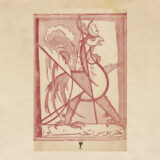
Master Jalil Ziapour, cover design of Fighting Cock Magazine (Issue 4), year 1948
Painting
The roots of all kinds of thoughts and ideas exist latently and weakly in the depths of human life. Despite the complexity of the mental and spiritual structure, each of these ideas “whose awakening and cultivation are prompted by general developments and inevitable rotation or the law of reaction” manifests in due course. These manifestations are always accompanied by the circumstances and needs of an environment. And often, due to unfavorable conditions, they inevitably emerge and establish a foundation after a period of wandering and failure. Surrealism, too (Surréalisme), after a series of weak manifestations that had occurred at different, not entirely suitable times, failed to establish a firm foundation. But in these very occasional manifestations it sowed its seeds until it was able to secure relatively greater success in its recent manifestations.
Those who are informed know how Cubism, with its hard and heavy fist, dealt strong blows to the mouth of past schools, and by enduring forty years of hardship and persistence, was able to compel those of sound and progressive taste to accept its legitimacy, and consequently, with more enlightened supporters, completely change the destiny of painting, in its own words. But because in its ideology it was still bound to things that involuntarily, and even beyond expectation, linked it to the past, and had not only not completely removed itself from external nature as it should have, but had become more bound to it, therefore Surrealism, which for some time had been progressing almost parallel to Cubism, rejects these constraints of the past that were still clinging ever tighter to the neck of Cubism. And, in its own words, it frees itself from their clutches! (Unaware that in its idea it entangles itself in an old ideology in a newer guise; that is, it dresses Romanticism in new clothes; with the difference that: if Romanticism engaged in a kind of storytelling that depended on the spirit of the people and public beliefs “such as the religious paintings of Raphael, Veronese «Véronèse» and their followers, or the mythological legends of a Rubens, and so on and so forth,” here the Surrealist only engages in the narration and dissection of its own inner characteristics.)
André Lhote «A. Lhote» says in this regard: Discussing Surrealist ideas is a futile effort, because merely astonishing people and stimulating their minds and nerves in this respect, such an action cannot be called taste and artistry, and regarding the durability and survival of this school he says: I do not know whether it will endure for a long time or not; but he regretfully states that “the period of the high inspirations of the Van Gogh era was short, and what a pity it ended so soon! And the artists in question, such as Rimbaud «Rimbaud» and Lautréamont «Lautréamont», who could have left behind notable and profound impacts, because they died young and did not reach old age to deliver the ripe fruit of their old age, their deaths thus caused an even greater loss to posterity than the inspirations of that period. For elderly artists, as they approach death, acquire a strange mental clarity, and possess an abundant wealth of artistic maturity and success, which, if the works of this period remain for posterity, are certainly valuable documents and results that serve as an excellent guide for beginners.” He wants to say: “that from a longer duration of the artistic inspirations of the Van Gogh period, one could have surely made better and more correct use to the benefit of new painting, Surrealism, or anything else!” And he further says: It seems strange that Surrealists say, not in jest but even very seriously: that their paintings are pleasing only to a few, and no more! How can these paintings, false and melancholic from head to foot “which speak mostly of terrifying nightmares”, be pleasing to the minds of a few, and that for only a fleeting moment, and fail to keep the viewer standing before them for a longer time? It is true that all masterpieces are mixed with a kind of exaggeration and lie; but why should the artist not construct a lie that is pleasing to a greater number? And lie in a way that is not offensive and unacceptable? If we refer to artistic masterpieces, we see that the highest and most pleasing exaggerations and lies that can be willingly accepted exist in these very masterpieces. There are thousands of kinds of lying that create pleasure of mind and inclination in a person, which can be put to good use. (Let us see: if the Surrealists had initiated another type of the thousands of forms of lying “according to Lhote’s liking”, would the Lhotes not have attacked them saying: There are thousands of other forms of lying that would create a better pleasure “better!”, why do the Surrealists not use them as the predecessors did? Assuredly, such captious objections were always leveled against pioneers.)
Anyway, in one of the sessions concerning Surrealist ideas, organized against the Surrealists in October 1929, Dr. Clérambault «Clérambaut» asked Professor Janet «Janet» about the relationship between the subjects of an artist’s mental world and the result of the work that appears from him. Janet responds as follows: Surrealists believe that truth is ugly, and beauty exists outside of truth, not in truth. Moreover, truth is not beautiful in itself, but rather human beings have caused the creation and establishment of beauty in the world. It is man who has been able to awaken and cultivate the sense of beauty-worship in another human being. Otherwise, in reality beauty has no meaning. And in order to be able to create beauty, one must, as much as possible, beware of people’s search for truth and their definition of truth. All the effort of the Surrealists is to create a temptation and produce a sense of curiosity and doubt in the viewer. By creating this temptation, they want to lead the viewer for a while through a fabricated world, a world fashioned from the past, present, and future, in a bittersweet purgatory, in the realm between the conscious and the unconscious. And this stage is beauty itself.
Clérambault says no, no, these extreme artists «Excessivistes» who, by means of such manifestations, have insolently trampled all artistic laws and conventions underfoot and introduce themselves as pioneers, and, taking everyone as nothing, count them vain, this action of theirs must be interpreted thus: they want thereby to provide a way of escape from firm laws and conventions “which are beyond the capacity of these negligent ones,” and to evade the burden of thinking correctly so as not to be caught by the severe criticisms of critics. These pioneering gentlemen, who imagine they have brought something newly appeared into being in this age, are unaware that the Concettists «Concettis» and Gongorists «Gonghoristes» in the sixteenth century and the Précieux «Precieux» in the seventeenth century were all among the pioneers. This action of the Surrealists is in truth a work that belongs to past centuries, not an innovation and a new work.
Janet says that in Mr. Clérambault’s relying on predecessors such as the Concettists and so on and so forth, and making their existence a means to reject Surrealist manifestations, he fails to notice this point: that if, due to unfavorable environmental causes, a group of people under the name of pioneers, or whatever other name it may be, cannot penetrate society with their new beliefs and work, and their work is not continued, this does not prove that these beliefs and thoughts or tastes were completely wrong. Rather, because they were not comprehensible to the people of that time, they did not progress. And now if today a group takes up the continuation of their work, must it be said that since they had no success at that time, today too, for the same reason, the continuation of their thoughts, despite the environment’s acceptance (however few they may be), should not be taken up? Mr. Clérambault should consider that Surrealist operations are coupled with a series of historical currents, not with whimsical manifestations.
Here, Clérambault refers to the measures of Monsieur Abély «M. P. Abely» against Surrealist thoughts regarding the book Nadja «Nadja» by André Breton «A. Breton», the famous Surrealist, and says: Where Breton said, «If I were a madman, and if they detained me, I would certainly use these few days of detention designated for me and thereby deploy all my nightmares and delusions to kill one of the most select doctors of the asylum who fell into my hands, so that at least they might leave me alone and let me rest in peace in some corner.» Do you know what Monsieur Rodiet «A. Rodiet» says in this regard? And how he attacks the protective body of asylum doctors, crying out: why do they allow the press to publish such writings, and why do they not control them so that these kinds of dangerous writings do not fall into the hands of madmen and create a risk of death for doctors? Do you know that Rodiet cried out that this sentence of Breton’s in the book Nadja had been underlined with a blue pencil by one of the madmen in his own ward! And this matter seriously threatened the medical staff; surely our carelessness in this regard will cause the threatening activities of opponents or madmen to gain strength.
Monsieur Abély’s measures have well demonstrated the scandalous nature of Surrealist activities. This subject not only threatens us and forces us into a fierce struggle, but also entails for the people the great danger of mental disorders and the disintegration of their thoughts. Clérambault adds that this matter should not be taken lightly, and certainly requires complete explanations. The session ends. But fundamentally, the Surrealists, without giving up, with the utmost stubbornness explicitly reject the chatter of the critics who, under the pressure of anger, are left panting, and continue their activities. And leaving to their own devices those whose work has escalated from criticism to abuse and of whom it seems that it will not be long before they tear the collars of the artists in hand-to-hand combat, where they are accused of madness and Surrealists are deemed a handful of melancholic and deranged people, relying on the beliefs of the Freudians and in their own words as the latest practical and scientific theory of the day on the subject of the generation of illness, they say this: (If one observes a neurotic patient a bit more closely, one draws closer to the means that connect them to the natural events and effects of human life. And in the midst of this, one particularly encounters a complex relationship, access to such a means seeming impossible at first glance. And despite one’s own opinions, one discovers the existence of truths that are in themselves a means of mental satisfaction, though apparently they were never intended. That is, one realizes that in any case, there is also a kind of life called fantasy life, which gives the form of reality to human desires. It is at this very moment that one must abandon the inadequate beliefs of the past and judge the various states of a patient more correctly and precisely. For in a state of illness, if the patient loses their world of fantasy «which they certainly possessed in a normal state» and whenever under suitable and exceptional conditions «which sometimes occur for the patient» they regain that world of fantasy, then in this particular state, too «if the patient possesses artistic talent» they can certainly transform their intellectual works and fantasy dreams «just like their normal period, that is, in a state of healthy temperament» into works of art. And in this way, these persons are also saved from a neurotic episode in the process.)
Relying on the above arguments: that even in an exceptional state, an artist-patient can make use of their fantasies, let alone in a normal state, and that: an artist-patient is only in those exceptional instances of the period of illness able to create works and artistic compositions «as in normal times», and in other than these exceptional cases, since coherence of the senses is not present for the patient and they are incapable of creating artistic compositions of their own desire and will, it is because of this that they always have crushing answers of this kind ready for garrulous critics, saying that: attributing melancholia, illness, madness, etc., to Surrealists is unjustified and entirely baseless. Furthermore, assuming the impossible, even if one attributes madness etc. to Surrealists, who is there who in their own turn is not a kind of madman?)
And again, they say in the words of Freud: – (A powerful and successful artist is one who can turn the fantasies of their imagination into a reality, and give them corporality and materiality. And whenever this conversion of the fantasy of imagination into material reality is lost due to errors, external factors, or personal weakness, in truth, such a person, in addition to enjoying external pleasures, remains deprived of another real pleasure hidden within themselves.)
Regarding absolute truths and compliance with past experiences, and accepting a specific type of beauty and the limited, common taste of the people, etc., they say: (These absolute truths, which have kept the eyes of their followers so fixed and gazing upon them, and which remain thus in their imposing presence with no one having the power to disobey them, are a straw figure) «that is, they want to say that the reality of the form of these absolute truths is, in fact, like the reality of a scarecrow in a crop field that has only an apparent personality, and rules only over simpleton crows who are not yet aware of the reality of the extent of its power. And if perchance a crow should dare and perch on one of its wings «which is nothing but a man-made construction to repel crows and protect their own interests», it will see that the scarecrow, this straw protector, is a powerless and wooden figure, having only an imposing appearance.»
Concerning experiences and their results, they say: (People do not know that by following the results of the predecessors’ experiences «which today are either a series of errors piled upon one another, or which the needs of the day now deem redundant and useless», they are officially signing the document of a kind of limitation.) It must be considered that those who rely on certain «imaginary» interests and say that basing the work on the results of the predecessors’ operations is necessary for more correct guidance – it must be known that these persons, under the pretext of guidance, by presenting only a handful of baseless and hollow logics, for the sake of preserving their own interests, drag the people toward an inappropriate limitation. And they forget that the results of the operations of the people of one era do not always yield the good and necessary fruit in another era. People are so bound to most results of experiences «which can only for a certain period, short or long – not always – resolve human needs» that they consider them revealed scripture and eternal; unaware that making the results of past experiences the foundation for starting action in the present time is in truth paralyzing the new action. And surely the result obtained from such an action will be the same that past operations yielded in their own time.
And here, one must join André Gide «A. Gide» in saying: Whoever is constantly creating and discovering is a truly living person: that is, they are someone who has to do with life; otherwise, dealing with conventions means exhuming the corpses of «dead truths». This is why the Surrealists, as far as has been possible for them, have spurned the conventions and operations of the predecessors and have cast away their broken and patched wheels of experiences, which now only serve as mementos for them. And they no longer wish to roll them along the road of art for their own artistic purposes, and they say: (These experiences and their results, this elixir and guide of aspirations, to the exact same extent that they were valid for some for a time and demonstrated capability, have to the same extent proven their invalidity to us) One must realize that every new life requires a newer experience and result of experience. Old experience belongs to old life. From the outcome of others’ operations, a newer conclusion must be drawn as to whether it was bad or good, sufficient or insufficient, necessary or unnecessary. If it was good, necessary, and sufficient, one must not, merely because of its being good or sufficient, forget the strong and weak temporal developments of an environment; and one must consider that human temperament and taste «like a thermometer that is dependent on the nature of atmospheric changes» are always dependent on the nature of the changes in the economic, educational, and political conditions of an environment and, naturally, dependent on the nature of its relations with the state of the world. Being good and sufficient must not cause repetition of the repeated and a lack of variety, which is the Azrael of beauties.
The Surrealist says: (The fine arts must be a means of pleasure “which is among the absolute needs.” And they must especially become the cause of a wonder “a new wonder.” For it is wonder that is beautiful. This wonder, whatever it may be, is beautiful in any case. There is never any kind of wonder that is not beautiful. The mere scent of a small breeze of wonder is enough to refresh a nostril and revive a soul.)
Those who run so much after the experiences of the predecessors, and by shuffling all kinds of critical words, and gradually dissolving the conventional rules and laws of the predecessors into their own conservative and slow operations – which drive themselves forward with tiptoeing and heavy caution – and imagine that they thereby bring about something more correct and at the same time newer, have nevertheless always marked time, or else, to consolidate the foundations of their own position, they have whispered, quibbled, jeered, and made an uproar in the wake of the pioneers, showering them with a warehouse of insults, abuse, curses, and profanity. Otherwise, with all this clamor, self-righteousness, and conservatism, they have never made any headway. In the words of the Surrealists: (They have never been able, by the means “which humanity has long been searching for,” to explain their intentions as they should. And due to their strong attachment to the chain of constraints, they have never dared to bring their hidden thoughts into the open and show the precise nuances of their souls.) Fundamentally, caution and conservatism should not be to such an extent that they accomplish nothing! It should not be so, for it is unworthy; it is the enemy of art. Why all these constraints and mental limitations?! Why should the artist not give substance to their mental creations? Why must they draw the firm fences of past constraints and experiences all around them? Why must they show only things that are visible only in appearance? Do thoughts themselves not have truth? Is the world of imagination not a real world of its own? Do the mental creations that are an inseparable part of the home of the artists’ soul not have the same value as the entities around them? Just as some wish to show only the appearances of the lives of objects and people around them, they too wish – and in principle must – show this relationship, this bridge that connects them to their imaginary life “in your opinion” but to their true life “in their own opinion.” They wish to show this world whose life is more tumultuous and perceptible to them than the clamor of external worlds. And in any case, this environment and the effect of its factors “whatever they may be, bad or good,” because they weigh heavily on the shoulders of their soul and thought, and hold them under their pressure, willy-nilly cause a reaction in them which they cannot avoid.
It is for this reason that the Surrealist says: (If my thoughts have no reality for you, to hell with it. They all have reality for me, I who have not been separated from them for a moment. These events must exude from me, because retaining them is beyond my control. Not only from me, but it is also beyond the control of anyone else like me. I praise these fantasies of mine. I worship and admire them, because to me they are admirable. One admirable thing about these fantasies of mine in particular is that after gaining materiality through me, they no longer have a purely imaginary existence; rather, they gain life through me and thenceforth associate with me in my external and material life. Therefore, to me, any kind of life “material or spiritual, imaginary or non-imaginary, real or unreal” is one. Each and every one has truth for me. Which of the material truths of life is there whose beginning was not immaterial and a daydream? Which of the works is there that in its beginning was not pure fantasy? I do not flee from any daydream that becomes a motivation of passion in me, and I do not turn back until I obtain the necessary result from it. And whatever stimulates my mind in a wondrous way – “even if it drags me to the most terrifying and revolutionary spiritual stages” – it is impossible for me to overlook it and consign it to the ashes of oblivion. Certainly all of them are valuable to me, even the hashish realm. For they create a colorful and fantastic paradise for me. I agree with this creation, because although it has no external existence, yet since they are first in the world of imagination, and second in the world of art, they have found existence and corporality, and are real to me. And in any case, it keeps me happy. This state of trance spontaneously visualizes a dream world for me. I too visualize this very world; I love it and enjoy it. He who thinks like me or somewhat close to my way of thinking will also love them and enjoy them as I do. If a spark illuminates my mind for only a moment, scenes awaken in the recesses of my imaginations which inevitably become the pretext for their own manifestations through me.)
Thereby, abstraction (Abstraction) or abstract thinking and ambiguity “which is one of the characteristics of the way of thinking of true artists: and is the very thing that defines the inner self of man” has greater activity in the field of Surrealism. If it is said to be greater, it is because abstraction also exists in past schools. It is highly prevalent even in the daily life of people in general, and in the life of artists in particular. However, in ordinary life, since this way of thinking is common to all, no heed is paid to the manner of its activity and intervention in thoughts. Millions of people, from the first light of day until night, and even in sleep, deal with vague and fragmented thoughts that are inappropriately patched together. And outwardly, these thoughts are entirely disjointed, and there is no subject or predicate among them. And rarely does a time occur for individuals when their thoughts, while reviewing topics “in which they are carefully engaged,” do not jump from one branch to another and the thread of their connections is not broken. Therefore, due to the absence of apparent connections, all these thoughts appear to others as mute and ambiguous. “It is right here that the hypocrites of the method of ambiguity, due to lacking breadth of discernment and not knowing the necessity of fantasies for pleasure – which is the root of the concept of fine arts – reject them under the name of abstract and private thoughts.” And yet, with a little attention to the principles of association of ideas and reactions, we realize the truth of the existence of thoughts that are seemingly complex and lacking subject and predicate, and we find the cause of the appearance of these disjointed thoughts: which has arisen from the desire for speed of conclusion-making “due to the speed of the flow of life.” And if perchance the understanding of it is now possible only for a few people and has a private character, it will certainly become common for more people a bit later and will emerge from ambiguity. And it must be known that ambiguity, or in the words of today’s humanitarians, abstract and individual thoughts “which they themselves under various titles are directly afflicted by, yet beat their chests for altruism and love of society to deceive the public,” always exists willy-nilly and involuntarily among the people, and has been and remains a truer reality than the daily occurrences of the people.
Gaston Diehl «Gaston Diehl», author of the book “The Problems of Painting” «Les Problèmes de la Peinture», says: If a painting is truly to have artistic value and fully possess collective instincts «such that enjoyment of it becomes universal», naturally something will come into being that will be called abstraction. And only in this state can the artist be like a mirror reflecting the spiritual states of his society. By this means Gaston Diehl fundamentally acknowledges the existence of abstraction in every ordinary individual and its necessity in art, and even considers the perfection of art to lie in its existence. But he establishes boundaries and limits for abstraction in painting. And he believes that one must not let go of the reins of control. And he says: «It is not right that today some, stepping beyond the limits of public understanding and mind, employ incomprehensible ambiguities in their art. Is it not true that design, form, and color are things that can always be transformed under various titles and have novelties created in them? Yes, of course. All of these are means of giving form to objects and transforming them; but that which is true and eternal is other than these. And it must be known that beyond the play of design and color, etc. etc., art includes other things as well, and that is inward and an inner thing.» From Gaston Diehl’s beliefs, it appears that he still turns more around insoluble mysteries than around self-evident matters! And for the spice or grace of the work, and beauty, pleasingness, or depth, or whatever else that in any case brings a work of art into being, he counts the play of design, color, and form as without substance in comparison with inner substances! And he considers their variations capricious and a kind of play and superficial! And it is as though he cannot discern the necessary and direct relationship between these two: that without the existence of one, the other does not exist and does not manifest. Is it not true that that very inner thing itself causes the creation of a mold in the form of design and color, or a specific and defined form? Is it not true that this mold itself represents that very interior? And any interior that is more cultivated due to perseverance, study, and precision in the worlds of life, in order to show riper, more meaningful, and deeper works, requires a more suitable mold, so that it may correctly represent those very hidden things that the artist wishes to introduce? Otherwise, how can spiritual manifestations be formed and made visible?
This question may arise: if we prepare the necessary molds with skill, but have nothing to pour into these molds, what can we manifest? It must be said, first, that one must not forget that although someone may possess sublime manifestations, if they do not have the necessary molds, they can never show their spiritual emanations as they should. How many there have been who possessed hidden things, but due to lacking the necessary molds, were as if mute or deaf and blind. How many poets who, due to speechlessness: that is, lacking the necessary mold to form their poetic manifestations, left no work behind, or left incomplete works behind. And how many painters sleeping in the dust who, due to lacking the necessary molds: such as form and design and color, failed to show their inner hidden things. How many musicians who, due to lacking technical skill in composition, were unable to express inner secrets, and we only perceive their spiritual manifestations to the extent that their technical skill has been able to show us. Every stroke, every line, every color, and every phrase represents the extent of the artist’s knowledge and depth. No matter how deep and sensitive an artist may be, if they do not possess the necessary technical skill in creating suitable molds to express this depth and their feelings, they are valuable to us only to the extent of those very works poured into their existing molds, and no more. For there is no more complete document than this present mold that can represent the extent of their contact with the various factors of life. Therefore, this mold, which encompasses spiritual manifestations, is of the same value to us as the inner hidden things.
Moreover, since the manifestations of the inward are observed by means of outward factors, if changes are perceived in the outward factors, it is proof that the inward factors have undergone changes and new desires have arisen in them. Inward factors do not change except by means of the pressure and influence of environmental factors: that is, needs. As soon as new desires exist in a person, the mold too begins to change its form. And the faster this act of changing forms is, to that same degree it is proof of the rapid change of desires. Therefore, if desires change endlessly at the demand of time, naturally forms too will be endlessly in a state of changing; that is, in any case, they have a direct and inseparable connection with each other. The point is that since a worthy mold is certainly necessary for hidden things, and this mold cannot spontaneously change its form endlessly except under the influence of the pressure of inward factors; therefore, for the reasons mentioned, one must not count this mold of spiritual states without substance. And one must not imagine that the play of design, form, and color is superficial, causeless, capricious, and worthless. Rather, it must be known that neither of these two is ever separate from the other, and they are always accompanied by each other. Furthermore, that inner thing which for Gaston Diehl does not admit of interpretation and makes the matter appear complex, directing thoughts toward supernatural factors, is nothing but a handful of jumbled human knowledge and intricate contradictions «which it has acquired through the chain of inheritance over millions of years of its life». It is these very million-year-old human contradictions that constitute the interior or inwardness of man, manifesting in the works of Surrealists in the mold of ambiguity, abstract thoughts, and so forth.
On the whole, Gaston Diehl says: (The artist must take great care not to fall into the abyss of error. «Error?!» And he also especially emphasizes that the works of those of the past were also abstract, but had not sunk to this extent into muteness or shallowness. In the same way that ambiguity in the works of those of the past was comprehensible, the works of today’s painters too must be comprehensible in that same way.) Diehl, by his statements, makes today’s abstraction appear to be a kind of shallowness in painting! Unaware that in the time of the artists of the past too, the ambiguities of their art were not comprehensible and intelligible to the general public. Have painters, writers, musicians, etc. etc., not always faced these difficulties, that is, been caught in muteness and confusion and the attacks of a group of people particularly of their own era, «just as they suffer from them today»? Have the artists and movement-makers of every era not always stood before barrages of insults and abuse? Yes. It has always been this way, and so it shall be. There is always a group of such verbose people or guardians of laws and conventions who, «like the custodians of shrines», recite visitation prayers and bestow thousands of unbridled and misplaced spit-and-curses upon the souls of the enemies of superstitions and conventions. This group always whispers the chant of uniformity and conformity into ears, introducing themselves as lovers of social interests and enemies of abstract thoughts. Otherwise, for the Surrealists and the pioneers it is quite clear, and they know well, that thinking individually is meaningless in the lexicon of life. And thinking socially is even more meaningless than that. Because they know that what the individual thinks is not solely born of the individual brain: «for such a thing is never possible in the phenomena of human life», nor is what they think solely social thought: «for they can never manifest any other emanations than what comes from the accumulations of their brain and thought through their society, which has been resolved, settled, and adjusted in them, taking on a subjective (subjectif) form.»
The Surrealist knows well that those who, «in the name of necessary logic» and decisive rational, scientific, and empirical arguments! on the baseless charge of deviation and decadence and other excommunicative words, have become stumbling blocks and thorns in the path of the pioneers, are going astray; and they have not grasped the true meaning of public benefit in art. And if the fist of this necessary logic of theirs weighs heavily in the air and at every moment wants to crush and pulverize the brains of «deviant artists, as they call them», it is because, in order to eliminate the economic repressions and deprivations that exist in this midst, they have, out of anger as well as compulsion, clung to various factors and, in the name of public cooperation, want to drag everyone’s thoughts and spiritual states after their own necessary beliefs and intentions – «even, unfortunately, artists» – so that, to fulfill these intentions, deviating from the path of art, they fabricate subjects for them by a populist method; that is, to write Haji Aqas, or paint sickles, axes, and clubs! This claimant group in the domain of art is nominally pioneering, intellectual, and destroyers of exploitation in general; but officially they are severely conservative and, in any case, fresh and cautious colonizers. This kind of exploitation, or in other words «public cooperation», might be, and indeed certainly is, in accordance with rational standards and necessary logic regarding all social affairs «for a while, until individuals or a society reach their aspirations», but in the case of art and artists (who create a work of art – not a subject – «and that for an unspecified and unlimited society»), it is pure crime.
They want art to be understandable to the masses, and they also say: (We do not say that the artist should drag themselves backward to the level of the masses’ thought, but rather progress. But they should do it in such a way that they also “meanwhile” raise the masses’ level of perception!) “And this itself in truth means trying to be both beardless and have a broad beard, and walking shoulder-to-shoulder with the masses, and progressing with them in art,” and otherwise, any work created by anyone, because it is not comprehensible to the masses, is not a work of art! Cubism, because by the decree of necessary logic it is not pleasing to the taste of the limited and uncultivated masses, is therefore of no value! (Whereas if the originators of this necessary logic deem it fit and do not themselves limit these poor masses and deprive them of progressive art, the masses would certainly understand it well, and it would also be pleasing to their taste. “For the spiritual power that this Cubism displays through its armatures and strong colored backgrounds is precisely representative of the very combative powers that the masses need.”)
But Cubism, abstraction, and Surrealism, because they are vague and incomprehensible in terms of “subject matter” and because they contain abstract thoughts, are therefore a deviant and decadent art to them! Only a kind of limited and expedient realism that belongs to several hundred and odd years ago, because it is understandable in terms of “subject matter,” useful for instruction and deduction, and demagogic, is therefore, by the decree of necessary logic, acceptable in any case and artistic! Strange!! With the emergence of this necessary logic, it must be said that in fact, it is the beginning of artistic reaction and decadence that is offered to artists. This is why, here, a pioneer presses the cotton harder into their ears, and as always, pays no heed whatsoever to their words. Because they know that the artist must never become the instrument of the hands and thoughts, and the work tool of a group of show-offs, or art connoisseurs! or pretenders to art connoisseurship, or this one and that one, and whoever else it may be. To a pioneer, abstraction and generalization are one and the same. For they know that such words are fabricated by philosophizers for garrulity. Otherwise, art is a work that, due to the contradictions and reciprocal currents of the society of any era, is necessarily brought into existence by the artist. And in any case, it is dependent on the ideology of the day, and is not controllable, nor should it be. Therefore, the pioneer, without paying attention to the criticisms, abuses, and garrulity of critics and hypocrites, proceeds with their work based on temporal needs. And it is established for them that knowledge, rules, laws, conventions, and experiences, all and sundry, come into existence in the wake of this temporal need, and after it. That is, action is always prior, and the rest always follow. The result of action is also certainly the result of environmental influences, and especially international influences.
In any case, although most of the Surrealists’ theories that were mentioned in their place are completely appropriate and relevant to artistic thinking, yet merely holding such a view that by any means possible – “supposing thinking individually or socially, rationally, or melancholically” – only ideas must be explained in any case, is not sufficient in the field of art and its purpose. To explain an idea – “which fundamentally, from a specialized perspective, belongs more to writing” – one must not completely trample upon the artistic foundation of various branches. For every idea – “whether it be a musical, painting, or writing idea” – in order to explain itself in the best way, certainly requires a specialized foundation appropriate to its condition, which each personally possesses to some extent. In painting, this foundation is constituted by design, color, form, and composition. Surrealism can be criticized in this regard because the “idea” in it is considered more important than the specialized foundation, and the Surrealist works without observing their position as to whether they are a painter or a writer. And in their work, there is no benefit from color, design, form, and composition – “that is, the mold of spiritual manifestations and the main foundation of artistry” which must certainly hold the absolute majority in relation to the idea “so as to acquire a technical and specialized aspect.”
And yet in painting, a canvas even without having an important idea can, by means of its own technical principles, explicitly represent the moods, knowledge, and feelings of an artist or, in general, a nation. For the analysis and definition of colors in terms of their various effects on minds, and the strong and weak and rough and gentle movements of lines that surround a subject, are themselves a complete representation and the best means of creating beauty. Surrealism, which has now become somewhat involuntary due to severe reactions and has engaged only in displaying ideas, will certainly before long, while keeping its justified ideas and logics, arrive at a shelter and a firm basic artistic foundation. And it must also be kept in mind that the anger of financial poverty, deprivations, and natural and economic repressions of a group or an environment must never, under any circumstances, cause artistic poverty, and especially the lack of freedom of the artist – “that is, hindering their progress in the field of artistic activity” – in the world or in a designated environment.
By Ziapour