by
by This article was machine-translated from the original Persian and may contain inaccuracies.
Article by Jalil Ziapour, titled “Abstract”, published in Contemporary Art magazine, December 1993
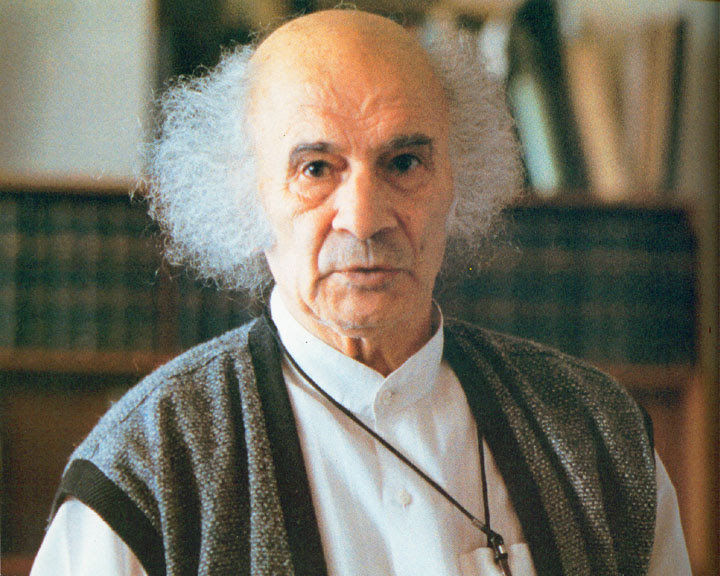
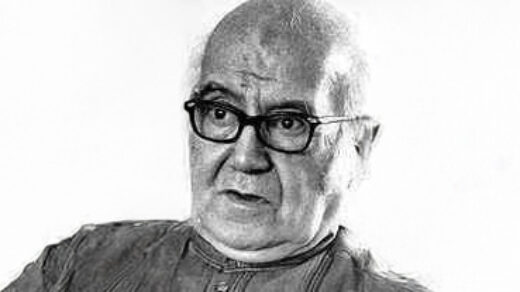
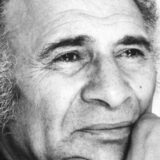
Master Jalil Ziapour, the Father of Modern Iranian Painting
We all have a kind of introversion in our subjectivity, the manifestation of which is always revealed in various forms under the cover of ambiguity (or the abstract).
Usually, the common people and people of average understanding do not clearly grasp this ambiguity. For these ambiguities are themselves unclear within the artist and in the world of his preoccupations, and the artist sometimes presents them in an allusive (symbolic) form.
Although the qualified artist strives to clarify ambiguities to provide a basis for a sort of interpretation of them, his success in this interpretation is only to the extent that his artistic and technical knowledge allows him. Other artists, who do not sufficiently enjoy this gift, cannot manage it at all, and only reflect a contentless shell of it, which, from the perspective of artistic psychoanalysis, yields a confused result and causes the aversion and indifference of the common people and the elite toward this style. In any case, however, this is a world with which lower-tier and upper-tier artists are involved, and they want, by any means, to pass from the objective world to the world of subjectivities (to a stage with another content), though reaching this world is of course not without difficulty.
From the time when societies expand the basis of mutual relations, in this relationship, an all-round give-and-take must be considered obvious, and in this path, the backward society loses to the point of being absorbed.
Most of our self-alienated artists of the last fifty years found themselves in decline compared to the rest of the world and wanted to traverse a hundred-year path overnight. Therefore, to promote themselves, they turned to the new art of foreigners.
With what our artists had learned in Iran – in addition to the academic styles of classicism, naturalism, and impressionism, which were combined with Iranian history and stylistics, and a brief acquaintance with European art history – without a real acquaintance with art, they set out for foreign countries and, as far as possible, pursued painting in Italy, France, Belgium, Germany, and America.
Naturally, some benefit should have been offered to acquaint young minds with our authentic book paintings (miniatures), which were an asset backed by the Islamic period, in addition to what we had in the past, or at least with the masterpieces of the artists of the Islamic period.
Those who were involved in the style of book painting had in mind imitation and repetition belonging to past times, which did not agree with the taste of the era and the advanced world; and nature-rendering was also an exact imitation that was far from the goal of the art of painting in this era.
Our artists of the last fifty years, despite all their limited knowledge, became aware of this striking defect of differences and imitations, but they did not refer to the world masterpieces of the artists of the Islamic period (due to not having them at their disposal and the specimens not being easily obtainable).
In our environment, it was not customary to present paintings among the people so that they might become familiar with them. These specimens were in the hands of the elite and people of taste, to whose souls they were bound like gold leaf; therefore, it was only with an acquaintance with existing arts, colored prints, imitative book paintings, and objectifications far from the breath of deep nature that our recent artists, when they entered the foreign world, noticed a stark difference in artistic vision compared to their own perceptions, and felt themselves backward.
However, with the view “that one must always be in search of the form of the discourse of the era, and every statement also has its own specific form,” they deemed certain approaches necessary. (And indeed, this was right). For historically, from the dawn of Islam until now, we have had periods in each of which striking events occurred that in themselves possessed the forms of the encounters of the time, from which works should certainly have emerged. But we possess works only sporadically, with many gaps between.
From the Umayyad caliphs to the recent period, we have had more than 24 select periods. Yet, of what we have from a few periods, fortunately most of them are authentic paintings and masterpieces, and only a small number among them are repetitive and the work of the masters’ students.
Severe traditionalism, which brought about raw, repetitive tastes, pushed creativity back and blocked progress. Over time, repetitions also continued to find a field of action.
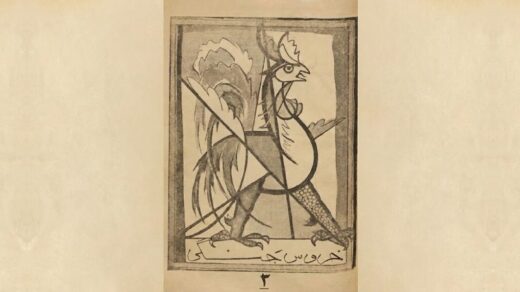
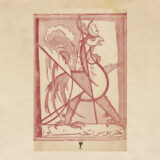
Independent artists and graduates of the University of Tehran who had gone to other countries and were gradually returning, upon their return to Iran, found a highly combative arena ready to display their acquisitions, which the Fighting Cock (Khorus Jangi) group, a vanguard group, had brought forward (in confrontation with three regressive fronts).
These newcomers and those who followed, without regard for the goal of the vanguard (who had national identity in view in a progressive form), presented their achievements as though they were presenting a new art to their own people.
The artists executing the styles of “Abstrait [Abstract], Expressionism, and Pop Art” continuously in Iran made a ladder for themselves out of the innovation and passionate vitality of the vanguard, and as far as their learning and capability permitted, they promoted what they had brought under the shadow of and reliance on the discourse of the vanguard.
However, through the decisive words and enlightenment of the vanguard and their consolidation and emphasis, these actions of the newcomers were made to appear only as a means of acquaintance with the foreigners’ way of working, not as offering a path in Iran.
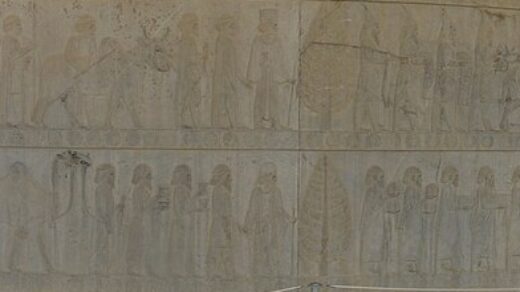
Those who developed a leaning toward national goals turned, in proportion to their awareness and degree of curiosity, to the art of the Achaemenid, Seljuk, and Qajar eras, and to existing possibilities (such as the presentation of Saqqakhaneh scenes, shrines, and the work commonly termed coffeehouse style), which of course was a good but insufficient start for turning one’s back on the arts of foreigners. For it did only this much: directing the gaze toward the creation of works with a national identity.
But none of these approaches caused a deviation from the thoughts related to “abstraction”-making. For “abstraction”-making (or seemingly, speaking in ambiguities) has a deeper path than other styles toward the artist’s existence and guides him to subjectivity (which is the reservoir of assets drawn from objective nature); it accustoms him to thoughtfulness, and strips him of superficiality, and this is a stage that every purposeful artist needs and must reach.
The vanguard’s goal was to stimulate thoughts toward curiosity, search, and artistic dynamism, in order to extricate the artist and the people, who are interdependent, from this intellectual lethargy, inertia, the routine repetition of tastes, highly closed and restricted prejudices, and the superficial artists dependent on them. Therefore, at every opportune time, matters were put forward by the vanguard to place freedom of action at the disposal of prepared artists and compel them to study, precision, and reflection so that they might find the way of artistic expression and national identity.
The article on Surrealism and other suitable articles, including: What Is Art and Who Is the Artist; The Necessity of Accompanying Evolution; Attack on the Article on Surrealism; The Influence of the Fourth Dimension in Painting; Innovation and Modernity; Dynamism, and articles of this kind, became a thought-provoking basis for abstraction-makers, and gave awareness to and stimulated dynamic artists to utilize their highest thoughts and incline toward superior realities.
Thus, abstract art – whose ambiguity was a pretext for those seeking to assert themselves, appearing to cover up flaws and attracting the naive – during the art movement set in motion by the vanguard, was a field of activity for pretenders to “abstract” art and other -isms.
We know that in all approaches, the uninformed also make a show in the midst of this to assert themselves and show off, unaware that displaying the “abstract” simply as abstract (ambiguity) is rawness and a failure to recognize the goal. For, indeed, many schools are only a means, not the end.
Authentic “abstract” art that is executed out of awareness and purpose is, in essence, a kind of pictorial symbolism that speaks to its audience with gestures and hints, and manifests itself through familiar or nearly familiar forms. Yet the “abstract”-maker artist, unlike symbolism, brings forward conservative or ambiguous concealments, and to do this, constructs the fleeting subjects of the mind as an ambiguous assemblage, while he himself remains behind the secret chamber of thought. But the knowledgeable are aware of this futile self-concealment of the artist, and know that he has a message that he expresses clearly in the coloring and in every line and design, and there is an assemblage or composition in his work that represents his state.
Thus, if the “abstract”-maker artist is himself aware of the identity of design, color, and composition, and especially of “suggestion,” he creates more powerfully and establishes a better connection with his audience.
With this very concise introduction, one can bring to view the horizon of the raison d’être of “abstract” art and the inclination of artists toward it in the last fifty years.