by
by This article was machine-translated from the original Persian and may contain inaccuracies.
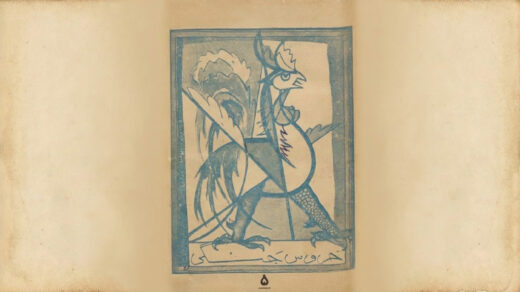
Jalil Ziapour’s article, entitled “An Exhibition at the Apadana Gallery and Ziapour’s Critique”, published in the weekly Azarpad, No. 4, Saturday, 15 April 1950
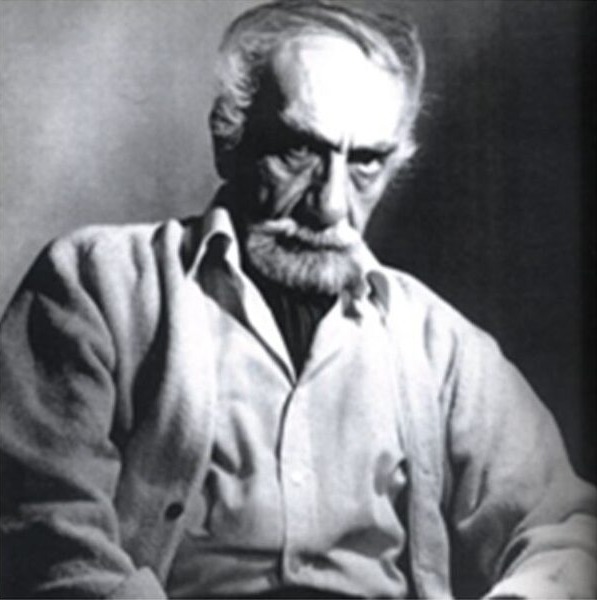
Master Hossein Kazemi, one of the pioneering and influential artists in Iran’s modernist painting
This time, the paintings of our friend Hossein Kazemi have been put on display at Apadana. Several newspapers and magazines (such as Peyk-e Solh, Iran-e Ma, and Jahan-e No) expressed opinions on this matter and showed friendly bias to encourage him (without any critique having been made of his works)!
It was unwarranted and misplaced praise. Friendship has its place, but criticism, which is the source of the artist’s progress and the public’s awareness, must not be made a pretext for friendly publicity, and the art critic must not make a contentless judgment based on self-projection the foundation of sound criticism.
If the desires of the majority of a society have not been fulfilled in an artistic work, one cannot reject it. Or if social intentions have been fulfilled in a work, one cannot recognize that work as an artistic and acceptable work. For a desirable story may have been presented without artistry. In none of these several newspapers had criticism been observed. Of course, one must not and cannot prevent people from expressing their views, nor can one necessarily and compulsorily count them among critics. But at least artists can be made aware of this point, that they should not listen to the views of uninformed persons and those who make a show of art connoisseurship.
Our friend will no doubt pay no attention to the misplaced praise and publicity of these newspapers, and will strive in his searching until he finds the way of his work. In these works, unfortunately, I must settle the matter plainly for Kazemi and say: my friend, you have been entirely lost, and it appears that you have not even completed a term at the art college! Your paintings are superficial; you have not put your thought to work, and it is only your hands that, like an automatic machine, have brought into being ordinary and monotonous lines and colors, and there is no connection established between your artistic mind and spirit and your hand.
To whom shall I say this without them falling into mockery and astonishment! Kazemi has prepared twenty-five paintings in the space of three months! Every painting, in proportion to the magnitude or simplicity of its subject and composition, requires a long time. How, during this short period (three months?!), not three years, not two years, not one year, does Kazemi bring twenty-five paintings into being! Is it mashed potatoes or soup or kateh, that they put its liquid in the oven and, with a little patience, have a large quantity of it at their disposal?! It is the height of inattention to bring into being works without precision and in a slapdash manner. How does an artist consent to place his hand and brain at the disposal of insubstantial displays and the exhibition of a handful of paintings that are not worth scrutinising? Would it not have been better for Kazemi to prepare one painting (only one painting) and exhibit it? Would it not have been better for him to exhibit nothing at all this time, and to exercise sufficient care in the exercises he had ready for preparing paintings, and to apply his utmost effort to bring forth interesting works?
Merely choosing a subject (that may be interesting in terms of variety) does not constitute artistry. Rather, after choosing a subject, cultivating it in an excellent and artistic manner is artistry.
To paint the clothes of the Kurds and Lors, or the Shahsavans and Bakhtiaris, or the Gilaks and Mazandaranis, or to present their dances and manner of life at the level of banality, is not artistry. If, from the standpoint of specialized technique, the embodiment of them is not observed, no more than a journalist’s work has been done. A reporter too can make us visualize that the Kurds wear such-and-such clothing with such-and-such colors, dance in such-and-such a way, and have such-and-such ceremonies, or what their manner of life is like. The painter also introduces, but should not the painter’s introduction be specialized, and should his work not differ from a reporter’s? Should the painter not observe the many laws that accord with the technical evolution of the day? At least he should work in that same Impressionism or Fauvism with understanding.
Why does Kazemi, with his unrestrained, rapid, and harsh brushwork, wish to attach himself to Cubism? What does it mean for someone who has not learned Cubism, who has not known the value of line and color and form, to wish to follow it little by little and stealthily, and to exhibit his practice work? Can one, without study, learn by oneself, parrot-like, something that will be of use? Mr. Hamidi, Majidi, Aqiqi, Forutan, and Esfandiari in particular are laboring for progress in Cubism and are still caught in its intricacies. This is not a simple matter into which anyone without groundwork can enter. Pezeshk-Nia too, who at first spoke of the truth of nature and feeling and inner calls and so forth, and who never approved of Cubism, nevertheless, after two years of care and scrutiny, as we saw, produced ordinary and defective works without form and color. Javadipour, with deliberation and attention, is cautiously stepping toward this technique. Vishkai, with complete care, is still probing and examining in order to understand it.
How is it that Dr. Khalatian writes in “Jam-e Jam” that: Mr. Kazemi has researched and examined Cubism, and, because he did not approve of it, did not pursue it! Had Kazemi researched this method and therefore not pursued it? If so, why does he now wish to pursue it? No doubt, in the continuation of his research up to today, he has now approved of it and entered into practice (since the handling of Kazemi’s works is in practice a Cubist handling). Then why has Mr. Khalatian presented a research that was still unfinished in the magazine “Jam-e Jam” as certainty and a conclusion, saying that Kazemi, after research, did not accept this method because he did not approve of it? That is, how is it that Mr. Khalatian has expressed Kazemi’s inconclusive and unfinished research with an opinion that conveys a definite sign of Kazemi’s non-adherence to and non-acceptance of this school? This is nothing other than Khalatian’s own disagreement with Cubism, his not knowing it, and his not considering it suitable to his party ideology. But because of the choice of a popular subject, he has made friendly publicity for Kazemi and has made him grateful and indebted to himself.
My objection to Kazemi is on these grounds: that Kazemi cannot be called an Impressionist. For Impressionism is a vast world and a colorful paradise, and none of our painters has yet shown the high period of Impressionism. Kazemi is not a Fauvist either, for the stages of Fauvism are so broad and profound, and even so difficult, that one can never attempt it without knowing the personality of colors and without having the necessary perception of the deep states of society’s spiritual life. Kazemi is naturally not a Cubist either, for he still knows nothing of Cubism, and having knowledge of Cubism entails probing and discussion around this method and showing a geometric work with concept and coherence. What is observed in Kazemi’s works is only this: he has placed a handful of easily found colors beside one another (without considering their value and relation to one another), and by means of monotonous, broken, and sharp lines like thin iron rods he has drawn around all the faces and figures in his paintings, and has wished to show classical compositions in the form of decorative grounds by means of certain lines that present themselves like tar. The faces he has made have been executed in a very banal and marketable manner. If these faces belonged to clients and were commissioned and done for earning money, they should never have been exhibited. For it is evident that such works are done only to please clients in return for money, and how many of these clients are tasteless and devoid of artistic taste as well, and inevitably the artist’s taste has very little involvement in them. But even in this commercial work, a qualified artist could have shown his artistic taste in terms of the choice of their color and composition amid the pleasing of those who commissioned them.
Miss Fereshteh: the ocher and dead color of this woman’s face against the black hair, and likewise the purple cloth over the chin, are very weak, and the background behind the head and face is an unsuitable dirty blue.
In the face of the man who has a Kurdish turban, the choice of green and blue on his shawl and hat is not bad. But the color of the face, against the selected colors of the turban, is very weak, and its dull and dead ocher color in no way represents the spiritual characteristics of the Kurd. The ground of this painting is in a lifeless and feeble color, and the motifs on the ground contain a number of monotonous forms taken from ordinary Isfahani curtains, with misplaced broken lines, without regard for form or for the necessity of their existence in the ground. Mohammad Ali’s garment is a dirty eggplant color obtained from the dirt at the bottom of the brush (though sometimes the trace of color at the bottom of the brush can create a masterpiece).
In Kurdish Dance – which presents a group like rugby players, the browns in it are ordinary and easily found.
In Dance of the Gypsies, only one red stain (which is noteworthy in terms of the search for artistic color) is seen.
Gypsy – this painting, which is made of two women washing clothes, has grounds which show that if Kazemi had paid attention to creating beauty through painting (not merely showing a subject) and had considered painting a much more serious matter than what he has shown, this painting could have been a good guide for him. The composition of this painting is relatively good, and the colors too have comparatively not been badly chosen, but the values of the colors in relation to one another are weak (especially the grounds outside the figures, which he has taken in green, are commonplace and easily found colors).
Washerwomen – from the standpoint of general composition it is good, and in the revision and correction of this composition artistic understanding (of course, of the classical method) has been applied, but the colors remain ordinary and are not living and spirited (they resemble colored muds more than anything).
Dance – is a relatively attentive composition, for some thought has been used in it from the standpoint of color harmony, but the colors are not artistic; like the other paintings, they have commonplace and easily found colors (that is, however the brush may command), and Kazemi does not take the trouble to find valuable colors.
The painting Caress – which consists of two women and a little girl, has one or two relatively noteworthy colors, namely the red of the girl’s skirt and the sleeve of the woman who is caressing her. The rest of the colors are banal.
The compositional handling in the painting Tambourine Player is good, but it has not settled into place. One or two yellows and blues on the sleeve (where the yellow stands beside a beautiful purple tending toward gray), and the yellow and black of the hair, and the color of the face against the black hair of the head, indicate Kazemi’s slight progress in this painting from the standpoint of color.
The painting Ganjali and Shahla also had good grounds for coloring and composition, but….
In the painting The Beggar, one very splendid and valuable color is seen, and that is the blue “ultramarine,” which is excellent, but from the standpoint of conformity with the condition and character of the beggar it has been chosen very much out of place. Unless Kazemi too is committed to the opening of such verses as (why should the beggar not boast of kingship now, since the cloud’s shadow is his tent and the edge of the field his banquet-place; or, from being bareheaded, the sky is my hat), in which case there is no obstacle to his choosing a splendid color for a beggar (by virtue of the fact that aspiration is no fault in beggars). In any case, this one color, for whatever purpose it has been chosen, is by itself, in relation to the almost orange ground, more or less good and excellent, and can be a good lesson for Kazemi in good colors.
The painting Woman and Kid – which has three grounds of (green-blue), (yellow), and (earthy-blue tending toward purple) behind the woman and the goat, and the woman’s brown and dirty skirt and the dirty white kid, all these are very banal and ordinary, and Kazemi has not taken any trouble to find color, and particularly for this very reason even the general composition of his work appears unstable. Only the color of the woman’s face with the black hair and the brown turban, taken together, are three small colors in the whole painting that create a pleasant sensation. Unfortunately, at this same point, a green color of the cloth behind the woman’s lip is banal and marketable and diminishes the harmony of that same area, which had not been too bad.
The painting The Spring – is a good composition, and the background motifs in the women’s clothing have been well chosen and have several suitable and harmonious colors. But the color of the ground behind the women’s clothing is ordinary and commonplace.
In the painting Miss Mina – in which some effort is evident, and to which more attention must be paid, the point is that the original handling of this painting is a decorative pattern. He has chosen the grounds from tile and carpet motifs and from this type of ground, and has played games with colors and forms. In the midst of this, he shows a girl with a sequined hat and a jug on her shoulder in a good pose and has dressed her in a yellow vest. He has begun the composition from the upper right corner of the painting, drawn it in the middle toward the left part of the painting, and again below inclined it toward the right corner of the painting (taken altogether, a pretty condition has been given to the girl). Here the design, from the standpoint of composition, has come out well, but in the composition of color he has entirely ruined it. For a yellow vest that he has drawn from the middle of the painting toward the lower right corner of the painting makes the eye attend only from the middle of the painting toward the right and lower corner of the painting, and the eye is no longer willing to see other places in the painting as well (for which effort has been expended). Kazemi could have compensated for this defect by coloring the jug on the girl’s shoulder with a color from the yellow family, but he did not know what to do, and in the end took an action out of “it does not matter and what can I do,” drawing a weak black line contrary to the course of the yellow color of the vest, and contenting himself with this work (it would have been better had he not done it).
The paintings “Autumn Landscape,” “Three Women,” “Farm,” “Dervish,” and “Blind Man” are very superficial, and Woman and Jug too, in terms of design and color, is one of those meaningless compositions in which the utmost indifference, impatience, and desire to finish the work as quickly as possible are evident.
Taken altogether, Kazemi is very lost and off the path in painting. He has preferred speed of execution to thinking and understanding and precision in art. With Mr. André Godard Andre Goderd (the head of the University of Fine Arts and the Museum of Ancient Iran at the time in Tehran), on the opening night of Kazemi’s paintings, we were speaking about him; he believed that Kazemi had been entirely lost, and regretted that he still (as always) pays no attention to coloring and to finding unprecedented and artistic colors, and is more bound to story and insubstantial presentation.