by
by This article was machine-translated from the original Persian and may contain inaccuracies.
An article by Jalil Ziapour, titled “Typification”, published in the journal “Jelveh-ye Honar”, the year 1996
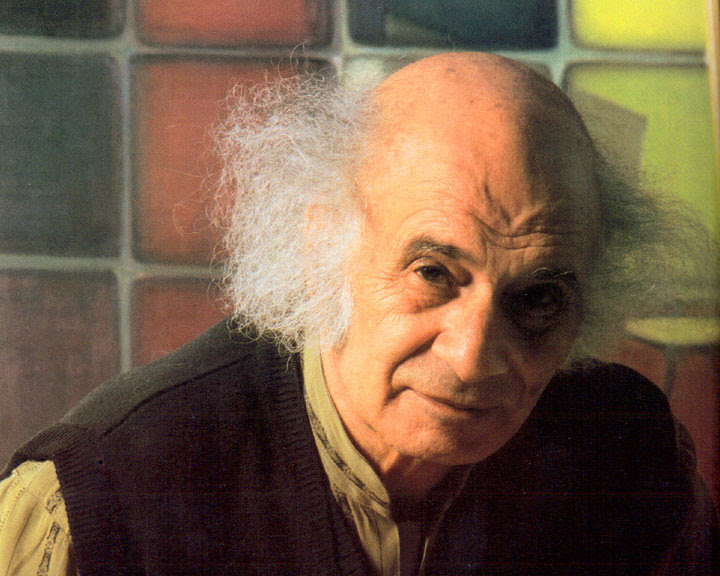
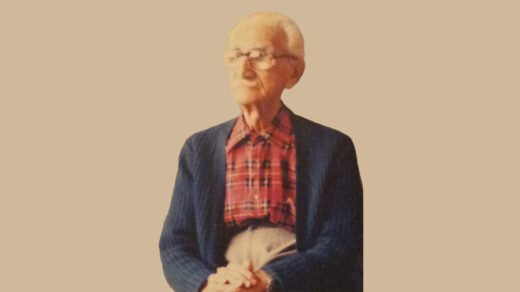
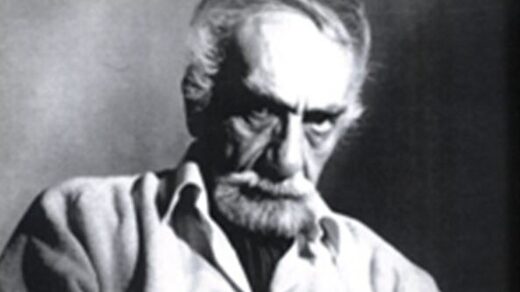
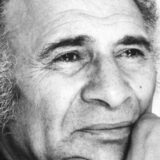
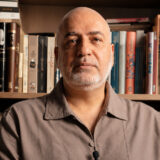
Master Jalil Ziapour, the Father of Modern Iranian Painting
From the distant past to the Safavid era, the artworks of Iran, in terms of visual expression, chose the most natural and simplest way to portray the intended subject. This portrayal, whether of humans or other living beings (animals, plants, stones, and other creations), we today call typification.
The creation of any face in this technique represents faces that are similar to one another, whose genus, as a whole, is of a single lineage. In other words, it can be said that their mutual resemblance represents belonging to the same clan. Just like the resemblance of plant species of the same family, or similar children of a single generation and family, which, in addition to facial resemblance, simply represents a kind of resemblance in personality, upbringing, and fundamental character. Like the resemblance of children to mothers, fathers, tribe, lineage, and clan, whose kinship can be identified through an anthropological lens.
This type of illustration found application long ago and acquired a direct and simple expressiveness. Yet, with this very basis of work, regarding characterization – which was fundamentally a collective characterization – it conveys ethnicity, nationality, uniformity, style of life (aristocratic and common), and overall resemblance. Another look at the typified human, his life, his simple or harsh face, even while being simplified, represents his present condition.
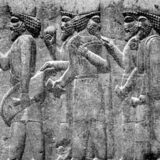
From more than two thousand and some years ago until recently, Iranians have been engaged in typification in the art of drawing and illustration. Excellent examples of this method of work are seen in all the earlier bas-reliefs carved on stones. In Persepolis, we encounter the delicacy and order of work in the typification of faces and bodies, which are comprehensively typified with the greatest majesty and grandeur, and with gentle and intimate movements, and it is such that representing reality to this degree does not seem realistic. Even in the Islamic period, despite the comings and goings and encampments of invading foreigners (over seven hundred years), Iran did not abandon the artistic creation of typification, and we can easily identify Mongol-Timurid trends by looking at the faces in the typified designs and illustrations of that era.
“Dr. Mohammad Hasan Zaki,” quoting Master Binyon (L. Binyon), has stated: “that the Iranian artist did not attach importance to the outward appearance of objects.” I must correct the opinion of both individuals, that the Iranian artist did attach importance to the outward appearance of objects, but depicted their selected features with simplification, sufficient technical skill, and with a close look.
Dr. Zaki has also quoted Pope: “When Iranians intended to draw the face of a specific person, they were fully capable of it. Even though in all the works of Iranians of the Islamic period of Iran, landscape-making formed the background up to the top of the work. They also had separate landscape-making (without humans and animals), just as – Aga-Oglu – had one of them in Istanbul.” (1)
In any case, culture and art in any society are subject to the law of relationships of ups and downs. Like the seven-hundred-year period of continuous and violent war and strife, during which the artist, under violence, was not free from the influence of violence. But the history of Iran has shown that our patient artists and people, in these ups and downs, have always preserved and not lost the dominance of their culture over the invaders due to their richly endowed foundations, making cultural dominance their own. For this reason, Iran has always been proud in terms of cultural dominance. Typification, since the time Iran was engaged in it, had no application among other societies. We have prominent examples of this method, which the entirety of Persepolis and Parthian and Sasanian works represent, and the entire Islamic period, with remarkable richness, has a high level of this method of work. Particularly the School of Shiraz and the schools of other regions of Iran (Herat, Tabriz, and Isfahan), each of which possesses several astonishing schools predating Western schools, are a source of pride. (Refer to the two articles “Reviewing the History of Art” and “Characteristics of Art in the Islamic Period”).
1- A. U Pop. Introdation Persian Art. P. 108