by
by The article by Master Jalil Ziapour, titled “Outcries”, published in Payam-e No magazine, special issue 10 and 11, August 1950.

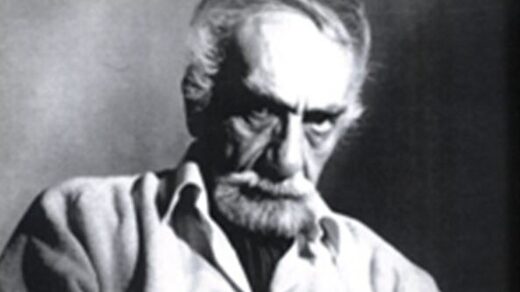
Master Jalil Ziapour, the Father of Modern Iranian Painting, 1948
I was looking at the artistic headings and the submitted article in large print by Musa Arvand (published in the weekly “Azarpad” on 29 April 1950). “Arvand” had cried out with all his might: “Destroy this decayed structure that you have erected in the name of Iranian culture. Shatter this doll that you have named culture.”
Together with our resonant voice, which cried out: “O… people, come to the aid of the College of Fine Arts! In this ruin, there is no one to see what is happening to these abandoned youth!
You, the future artists of this land, you are the children of those artists who, from the very distant past, have been the guides of the world’s art; what are you doing now? Apply your minds and know what you are doing! And what you intend to do. Do you not remember what Fatemeh Sayyah warned in 1946 (at the First Exhibition of Fine Arts of Iran)? “Our society (even its most intellectual classes) is not familiar with the state of contemporary fine arts, and many are also completely out of touch with this stage.
Most of them sincerely believe that the fine arts of Iran have not gone beyond the limits of classical miniature and the delicate workmanship of other minor arts, and have stopped at that very point. Every viewer, after viewing, will see with their own eyes to what extent their opinion is contrary to reality, and that this incorrect view has been presented only as a result of unfamiliarity with the works of contemporary painters (especially the youth). Talents and the search for new paths, which have often been accompanied by success, are fully evident, especially in the field of painting. Iranian society is obliged and duty-bound to provide the means for progress, to pay special attention to its painters, and to assist them in all material and spiritual spheres.”