by
by Kianoush Mo’taqedi’s conversation with Siamak Delzendeh, titled “Iranian Art on the Path of Modernism”, about the “Fighting Cock” (Khorus Jangi) Association, published in the specialized visual arts magazine “Posht-Bam”, No. 2, summer 2019, pp. 34 to 55.
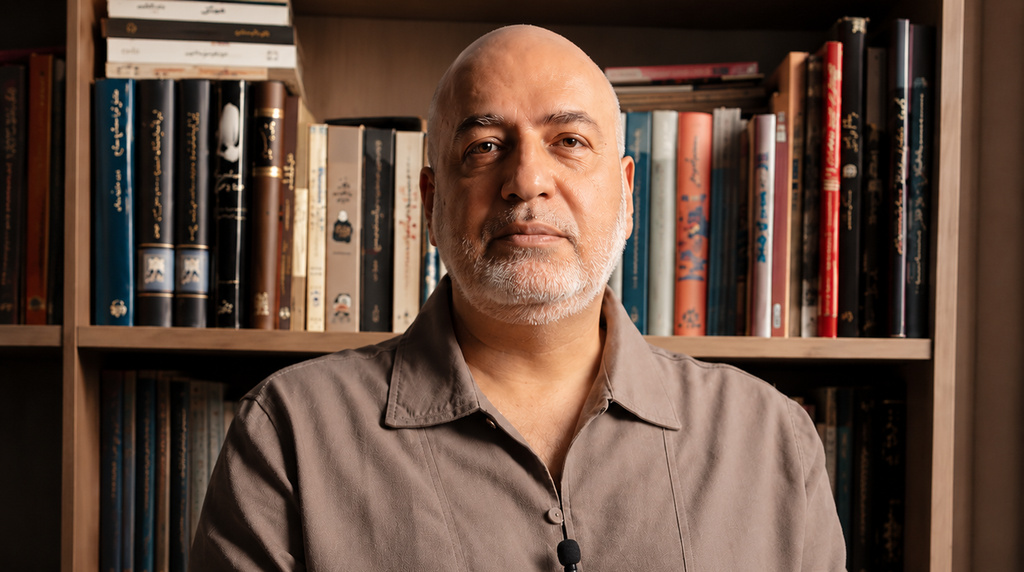
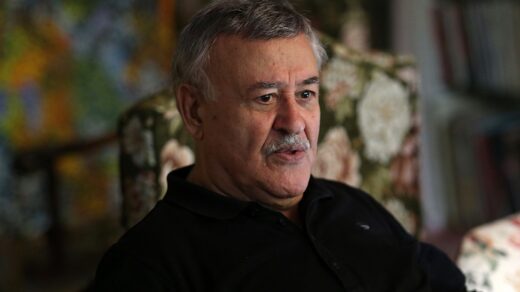
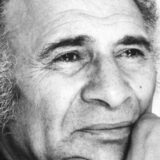
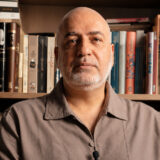
Siamak Delzendeh, critic and researcher of contemporary Iranian art
In this conversation, Siamak Delzendeh speaks about the “Fighting Cock” Association, the role of Jalil Ziapour in its formation, and the place of this association in the history of modern art in Iran. The full text of this conversation was published in “Posht-Bam” magazine (No. 2, summer 2019).
Siamak Delzendeh is a writer, critic, and researcher of contemporary Iranian art, who has published one of the most important books in the field of visual arts in recent years, titled “Pictorial Transformations of Iranian Art: A Critical Study”. In parts of his research, Delzendeh has examined the contexts of the formation and birth of modernism in Iranian art and has studied the effects of the Fighting Cock Association on the artistic climate of the 1950s and 1960s. On this occasion, we discussed and exchanged views on the place of the “Fighting Cock” Association in the history of Iranian art, and the influence of Ziapour’s ideas on the developments of modernist Iranian painting up to the beginning of the 1960s and the Saqqakhaneh movement.
● As the first question, please explain the contexts for the entry of new ideas into Iranian art and literature and the formation of the initial germ of modernist thought by Akhundzadeh, and the ideas that he breathed into society.
I prefer to make minor changes to your question. That is, instead of saying the entry of modernism into Iran, I would say the turning of segments of society toward important approaches in the creation of artistic and literary works. Perhaps this is a bit more precise. I cannot determine Akhundzadeh’s position on my own, nor do I have any expertise regarding him. But I know that Akhundzadeh’s view had many differences from that of the Constitutionalists. In fact, he somehow sought the revival of the ancient past, and incidentally, he did not see this ancient past in the form of a modern nation-state or new political structures; rather, he somehow searched for the core essence of something called the old Iranian empire. How this Iranism (during the Constitutional period and afterward until the beginning of the first Pahlavi era, and if we want to be more precise, throughout the entire Pahlavi period) connects with modernism, the modern nation-state, and such issues is as if we are dealing with a kind of conjuring trick here. I think we must explain this conjuring trick through several conceptual cores: one is the “exhibitionary order,” another is “Orientalism,” and the third is “archaeology.” These three pillars become the foundation of something that forms a new nationalism, and in fact, just as many other issues are alien to society, this type of nationalism is also alien. This is an entirely new issue. However, through the stratagem of turning to ancient Iran and such stories, and arousing national pride, nationalistic sentiment, and social homogenization, especially in the first Pahlavi period, this new concoction is fed to the nation. Now, what is the main issue? Suppose we are looking at the matter from the angle of statesmen: statesmen tried to link this ancient past to Europe’s present at that time and, in a way, leap over the issue of time and the term “historical backwardness,” which is the product of this time, in this manner. That is, we have a very old ancient culture, and incidentally, through the linking of that ancient history and this new history, we enter the modern era. Now, if you allow me, let us not delve too deeply into these categories.
● Of course, this archaism and attention to the ancient period was not a new achievement to which the Pahlavis paid attention. From the beginning of the Qajar period, we see that Fath-Ali Shah himself is a supporter of this approach, and for this reason, the theme of archaism is seen in many aspects of art, and certain forgotten arts such as figural depiction and the creation of reliefs, which had been forgotten for more than a thousand years, gain new life through the support of the court. Here another question arises: is this view that Fath-Ali Shah introduces, and that Naser al-Din Shah later pursues with a different quality, the same thing that continues in the Pahlavi period, or are they two completely different approaches?
My impression is that it is completely different; for a very simple reason. It might be very difficult to refer to what happens in the period of Fath-Ali Shah as archaism. The symbolic revival of the ancient past, writing the Shahanshahnameh in the meter of the Shahnameh, performing a series of court rituals that have a trace and flavor of the past, making the three royal thrones, making the Kiani crown as the most important symbol of ancient Iran, and so on, take shape within another epistemic system. From the period of Fath-Ali Shah to the Pahlavi period, we have a shift in the epistemic system; this is a very important point.
Pahlavi archaism (of course, if the word “ancient” can be used here) is based on archaeology, digging the ground, and extracting things from under the earth. So we should not use the word archaism regarding Fath-Ali Shah. In fact, to speak more precisely, the inclination of Fath-Ali Shah’s governing apparatus toward Khosravani wisdom and images of ancient Iran has nothing to do with archaeology. Theirs is derived from within a living tradition, and this one’s is heavily under the influence of Orientalism; it is the highlighting of parts of history by Orientalists and, following that, the archaeological missions that dig the ground and bring something out of the ancient past. This is a major difference between the two. What distinguishes the epistemic system of the Pahlavi period and the post-Constitutional period from the period of Fath-Ali Shah is a concept called the “exhibitionary order”. Many describe this new epistemic system solely with the abstract concept of modernity. I put modernity in parentheses and say it is the exhibitionary order. It is the exhibitionary order that comes and creates new forms of articulating these old narratives, shifting the emphasis elsewhere. You can see the difference between the two in the Pahlavi crown and the Kiani crown. Therefore, these have a serious difference from one another. In principle, I prefer that instead of entering this discussion from the perspective of modernity, we allow ourselves to approach it in a much more concrete and tangible way. Therefore, if I want to answer your question, our artists’ turning toward modernist approaches is perhaps more of an external project than an internal one, more than we think. Part of it is natural, especially when we are in the period of Naser al-Din Shah. That is, Naseri art is the joint of this turn. By the end of Naser al-Din Shah’s period, this turn takes place. The Constitutional Revolution is the crystallization of this great shift, and after that, up to the Pahlavi period and the consolidation of these things in Pahlavi political propaganda, we have a period of very serious intellectual shifts. When we reach this period, the concept of the West, Westernization, and imitation of the West has acquired a new meaning that is different even from the Naseri period.
● When we think about the study of cultural currents of the first Pahlavi period, it seems that the pioneers of Iranian art who were born in that period and lay claim to modernism are in fact graduates of the traditional method of art education. But at a time when Iranian society is in no way prepared to accept this kind of modernist view, people such as Ziapour or currents like Fighting Cock are born. Is their concern a return to that same past, or do they have a completely avant-garde and new view? What context comes into being in Iranian society that demands the emergence of these new views?
Simulation. We want the material forms of our life to become exactly like those of Europeans. From a certain point, when they change clothes and wear Western clothes, they change hats, remove the turban from the head, remove the Qajar hat and put on the Pahlavi hat, remove the Pahlavi hat and put on the chapeau. These changes happen. We want, both outwardly and inwardly, regarding that temporal distance which is an entirely fabricated thing (Eurocentric culture, Eurocentric technology, Eurocentric natural science) to create this conception and illusion, both in ourselves and in non-Europeans, that we have a temporal difference from one another. My impression is that to cross that temporal distance, the simplest way is first to simulate yourselves outwardly. When you wear European clothes, you should also acquire European behavior. That is, the material transformations that take place in society; old houses gradually change their form, residential units acquire the style of international modernism in Tehran and many other cities, central city squares enter modern urban planning. These are the appearances that change.
● What are the instances of new art in this period? What path of pictorial transformations are we facing, and who are those who pave this path?
Look, this is a very complicated issue. You have to consider several different fronts. I can speak about painting, and if I were to say anything about literature, it would be non-expert. If we want to speak in the field of painting, we are faced with a very particular intervention that disrupts the process of simulation for a while, and that is the intervention of Arthur Pope and his influence in shaping the school of new miniature painting. That is, precisely at the time when this simulation should have encompassed all fields (for example, that painting with an abstract and Cubist appearance and the like should have taken shape inside Iran, though of course this is a question) its groundwork and requirements were not yet ready. But, well, when we were imitating everything, we might have imitated the appearance too. In fact, the Pope factor causes this current to be engineered along another path, and in this form: that we have a very glorious past, so there is no reason to imitate Western art, and our strength is our art of the past. Therefore, we must revive what existed in the past. And that revivalist current which comes into being in the Pahlavi period and appears in the form of the School of Old Fine Crafts and the Higher Conservatory of Iranian Arts brings new miniature painting into being, which, well, is not very well received by society. As a result, after the transformations that come about with Reza Shah’s departure, this atmosphere is also disrupted. Here we also have the School of Fine Arts. The School of Fine Arts gives students a simulation model, and they try to take that model and, on its basis, welcome and learn from what is taught there, which is a combination of that Kamal-ol-Molk school with Impressionism and Post-Impressionism, depending on their teachers.
● But when we look at the output of these schools in that period, we find that generally no precise and correct understanding had formed of the modernism that we now have in mind. Few graduates of those schools are people who seek to create a new space and an opening. From where does this aspect of the modernist viewpoint enter society?
Look, I want to say that even we ourselves, right now, do not have a correct understanding of modernism. In fact, modernism is a vague and general word. If we want to examine modernism in the form of various European artistic currents from 1870 to 1950, which in fact we call modernism, the issue is that we want to make ourselves resemble them. So we want to make our painting resemble theirs too. But in the midst of this, national pride appears. This Iranian pride is very interesting. In my book, for certain reasons, I have called it the Iranshahri discourse, because as a discourse it is still alive and active right now; like the Reza Shah period, it is taking a deviant path. That is, it has once again revived and adapted itself within the mechanisms of the new epistemic system. It has not come to say, “I am this and you must conform yourselves to me”; it says, “I will adapt myself in such a way that you accept me.” This is a very important issue.
Therefore, in that period we have a kind of Iranshahri discourse (which in their own time or later they called archaism) that is a mixture of many views toward ancient Iran. This matter encompasses the nostalgic and sincere kind of view of people like Akhundzadeh and Mirza Aqa Khan Kermani to Jalal al-Din Mirza Qajar, and the strange and peculiar views of Taqizadeh, Foroughi, and others. Speaking precisely about which thinker and what kind of thought existed is very difficult. The essence of the matter is that for these there are governmental regulations and instructions. In a book recently published by Ali Gholipour, these issues have been dealt with very well, and those governmental regulations and instructions have been expounded upon. We see how this archaism is injected into society and imposed upon it. Of course, it is propagated through the new media of its own time, by means of newspaper and radio. But the main issue I wanted to mention is that these people’s inclination toward modernism is somewhat obvious. You have to look at this within the framework of the overall simulation of life. Just as we are making everything of ours resemble theirs, we want to make painting resemble theirs too. And well, it is a period in which people go and come back, and there are professors who say, “Now they paint this way,” but ten years have passed since the model they describe, and newer forms have arrived. There is a state of “always running to catch up” within this simulation.
But there is a point about Iranian pride: that inside us Iranians there is a spirit and a fire that, while we are becoming similar, we also want to be different. This is the issue that brings Iran’s modernizing art into being.
● Based on what you said, the emergence of the illusion of a kind of recovery of forgotten splendor in Iranian art causes artists to enter a new current. But apparently they themselves are not very aware of the event that is taking place, because in a way viewpoints that come from outside are guiding them.
Look, it is very hard for us to be able to speak about the awareness of, say, two generations ago. Just as our own awareness now is not very clear either. Some of us can see the macro plans, but it is only guesswork and speculation. We do not have a full grasp, because we do not have information about the backstage of world affairs. We can look at the issue of the inclination toward modernism and modernist approaches in a country like Iran and in similar countries both as a general program that takes place simultaneously in all countries at a certain point in time, and we can also sift through everything and look at it from the perspective of the country’s internal currents. We must have both views. That is, we must both see why this temporal delay has come into being, and from the other side, look at what we have in terms of internal forces and transformations in the country in the field of art and in social and intellectual discourses. We really cannot isolate the environment and concentrate only on Iran.
● In the midst of this, how does the idea of the Fighting Cock Association take shape in Iran?
Let us look at it this way: there is an inclination toward modernist painting in Iran that gets organized through Fine Arts. There are teachers teaching this new language. But this language is also mixed up in the school. There too you are not faced with a unified curriculum; that is, from that same year 1940 when the university starts up until the 1960s and perhaps later, a major part of the work is that you set up a Venus sculpture and copy from it. Therefore copying, just as it was current from Kamal-ol-Molk’s School of Fine Crafts, continues there too. It is also very natural that the senior teacher and head of the painting department for many years is Ali Mohammad Heydarian, who has that same view. But alongside that, there is also Impressionism, there are historical examples, they have foreign teachers. There are those who, in subsequent periods and later years, come fresh from Europe and introduce new schools. This is something that always happens, and students constantly say that up to now we have been doing things wrong, and this kind of outlook is fashionable, and as a result we must go toward it! This is my impression.
As for how Fighting Cock comes into being, let us look at it as an event. In fact, there had been a general view, but these efforts had no spokesman and no written or oral manifesto. Ziapour becomes the top student of Fine Arts in Iran and receives a scholarship to France. In addition to going and taking the regular courses at the École des Beaux-Arts, he attends André Lhote’s classes. André Lhote is an important and key figure. Incidentally, I saw that some people who want to call Ziapour’s Cubism into question also call André Lhote into question. But André Lhote is an important figure. He opens the door of his studio to foreign students. That is, those who are trained under André Lhote, when they return to their countries, are the Ziapours of those countries. We also have the Japanese and Pakistani examples of Ziapour. Now, I do not want to look at this matter pessimistically or negatively, but it seems as if he had a mission to teach them so that they would later spread this Cubism-like style in their countries.
When Ziapour returns from France, it is as if, with a determined and confident spirit, he wants to say that the only path for transformation in Iranian painting and for reaching real modernism in Iranian painting is to pass beyond all Kamal-ol-Molkian notions and the old models of the past; notions that have stuck to us, and which we must pass beyond in order to understand Cubism and, on the basis of Cubism, create pictorial transformation in ourselves. This is the beginning of Ziapour’s work, and in his articles and the memories others recount of him, we see that he presents Cubism as the most complete and most progressive school of that period. What year is this? The year 1949 AD, meaning a time when Cubism had already been laid to rest. But, well, it is very interesting, and this issue makes us think about why, at a time when even Picasso himself is no longer working in a Cubist manner, people from other countries undertake this mission of making their country’s painting Cubist. I can give a straightforward answer to this question, but I will not. But we can put a series of pieces of evidence beside one another and think about this. In fact, instead of looking for an answer to this question, I think it is better to raise more questions and allow more research to be done. Those questions are these:
- One: At that time, did Cubism begin suddenly only in Iran in 1949, and did people come and say that we must work in a Cubist manner, or did the same thing also happen in Iraq, Egypt, Pakistan, India, Turkey, Morocco, and Algeria?
- Two: How does the transformation that took place in Iranian painting from the time of Fighting Cock until two decades after it take shape in these same countries? Do they resemble one another?
Answering these questions, which requires the study of the history of modernist art in each of these countries, is difficult work and needs a formidable researcher, because these countries, like Iran, do not have good sources. It is only for the past five or six years that we have had pictorial sources on our own modernist, modernizing artists. Apart from Mr. Pakbaz’s book, which was an important book in its own time, its small volume reminds us that despite its importance, it does not give us sufficient information. On the other hand, the encyclopedia of art came out later. Incidentally, Pakbaz is someone who, in his book, has examined each of these countries to some extent. In his encyclopedia, one can see part of those questions. But the reality is that regarding the history of Iranian modernism, until Mr. Keshmirshekan’s book, which was published a year or two before my book, we did not have a collection that would come and show this trajectory, introduce it, and make it possible to see its pictorial examples. Then, my book framed this in another way. That is, my issue was not necessarily to show this trajectory one hundred percent. I had another question, but this trajectory emerged from it. Now, probably in these same intervals (meaning precisely these years, perhaps a year before Keshmirshekan’s book came out or simultaneously with it) Iftikhar Dadi’s book on the modernist art of Pakistan also came out. Suddenly we see that we were able to see Pakistani examples too. Apart from that, our information was very limited, and the only place that gave us brief examples was Pakbaz’s encyclopedia. And well, that book too referred to those general encyclopedias and brought this information. To have the narrative of an insider in the culture of a country with that space and atmosphere, and for these narratives to become numerous, and then to be able to place them beside one another, takes some time. Perhaps we should give it twenty years for countries one by one to bring out their own histories of modernism, and then this research will be completed. But as I said, it needs a formidable and capable researcher who will spend time and can really examine these well. But if we look at it offhand, we can say that in all countries we see a similar trajectory of transformation. Therefore, when we see this trajectory of transformation, Ziapour or anyone else was not all that important; rather, the program was for this current to start up in these regions and to follow its trajectory in a controlled manner.
● Ziapour, as an art graduate from France, tries upon returning to his homeland to introduce new viewpoints into Iran’s cultural space, and he thinks of starting a magazine. Incidentally, he goes to friends who are also avant-garde individuals and have new demands. Under these circumstances, how is Fighting Cock born, and at the beginning, who are its audiences?
First, we must periodize Fighting Cock; the early Fighting Cock was created in Ziapour’s house with the presence of Hassan Shirvani, who was a playwright, and Gholamhossein Gharib, who was a literary figure and later inclined toward music and also became a player in the Tehran Symphony Orchestra. All of these people had a fervor and excitement in their youth; each was passionate for a few years and carried these discussions forward. I want to look at it from this angle: what matters to us from the perspective of the history of Iran’s visual art is that in 1948, with the formation of the Fighting Cock Association and almost simultaneously the establishment of the Apadana Gallery, artistic modernism in Iran acquired a statement (that is, a manifesto) and acquired a private and dedicated space.
If we examine and compare the existing conversations of Ziapour, Javadipour, and others, the main issue at that time was audience-building; this is a very important issue. Specifically, their preoccupation was that our people do not see good pictures, do not see good paintings, do not see good works of art. They had such an impression; that is, in fact, what we see and know, the people do not know and do not see. As a result, we must acquaint them with high, progressive, and good art! Consequently, their effort is audience-building. Some of the lectures and articles that Ziapour writes in “Fighting Cock” magazine show part of this effort to educate and create an audience. This educational and pedagogical aspect exists in their work.
At that time, their issue was that through becoming acquainted, one could make better use of the cultural reserve. That is why, in all these stages, this term to which I am sensitive and which I keep recommending we not use, this synthesis of tradition and modernity that they speak of, was meant to signify that they want you, by understanding the essence of modernity, to be able to use tradition correctly. I say this combination is one hundred percent wrong, because neither modernity is a fixed concept nor tradition. These must be seen with their contents, and one cannot generalize. But they have repeated it so much and established it to such an extent that when you hear these things, which act like codes, you think you understand. Whereas when you hear this word, a series of particular instances come to your mind which may not come to my mind, or may come differently to another person’s mind. That is why I emphasize that we should explain these issues using general concepts such as the decorative perspective and the exhibitionary order. That is, we should formulate the conceptual cores anew. Therefore, it does not matter to me what Ziapour said to so-and-so or what he said to Ziapour. Knowing it is interesting, but in fact, we look at it like a discrete point. We can look at it quantumly. From that angle, its continuum matters, but as a current in motion it is not very important. It is a moment. In my opinion, in the year 1948, something crystallizes, manifests, and condenses, which finds manifestation in two forms: one in the form of Fighting Cock and the announcement of the presence of such an association with a cock-a-doodle-doo crow, and the other a manifesto that is not very clear and, in a highly slogan-like condition, has no particular use and comes into being in 1951. The subsequent points also matter in 1958; we have a turn, which is accompanied by the formation of the biennials and the official recognition of modern painting. That is, the war they started ended, and in 1958 they became its winners.
● Why do these people, especially Ziapour, feel this mission? Had society given them this legitimacy? Why do they think they must create this change?
I do not know. It is a good question, but I do not know its answer exactly. What I can say is that they felt they had to acquaint the people! You know, there was a general conception that was both part of the propaganda of the time and, in any case, had a reality in it. The general conception is that our society inside Iran has fallen behind transformation and dynamism. Now each person, depending on his political and social viewpoints, considers the reasons to be, for example, despotism or the absence of social institutions, or something else. They say this society has fallen out of culture-making and generativity, has lagged behind and become passive, but there is another place in the world whose people are not like this: they work, they are active, they are constantly building and moving forward. You know, this strange and peculiar historical understanding of moving forward is a major issue for these people!
Of course at that time this view existed. As a result, they feel this mission that they must awaken the sleeping people. If you look at the poems of the modernists of those years, like Nima’s poem, dated 1946, which they put on issue one of Fighting Cock magazine, “Cock-a-doodle-doo! The rooster crows,” meaning we are cocks that are crowing in order to awaken. The people are asleep in heedlessness; we are the avant-gardes of new thought who must awaken them, and when they awaken, this society will find itself again in a coordination and harmony, and will make that temporal leap and join the caravan of progress and civilization.
In fact, I think part of the main platform of Fighting Cock must be seen in audience-making and culture-making. They are making efforts and making culture. They believe there is something authentic in European culture and art that we must learn; we must be able to learn its essence. That is, in addition to simulation and appearance-making, we must learn its essence. Ziapour’s issue was the essence of Cubism, not Cubism itself. In his articles too he emphasizes that the essence of Cubism is important.
On the other hand, we must see Fighting Cock in the form of two manifestos: the first manifesto is the collection of Ziapour’s lectures and articles, which becomes manifesto one, because there is no other manifesto, and in those years four articles by Ziapour were published, with one or two articles by Gholamhossein Gharib that deal with folklore. These become Fighting Cock. In fact the first manifesto is not a definite manifesto. This verse by Farrukhi Sistani is one clause of the manifesto:
“The tale of Alexander became legend and grew old / Bring forth new speech, for the new has a different sweetness”
And Nima Yooshij’s “Cock-a-doodle-doo! The rooster crows” is clause two:
“Cock-a-doodle-doo! On this dark path / Who is left behind? Who is weary?”
In fact Nima’s poem and Farrukhi Sistani become clauses one and two. And then the set of clause three is the collection of Ziapour’s articles and speeches. In the second Fighting Cock, we have only Hushang Irani’s manifesto, in thirteen clauses, which begins with struggle against everything old and ends with death to fools.
● Is the reason for Ziapour’s choice of the name “Fighting Cock” the inspiration they take from Nima’s poem?
Yes, that is so. In later interviews, Ziapour emphasizes that he considers the cock as a symbol taken from ancient Iran and as the symbol of that call to awakening, that in fact the period has ended and now we must wake up and see what is going on.
Look, Constitutional literature too constantly says this same thing. Nima speaks of the long and dark night, and before him the Constitutionalists also say the same thing. They constantly remind you that it is night. This says that morning has come and you should wake up now.
Look, regarding your question, I feel somewhat that we are getting stuck in a strange place. Let us pass altogether beyond these causes and whys and discuss the matter itself. My feeling is that if we speak this way, we will find two or three issues. We can speak generally about modernism, and we can no longer speak very much about Fighting Cock.
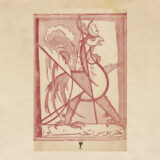
Let me just read this part from page 285: “In our ancient literature, the cock always, on behalf of the angel Bahman, would cry out from the hedges every morning and give the awakening call. We took the cock as a symbol, both from the point of view of the work we were doing and from the point of view of the beauty it had. And fighting because we had an artistic struggle, and we judged this name very suitable.”
● Today, when we look at Ziapour’s personality, we see him as a multi-handed person: in one place the owner of a magazine and the creator of the association’s current, elsewhere a teacher, in one place an employee of the Ministry of Culture who must advance his administrative goals, and in one place also a painter who claims that he has created a new transformation in painting. How can Ziapour the painter be evaluated in the context of that time and among the painters of that period?
Ziapour the painter, from 1948 to 1951, which is the Fighting Cock period, is a Ziapour who thinks a great deal about his painting and tries to implement the Cubism he has in mind. That is, he thinks about how to Iranianize this Cubism, or how to execute the Iranian mental image in Cubist form. Perhaps this way is more precise. Another issue regarding him is that he is not a prolific person. I think he has had twenty to twenty-five paintings in total; at least we do not know of more than this. In the intervals between 1948 and 1951 we have two paintings by Ziapour, one “Public Bath” and the other “Sepahsalar Mosque”. I can say it this way: we have a first Ziapour, a Ziapour of the native figure, a Ziapour of Fighting Cock, a Ziapour who prepares textbooks for the art school, an art-school teacher and employee of the Department of Culture and Art, and then we have a Ziapour who later speaks about his past.
Many people, considering Ziapour’s works, say that he did not have a correct understanding of Cubism. In my opinion he certainly had a more correct understanding than I and you and they did, because he learned directly from one of the members of the Cubist current and a teacher of Cubism. These remarks are somewhat strange and peculiar! For example, some people say about Kamal-ol-Molk that at the time when he was in France the Impressionists were active, and instead of going to learn from the Impressionists, he went and copied Titian, for example. Well, this is an irrelevant remark. And besides, he was friends with people from whom he could have learned if he had wanted to. This was not Kamal-ol-Molk’s issue and concern. That we expect today that Kamal-ol-Molk, for instance, instead of classical naturalism, should have brought Impressionism to Iran as a souvenir is completely irrelevant. Why do we think at all that people must bring souvenirs for us?! Regarding Ziapour, too, my opinion is the same, that he is himself and his own project. We must look at him as a completed project. My conception is that Ziapour in the first step created two or three thoughtful paintings. Incidentally, in my book I have explained both of these. I have spoken in detail and at length especially about “Public Bath” and have compared it with Kamal al-Din Behzad’s painting “Harun al-Rashid’s Bath”, and I have shown how each one leaps upon a tradition of what this should have been or what that should have been. Ziapour, especially in “Public Bath”, shows that he is strongly influenced by Iranian miniature painting, and the reason is that he studied at the Higher Conservatory of Iranian Arts. I do not know exactly who his teachers were, but in one of his articles in 1949 he also lashes out heavily against Hossein Behzad and his likes, which shows that he wants to distance himself from that current. Incidentally, he was able to fit this current with complete success within a Cubist framework. In my opinion, the painting “Public Bath” is Ziapour’s most successful work.
● And perhaps we are seeing for the first time a new thought entering Iranian painting. In this way, he distances himself from his contemporaries, while the rest are working figuratively.
Yes, it is a new thought. But one can say that at that time Javadipour also painted portraits of people relying on material elements and tables and chairs, which was a bizarre move and no one was doing this at that time. Incidentally, in his three famous portraits, the face has the least importance. For example, Hossein Kazemi’s face is not visible at all; if he had not said that this was Hossein Kazemi, we probably would not have recognized him.
Look, each of these people cultivates a thought at some point. But then a current becomes dominant. In my opinion, in the next current that becomes dominant, from the year 1951 onwards, Ahmad Esfandiari is more successful than Ziapour in Cubism. Ahmad Esfandiari’s Cubist still lifes are similar to Picasso’s and are more Cubist relative to Ziapour’s. The point is that from around the years 1946-1947 to the years 1958-1959, we are faced with two major currents in modernist Iranian painting: one is the landscape, and the other is the native figure. These two also have a relationship with each other. That is, first we have a series of landscapes and Imamzadehs and such, which are the continuation of the tradition of Kamal-ol-Molk’s students, and incidentally Esfandiari has painted one of the most prominent ones, or the early work of Behjat Sadr, which was an Imamzadeh; and then we have the native figure. What does the native figure mean? It means you have an image of a nomad woman or a rural man whose identity is not clear at all. Ziapour himself is a master of this work; Kurdish Woman of Quchan. Well, who is this Kurdish woman of Quchan? What features does she have? We see a garment that you don’t know what it is. We can say Ziapour traveled a lot in the 1950s, looked at them anthropologically, took elements from them, put them in his grid squares, and they became the Kurdish Woman of Quchan. Or, for example, he has a painting of a rural man and woman belonging to Gilan.
● This in itself is also interesting, that Ziapour is among those whose paintings always have titles.
Yes. The figure has no features that would have a use in an applied anthropology book, but for them, drawing that native figure is a test of their abilities to construct a modernist language in painting. Most modernist painters of the 1950s worked in this field for a period. Even someone like Mohsen Vaziri-Moghaddam. Behjat Sadr too, whom we know by her abstracts, herself recounts that she used to work like this, and we have at least one example of her work. There are also others like Ziapour himself, Javadipour, Pezeshknia, and many others who worked in this same way in this period. One can work on each of these case by case as well. Pezeshknia’s native figure has differences from Ziapour’s. Pezeshknia uses other symbolic elements, like symbolic color, in his works, which makes his native figure more special. He takes it toward a type and creates typologies, but again it is not clear who these people are, we don’t know. This is our major problem with all of them. But, for example, if you want to examine Pezeshknia specifically and on a case-by-case basis, he has a personal tone that differs by one step from the general type. In any case, we have a native figure, the likes of which we see in Pakistan, like the shepherd man. It is a typical theme that is general and in fact is very strange, and it becomes an identity-related aspect of modernist paintings in Iran, Pakistan, and probably Turkey. Ziapour is important in this period, and it is precisely in this period that his work practically comes to a halt.
● With this in mind, is Ziapour the only voice of Iranian Cubism?
Yes, but well, as we said, some of Ahmad Esfandiari’s works are much more Cubist than Ziapour’s. In the 1950s, many of our artists, after their initial training at Iranian universities is completed, travel, and they mostly go to Italy as well. But what is important is that we should want to question the issue of indigenization as a general approach. This is a very important question, especially its widespread nature in our region is a very important issue. We must look at it.
● That we are faced with this viewpoint almost throughout the Middle East.
Yes, and again this highlights the question of modernist art in the region; what features it has and why at this time?! Why with a twenty-to-thirty-year delay compared to Europe?! If they didn’t allow it at first, why did they suddenly allow it?! Then, despite the fact that they allowed it, why did they not place it in the history of art? Why did they separate these? These are the questions we are faced with.
● From a certain point onward, new radical avant-garde figures, like Hushang Irani or Gholamhossein Gharib, enter the picture, and gradually Ziapour distances himself from the association.
I think the Fighting Cock Association does not change its nature in that sense. But Ziapour softens. Although Ziapour’s position remains in its own place. He was not as revolutionary and radical as they were. In fact, Hushang Irani was much more radical.
● What was the position of painters like Mohassess towards Fighting Cock? And can we include them in the story simply because they are contemporaries?
Look, I can imagine it this way, that the revolutionary and reform-seeking spirit that existed in Ziapour was limited to art and the two-dimensional surface of painting. But in their case, it took on social dimensions; for example, Bahman Mohassess is attracted to Fighting Cock with a political leaning. In those years, he has this spirit and associates with the Third Force [Niru-ye Sevvom] members, Khalil Maleki, and Jalal Al-e-Ahmad. As for Hushang Irani, I also think perhaps that political aspect is not very prominent, but he has a very complex social and mystical view. Hushang Irani is very important and periodically influences the rest. We can consider Sohrab Sepehri as the product of Hushang Irani’s viewpoints.
One can divide Fighting Cock into two parts.
● After Ziapour’s departure, is Fighting Cock the same former Fighting Cock? And does that same reading they have of that protesting view still stand?
I want to tell you this way, that after Ziapour, the protesting view becomes more protesting and sharper. In the Slaughterer of the Nightingale manifesto, which is very sharp, we see this protesting view. But the issue that is very important in my opinion is that we no longer see this matter in the artworks. We might see it in the field of literature; we neither see this in Sohrab Sepehri’s painting nor in Mohassess’s painting in those years. Because Mohassess leaves, and by the time he returns, he is another painter and another person, he becomes a completely different character altogether. Incidentally, perhaps a part of Fighting Cock remains in Mohassess; that criticism he always has of everything and his independent warrior spirit remain to some extent. But each of these is a Fighting Cock member for six months, not more. If we look from this angle, Barirani is also a Fighting Cock member for a while, and incidentally paints in a Fighting Cock manner too.
● Which is mostly the influence of Hushang Irani.
Yes, here it is now the radical view of Hushang Irani. Of course, I consider Hushang Irani an important personality who has not been paid enough attention to, and suddenly he lost himself and could not have a strong presence in that society. In this second part (now whether it was largely under the influence of Hushang Irani or not, I don’t know) we have the folklore approach, whose representative is Gholamhossein Gharib. Gholamhossein Gharib highlights this approach in conversation with Hedayat. But the folklore current is a current that has also acquired state aspects, and this story has a governmental history too, like being taken over by the government. The folklore current is also an important issue that we can somehow link to Fighting Cock as well.
● In your opinion, at the end of this historical path, is there any relationship between Fighting Cock and the next current, meaning the Saqqakhaneh movement?
One can see a continuity, and this continuity is the people who are working. Let me put it this way, that after Ziapour’s Fighting Cock, Ziapour’s own native figure, and the native figure that the rest collaborate in making, and then while they are making native figures, from amidst those native figures suddenly a new current and a rupture occurs.
● Meaning the Saqqakhaneh members no longer look to the past and Fighting Cock?
No. Look, it is very hard to speak about the historical details of these, the narratives are numerous. Because it is a period that is behind us and is close. We still have living people from that period, whose forms of narratives change with the passage of time. The market demands new narratives from them, and they update their narratives to conform to that. All of these things exist. Then, well, people’s ages go up, and if even I want to speak about issues from ten years ago, my points of emphasis change. For example, at that time so-and-so was important to me, and now they are not, and I omit them from the narrative.
Regarding your question:
- One: Fighting Cock is the first place where modernist art acquires a manifesto, which also gives us a concrete example of work. That is it. Then this current, along its path, reaches the native figure, and the native figure also follows its own path.
- Two: We have a rupture, and the Saqqakhaneh School emerges.
● What about the opponents of Fighting Cock, meaning the Tudeh party members and the miniaturists?
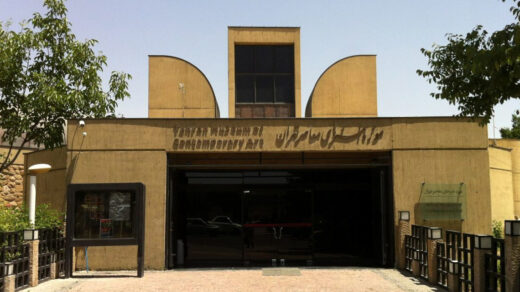
When we want to look at the history of modernist art, our turning points are, first, the formation of Fighting Cock, Apadana Gallery, and, well, their manifestos. Second is the exhibitions of the Saqqakhaneh School and its sudden importance. Then we have Qandriz Hall and Iran Hall, which also have their own stories that are important. Next we have the Azad Group. And then we have the opening of the Museum of Contemporary Art. That is all. These are our main and prominent points. From Fighting Cock to the opening of the Museum of Contemporary Art, which is about three decades (approximately twenty-nine years) is the period of hegemony of modernist art, the period of hegemony of modernist painting in Iran. This does not mean that we did not have modernist painting before that, nor does it mean that we didn’t have it afterwards. But historically, this period of about three decades is the period of the hegemony of the modernist approach and the modernism approach in Iranian painting, which is important. Now, how do I interpret this? I interpret this using the concept of the decorative perspective. That is, when I want to give a more general and comprehensive map, besides the fact that this cultural and formal simulation is important, this story begins from here: in the nineteenth century, a concept comes into being in Europe called decorative theses. Europeans, whose entire assumption was that perspective was the greatest artistic intellectual discovery and achievement in history, and based on which they wrote their own art history and defined and described artistic movements, for reasons that also find a relation with the exhibitionary order, realized from the middle of the nineteenth century that other pictorial approaches, including the decorative approach, are equally important. Some even realized that it is actually more important, because it takes the result of objective observation into a mathematical structure and transforms it into abstract decorative patterns. Therefore, in this respect, it is much more complex. This important issue finds very important relations with politics, with changes in the episteme, and with the structures of life. In the narratives we hear of European modernist art, in Eurocentric art history, this issue has been marginalized; the emphasis is on the creative role, the avant-garde approaches of the independent, individuated, genius artist. In my opinion, this is a very important issue that has been eliminated or downplayed in art history. I highlighted this for myself and explained the pictorial transformations of Iranian art in this transitional period from the Naseri to the Pahlavi era, and modernist painting, with the help of the concept of the decorative perspective. What is the decorative perspective? First of all, I have a history for it, which there is no room to explain here, and I have written about it in detail in the book. But the decorative perspective means that it takes the product of objective observation into the mind, transforms it into a mental image, and then, with the help of mathematical tools, turns that mental image into a pattern. In this respect, we take this as a foundation and consider it the main essence of Iranian art from the Timurid period, for example, to the early Qajar period. From the middle of the Safavid period, it decreases in painting but has a living presence mostly in illumination, flora-and-fauna motifs (tash’ir), and industrial arts such as metal engraving, carpets, and so on. After the Constitutional Revolution and the events of that period, these suffer from weakness and decline, because this simulation reaches its peak in society. For example, one instance regarding pen boxes is that suddenly Russian pen boxes enter, and the old pen box makers no longer work; instead of the reed pen, the Russian pen and fountain pen come along.
This decorative perspective is formulated by Arthur Pope and is introduced as the main essence of Iranian art. That new miniature painting current, which was the revival of miniature painting and the revival of ancient industries, based on Pope’s particular interpretation of the decorative perspective, is placed on the agenda of the institutions in charge of art, which manifests both in the schools and in government directives. I examined a series of these documents; for example, in the letters the Ministry of Foreign Affairs would send to the Iranian consulate, the items that must be transferred as diplomatic gifts are one khatam frame, preferably the work of Master Sani’i Khatam, and one miniature painting, the work of Master Hossein Behzad. This is a very important issue. You must conceive of new miniature painting as Iran’s modernist art. But because in formal terms it does not simulate European art, we have overlooked it. However, when we want to address modernism, this is actually a modernist behavior. Yet because in appearance it is far from what is intended, and the general Iranian public views it as a sign of backwardness and distance from European civilization, it is consequently rejected and remains only by force of government support. This is why Ziapour at some point attacks new miniature painting, saying that these people are painting the image of those same old flowers and bushes and, at best, they become Master Hossein Behzad, and well, bravo to Master Behzad, and the rest of them are like this and so on.
● Who, incidentally, was also his own teacher.
I also think he was his teacher. Therefore, this is the first interpretation. When we reach the period of the native figure, we are faced with the second interpretation of the decorative perspective. In fact, Ziapour is interpreting the decorative perspective. The Fighting Cock interpretation is that we must be able to indigenize Cubism in such a way that it reflects that ancient art, that it reflects tilework, for example.
● So it seems one of his concerns was also the decorative perspective.
It is hidden in his approach. Today, I formulate it this way. He is, in fact, under the influence of the powerful core of the decorative perspective as the spirit of Iranian art, and he tries to carry out this synthesis. Incidentally, its peak is in the painting “Public Bath” and then in “Sepahsalar Mosque” itself, which in my opinion is largely a successful work. Then there is the form he creates within his native figures, within that Cubism which is supposed to take the form of square grids. And let us remember that the square form is a very important form in modernist art. This is the second interpretation. Regarding anyone other than Ziapour, it is hard for me to find who interpreted this in the form of the native figure. But the pervasiveness of the native figure in the entire region from Africa to India tells us that it is as though this has been interpreted somewhere in some way. Whether it has been interpreted in the form of folklore or in another form, I cannot explicitly say. But the best interpretation is provided by Ziapour himself, that Cubism in a way, there they interpret the decorative perspective in a manner that the possibility of using decorations, popular art, and popular industries comes into being. Here it no longer finds a connection with miniature painting and deals more with talismans and prayers and religious popular arts. Therefore, in my opinion, at the core of these three movements is the decorative perspective. Now, if this decorative perspective is important to us, then the historical details are no longer important as to why so-and-so said this or why Hushang Irani did that. Hushang Irani’s issue is also folklore, it is abstraction, and Gharib too is in a way pursuing this story in music. Hedayat was pursuing this same story as well.
● In later years Ziapour travels in Iran, documents, and writes books.
Exactly. Because he then becomes an employee of the Department of Culture and Art. Now the important issue is right here; it is, in fact, Ziapour’s formulation of this matter. His emphasis on the fact that we put this cock because the cock is the symbol of ancient Iran and… though he does not use his terms precisely either, and then night turns to day.
● So the cock must sound the awakening call so that the nation wakes up.
It is the exact same thing that Nima Yooshij says in his poetry at that time, and probably many others in the political and cultural spheres are saying such a thing. When, for example, the representatives of the Tudeh Party go to factories or schools, they want to awaken the people. That is, there is this view that if we awaken the people and make them aware of their rights, a social current will be set in motion. They, too, in their own sphere of action, which is the visual arts, want to awaken. For this same reason, they also largely define their hypothetical enemy. In principle, these modern polarities are in opposition to something else. The modern is in opposition to a traditional one. Now, what is this modern? I always avoid these terms because they are problematic for us; the tradition-modern polarities. But in reality, modernist movements always come into being in challenge with the tradition preceding them. For Ziapour, this tradition is, more than anything else, Kamal-ol-Molk-style painting, which, of course, Kamal-ol-Molk-style painting has itself distanced from Naseri realism. The Kamal-ol-Molk school is actually copying postcards, or, for example, it places an ancient image in front of itself and copies from it. They have become copyists.
● Of course, this is not just the product of Ziapour’s mind. Even the students of the Kamal-ol-Molk school, such as the Petgar brothers and others, are protesting and criticize their master. But apparently, Ziapour wants to find another path.
Ziapour says that this path cannot be taken with that language, and then explains why Cubism is the most progressive movement. But the important point is that Ziapour, just as he places the rooster of ancient Iran and the call of the Amesha Spentas and the awakening call of the Aryan deities on one side of his argument, on the other side, in his own painting, he wants to open up a place for the ancient past within this Cubism he has in mind, that is, the two-dimensional surface of the painting. He shows this through the grid of checkered squares that he draws, saying this motif is a memento of the tilework of old buildings.