by
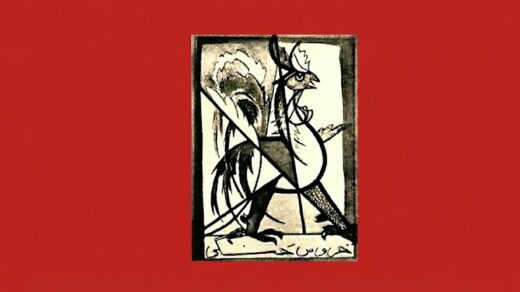
by An article by Master Jalil Ziapour, entitled “Painting” (The Transformations of the Art of Painting in Europe), published in Fighting Cock (Khorus Jangi) magazine, Issue 2, pp. 3 to 10, year 1948

Master Jalil Ziapour; cover design of Fighting Cock magazine (Issue 2); 1948
Painting
It is not necessary for the seeker to traverse a long and distant road and begin investigating from the first foundation in order to find the cause of the whys and wherefores; rather, an inquisitive person, that is, someone who truly has the desire to understand, if he closes his eyes and places his finger on any page of the history of art, will find his object. But in order to know from what years the foundation of modern painting, now, was laid, for the time being we place a finger upon the vicinity of the seventeenth century and consider the artistic world of that age. And if we refer back to three centuries ago, it is because we must know this point: nothing exists by itself and directly, and in a separate and sudden manner, and all things always have a general connection with one another. Only, this connection is such that the succession of time covers the thread of these connections and places them behind a veil of forgetfulness and complexity. It is for this reason that for greater awareness one must draw them out from beneath the dust of forgetfulness, so that circumstances may become clearer.
About four hundred and some years ago in Italy, there were two painters; one named Caravaggio Caravage and the other Carracci Carrache, who both worked in two different styles. Caravaggio, who had an inventive spirit, brought forth a new method and created a school exactly opposite to Carracci. In painting, he controlled lights and used them in whatever manner he deemed necessary. For example, sometimes in a compositional assembly, to give expression to the faces, he found it appropriate, instead of working in the open air and sunlight, to realize his purpose in a dark place by means of a torch. Or he painted by means of a spark of light that he made the pretext for illuminating certain parts of the faces, or he pierced the ceiling of his studio so that light might enter his studio from an aperture just to illuminate the faces of his models. By this means, the type of his works was distinct from others. Carracci, contrary to Caravaggio, carried out his works in the open air and natural light, uncontrolled and decorative.
Just as nothing ever remains hidden and if there is news in any corner of the world it becomes connected due to compulsory relations, this manner of working of these two individuals also, in accordance with tastes, spreads everywhere in Europe and, willy-nilly, disciples are found for them. The country of France lived among the tastes of these two painters; some worked like Caravaggio and others like Carracci. Around this time, Simon Vouet, due to the connection he finds with Italy, comes under the influence of Venetian paintings and by this means popularizes decorative painting in France. And since he produced pleasantly colored and agreeable works, he was soon accepted by people of taste and the general public and, as a result, became known as one of the important decorators of France. In particular, he prepared designs suitable for carpets that were very agreeable. Vouet’s colleague, Jacques Blanchard Jaques Blanchar, who had comprehended the art of the Venetians much more deeply than Vouet himself, unfortunately, due to death which seized him by the collar at the age of thirty, did not get to leave behind effects of his artistic merit and understanding for others.
A little later, around the years fifteen hundred and ninety-four, another painter named Nicolas Poussin emerged, who came under the influence of Carracci’s style and later mixed it with French taste, creating a school, and was considered among the greatest painters of France; this same influence penetrates into Holland as well. In its northern part, where they were Protestant, due to religious conflicts and the aversion they had to Catholic subjects in painting, it is forbidden for painters to create religious subjects. Inevitably, the two working methods of Carracci and Caravaggio gain influence in Holland with the elimination of religious subjects. For this reason, the Dutch in this era mostly begin family subjects, portraiture, and landscape painting. The Dutch in principle seemed to carry the art of painting along with their blood and soul; for the artistic environment they formed brought forth from it distinct schools that were considered among the important schools of the art of painting in Europe. From among them two important painters emerge in whose works the influence of Caravaggio’s style is well seen more than that of Carracci; one is Frans Hals and the other Rembrandt Rambrandt. The characteristic of Hals’s work was that his free brushstrokes were evident in all of his works, and he was someone who, contrary to others who picked up colors in tiny touches, mixed them into one another, and worked in a licked and smooth manner, raised a clamor with his broad brushstrokes and rescues the eye from the twists, turns, and minutiae of others, which were akin to a cage for the spirit and the eye. Rembrandt also employed this same practice but with other characteristics; for example, all the depth and understanding that Hals had acquired for himself over the course of years, he understood in a brief time and passes beyond them.
In northern Holland, that is to say where Hals and Rembrandt lived, firstly due to the struggle of religious circumstances and secondly due to painters being forbidden and restricted in the choice of painting subjects, a spiritual dullness and darkness willy-nilly results, and provided more favorable grounds for the better acceptance of Caravaggio’s style, which had a suitable harmony with receptive and darkened spirits. For this reason, the canvases of the painters there, especially Rembrandt, possess backgrounds of heavy air, and everywhere brown colors are evident in places where the painting’s subjects have appeared on the canvas, and the air of warm, heavy, and damp cellars is well felt. Conversely, in southern Holland and the region of Flanders, where due to being Catholic, painters had freedom of subject and action, and their political and social relations were greater than the northerners, and since they also had dealings with Italy and Venice, hence an artist like Rubens appears there; and his works show how cheerful the spirits of the southerners had been, unlike the northerners, and it is apparent how much they differ from each other in terms of coloring. Rubens creates a world full of cheer, wealth, and fantasy, but Rembrandt has a dark, sorrowful, and heavy world.
The Germans and the English were asleep at this same time, and their ears were not attentive to the art of painting and to taste and refinement at these levels. Only one German named Elsheimer Elcheimer produced some works, and even that was in such a manner that a kind of miserliness, narrow-mindedness, and envy was sensed from his way of working and coloring. But in Spain, where they had accepted the Baroque style from Italy with heart and soul and were directly under the influence of their arts, by mixing the Italians’ working method with their own taste, they created a school specific to themselves, and figures such as Velázquez Velasquez, Zurbarán Zurbaran, and Ribera emerge and manifest a personality for Spain in the world of art.
In this same manner as the era of the art of painting turned in its century, and since artistic reactions were being created one after another, in France the existence of Roger de Piles, the fervent critic of this same era who was in love with Rubens’s works, comes into use in an effective artistic movement, and he is incited by a group to show his mettle against Nicolas Poussin. Willy-nilly, Poussin finds himself at a stage where he is compelled to debate. Therefore, discussions begin regarding the law of color application. Altogether, with these sorts of discussions and criticisms, the ground is prepared for a reaction, and the desire for variety among people of taste directs attention to Flemish paintings, and the artists’ belief regarding the Baroque style weakens.
(Baroque and Reform are two different styles that existed in Italy. In the Baroque style, its followers observed more principles and conventions in their works; that is to say, in altering the model and structure, they interfered in a way that the work would not lack its prior foundation and, at the same time, would also possess novelties. They employed an obstinacy in this matter and in any case did not relinquish tradition in a way that would take the form of Reform).
Among the opponents of the Baroque style in France, Chardin is the only person to whom the eighteenth century belongs; for he had understood the Flemish craft much more excellently than others. He chose his painting subjects mostly from still life Nature Morte and composed them with understanding. His works were not exhausting and heavy like the works of northern Holland; and moreover, because he chose new subjects and fearlessly set about painting things that others did not have the courage to undertake, this fearlessness of Chardin had astonished everyone.
If it is said that Italy, even though it was the fountainhead and model for the advancement of the art of painting of both France and England, had itself not possessed such brilliance up to this time, it appears strange; and except for a little in Venice and Tiepolo, its other places had sunk into a stagnation, while France at this time had a great artistic movement. And in addition to this, Italy’s artistic environment at this time traveled in an atmosphere that generally belonged to the sixteenth century, and in truth it was as if no seventeenth and eighteenth centuries had been in between and passed! And they had just latched onto antiquities Antiquité all over again. This limitation and rigidity anew was because new discoveries had been made in the cities of Pompeii and Herculaneum, and inevitably directed the imagination of the people of Italy to the past, and they were compelled to cast a glance behind themselves. From this point on, due to this current, Rome, the capital of Italy, becomes the arena of activity, and foreign artists gather there from every corner; and Rome becomes the source of a new movement named the Romantic movement, whose followers show great interest in antiquity, and artists set to work on the legends and past Romantic currents that these very antiquities had awakened in them. And this had two causes: one was that they did not find them devoid of beauty, and the other was that since they in any case had a perceptible closeness to nature, therefore they could not be indifferent to these recent discoveries. David at that same time considered this group antiquarians and deemed the emergence of the Romantic school in Italy to be its period of artistic decadence.
The Romantic school in France begins from the studio of Gros; even though he himself did not directly show activity in this school, his method of teaching was such that this school was latent within it. But the one under whose name this school is mostly registered in France is Delacroix. Ingres Ingre, who was his contemporary, has a great difference with him in terms of artistic theories and manner of working; abundant debates are exchanged between them and ultimately Ingres finds himself compelled to protect his students from the artistic tricks of Delacroix and his style. For, in Ingres’s view, Delacroix’s method of working is very superficial, hastily sketched, and nonchalant. Ingres attached importance to drawing more than what seemed apparent, and Delacroix sensed exhaustion in all this precision of his in drawing, and mostly gave importance to color as opposed to design. And ultimately Romanticism, which had entirely occupied itself with storytelling and myth-making and dealt with the fantasies of daydreamers, exhausted the spirit of the people of taste.
Is this expression of exhaustion not proof of desiring fresh things? Hence, another reaction contrary to Romanticism begins, and Realism (which had penetrated into painters from writers) steps into the arena and finally sets forth a path for people who were thirsty for truth and reality. Courbet was the first person who commenced this school and rescued himself from the clutches of storytelling. He no longer seeks anything other than tranquility; he brings onto his canvases gentle and natural subjects that provide a tranquility for the mind. A few chubby village girls beside a spring, a few fattened cows reclining on the grass, constitute his painting subjects. Ultimately, seeking tranquility and portraying reality, however agreeable they may be and though they may lack a state that grips the heart, become exhausting like anything else and make a person desire another novelty.
For this very reason, against the Realism school too, a reaction named Impressionism is willy-nilly carved out and creates a great danger for Realism. Because the Impressionists said the truth that the Realists boast of does not exist; moments pass one after another, and from these passings changes inevitably arise in the appearances of objects. And since painting relates to the sense of sight and, in the first degree, has a direct connection with the appearances of objects, therefore the eye never sees a single scene uniformly during the day, but rather observes different scenes at varying moments. Thus, one must strive to bring onto the canvas by some means the impressions that nature shows us in one or several moments, not to be bound by things other than sense and impression. In this manner, the Impressionists dismantle the setup of the Realists with fresher and firmer proofs, and Claude Monet Cl. Monet for the first time shows a work of his own that, confirming the truth of the Impressionists’ claim, turns out to be agreeable. Around these times, since the science of physics had made considerable progress, it becomes a great help to the Impressionists’ way of thinking and reasoning; meaning that with physical laws they were able to introduce a new method in coloring and, instead of mixing colors together, place them side by side and begin greater virtuosity with it.
Manet, Monet, Degas, Sisley, Cézanne, all of them, with differences in their manner of seeing and working, are part of the Impressionism school. For example, Manet is the first person who, under the influence of Claude Monet, opened a newer path for novices and broke the conventional laws of painting and adorned his palette with only a few simple colors. Claude Monet, by means of light and air, was able to show the precise and sensitive points of nature on trees and cathedrals. Renoir adds a kind of poetic grace upon the conventional lights of painting.
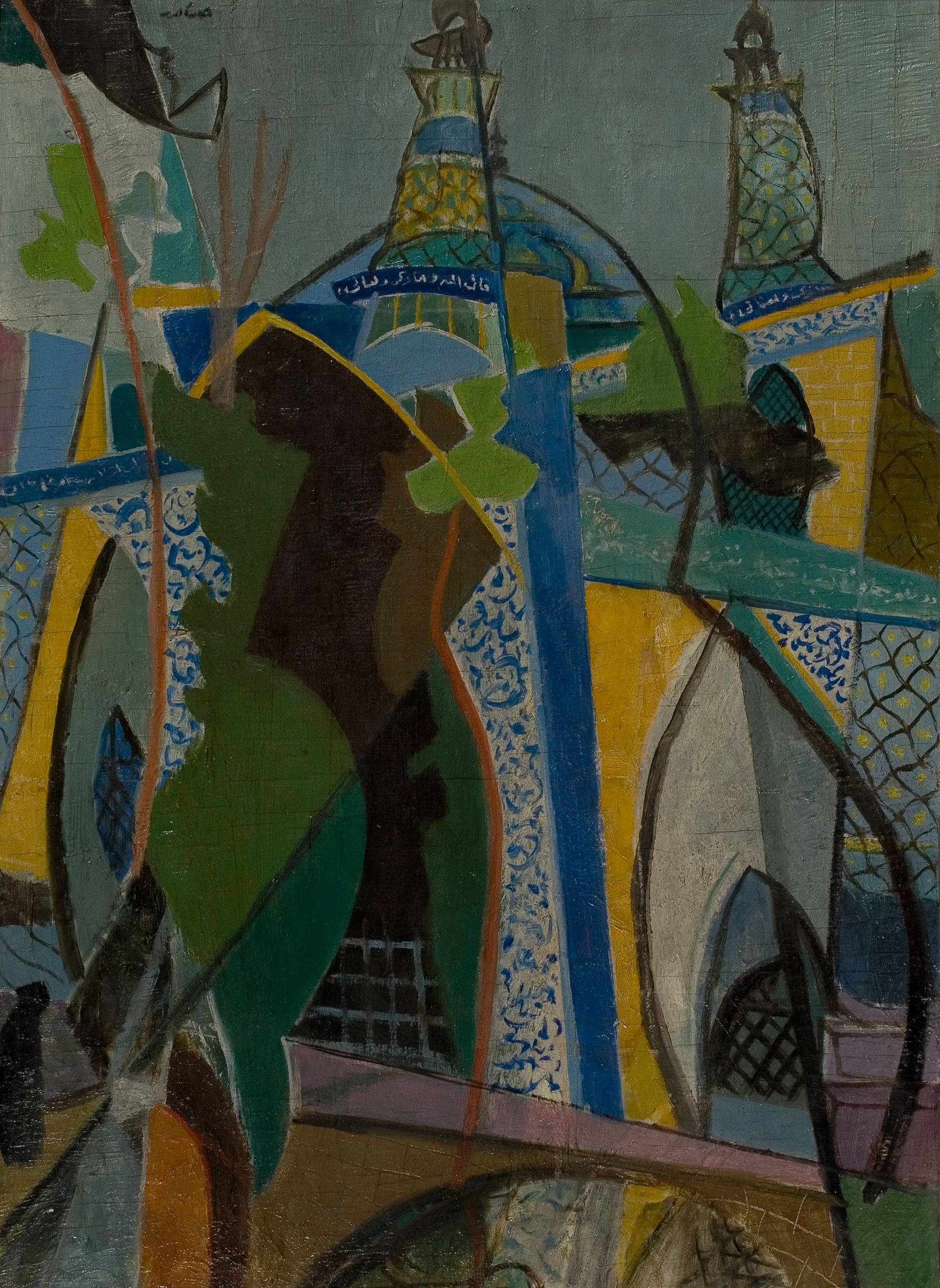
Master Jalil Ziapour; “Sepahsalar Mosque”; Abstract Cubism; oil; 120×80 cm; 1948
Degas, contrary to his comrades, works mostly in the movements and ordinary life of his own era and especially in the life of dancers. Sisley had well understood the secret of showing delicate air and situational differences in painting. Cézanne does not remain in the stage of the Impressionists and becomes the source of Cubism painters.
Despite the variations that had come into being in the Impressionism school, the thirst of the seekers of variety still did not subside, and Van Gogh, Gauguin, and Pissarro began their activity; Van Gogh, as a result of great effort and power of talent, in showing the dramatic states of life, shows a path and a power to the Impressionists and advances painting from Impressionism to Fauvism. Pissarro too does not remain without result from his search and from simple Impressionism sometimes advances himself to the new Impressionism. (The difference between these two schools is that the new ones, contrary to the old ones, place colors entirely separately and side by side instead of mixing them, and if the old ones had some reservation in this matter, the new ones cast aside even this little reservation). Gauguin had an interest in Pissarro’s manner of working and most times went his way until he consolidated himself and found a distinct school; with all this, it is a mixture of the old and new Impressionism schools and a little of Fauvism.
Did the thirst for variety seeking, which had manifested with such intensity in the artists of this era as a result of the monotonies of past periods, subside so soon? And did painters soon cease working and content themselves with these amounts? Certainly not; because Cézanne, who in the midst of this had brought forward a newer path, could still guide the possessors of desire and taste on a more extensive road and to a farther destination, since destinations farther from reach always make man more greedy. Hence, in this midst, the Cubism school is created of its own accord. And in spite of the gentle and soft lines and surfaces that the eye was now exhausted and fed up with seeing, and especially the nonchalance of the Impressionists in design, who believed that surfaces inherently possess design and there is no need to determine their boundaries, geometric lines and surfaces step into the arena of painting and the taste of painters out of necessity. And the Cubists claimed that since painting is part of the plastic arts, then like other plastic arts (which deal with material Matériel), the aspect of materiality in it must be perceptible more than other aspects at first glance. It must appear on the canvas like a powerful and solid edifice.
Therefore, the pioneers of this school, by making use of Cézanne and pursuing his goal, broadened the arena of this school and brought it to where it was necessary, to the point that Jean Cassou says in this regard: I do not suppose anyone could ever explain the work that Cubism did in the world of painting in the way it deserves. The torchbearers of this school, namely Braque and Picasso, with two completely different personalities, fell into the arena of Cubism. One advanced in his work gently and very cautiously but with power and a distinct goal, and the other madly and thirsty to disrupt and turn upside down whatever the conventional laws and considerations of painting are; he is hulking and butcher-like. The brush in his hand is like a cleaver with which he prunes the branches and forms of nature, but he is as sensitive and intelligent as possible. In his works he always leaves open the path of understanding and advancing and thinking for others, he does not limit and imprison them, and he becomes the motive for their sense of invention. He himself too, due to not being satiated by the prevalent schools which were ordinary and insufficient for expressing his inner feelings, passes with speed and leaps over all these various branches, and the work that Rembrandt had done in his own era, Picasso does in this era with power multiplied several times over.
In a machine and atomic life that necessitated the existence of such a school, people could still not perceive this sole solace of the mind and uprooter of the material spirit from the earth, meaning “poetry”, within the Cubist style, and their legend-seeking mind, which had long been accustomed to poetry and legend, would not be satisfied by this working method. Based on the principle of that same need, the Surrealism Surréalisme school takes the place of Romanticism; meaning Romanticism puts on new clothes. Now it has been quite some time that it is advancing in parallel with Cubism, but what an advancing, that one wears its own true clothes and the other has borrowed from writing, having lost its personality within it….
The Transformations of the Art of Painting in Europe – By Ziapour