by
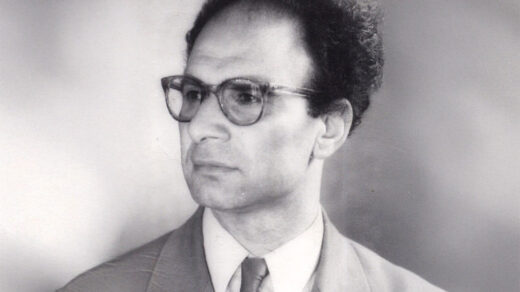
by Text of the lecture by Master Jalil Ziapour; published in the magazine “Andisheh va Honar” (No. 6), June 1955
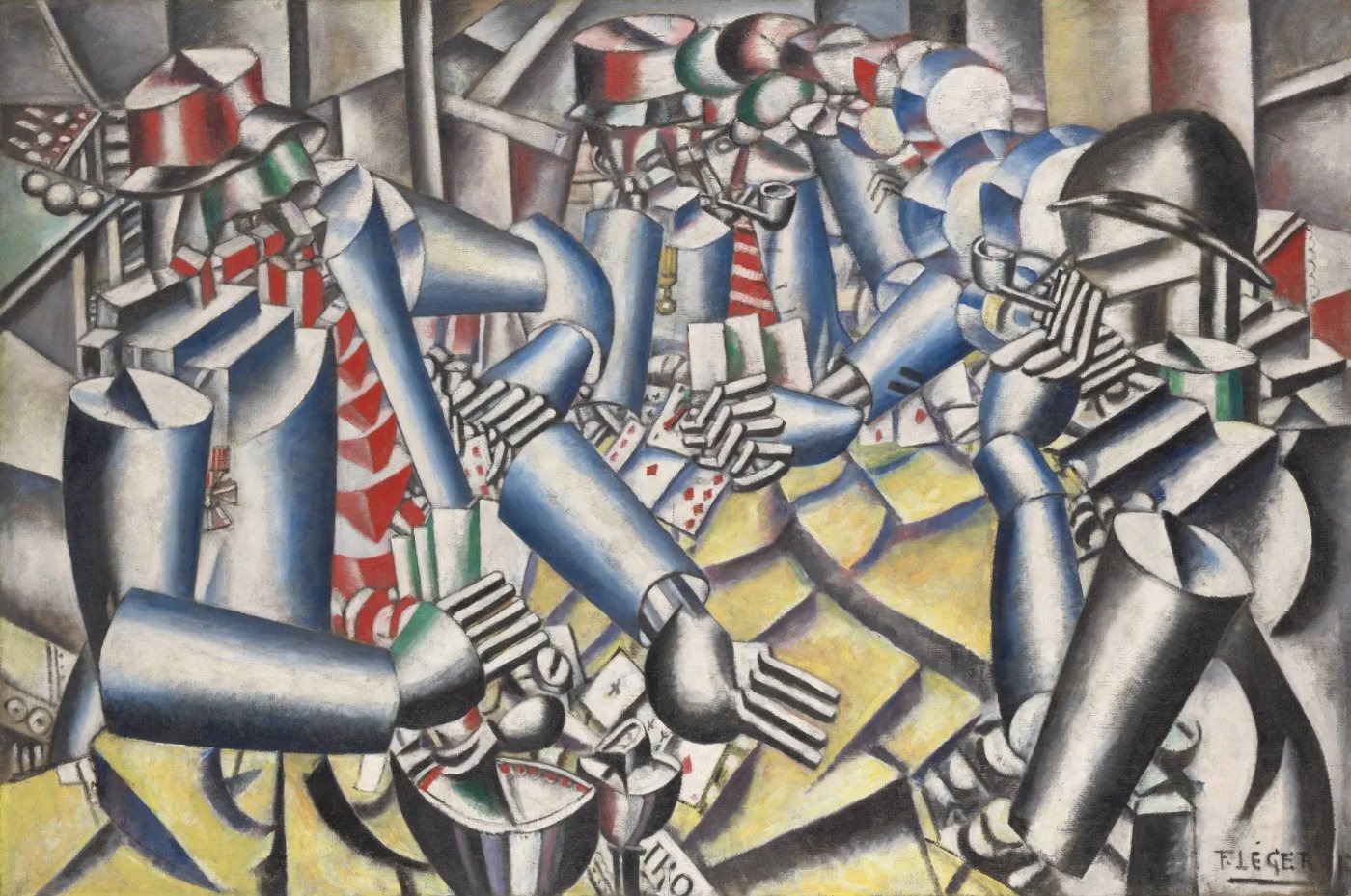
Fernand Léger; “Soldiers Playing Cards”; 1917; oil on canvas; 129.5×194.5 cm
In the previous issues, I explained general aspects of the common characteristics of the schools of Impressionism, Fauvism, Passeism, Dynamism, Crystallism, and Futurism. Needless to say, these explanations were only for general awareness of how these schools were created, not detailed accounts of the paintings of these schools. There are indeed other explanations involved, which must gradually be written as simply and clearly as possible, so that the scientific nature of each method of work becomes clear. Therefore, first comes the explanation of the primary cause for the creation of the schools; next, their field of activity; and then, the definition of their variations through the working methods of the great artists of those schools.
Since the reality of existing life in the era of Fauvism (early 20th century) had brought about such agitation in the public mind that it had brought perceptive artists under its influence, the more the wheel of agitation rolled on the roller of progress, the more speed it gained, and through diverse means, made manifestations and needs more available. Fauvism, cracking the whip, spoke harshly and showed bitter and dark faces. Passeism was a moderator that tempered the harsh language of Fauvism and preserved its sharpness and intensity in a new form. But it maintained the ambiguity and intellectual elevation of the majority, who were in a state of crisis, in the form of creating scenes of mystery and secrecy. Dynamism displayed the disrupted internal state of the people (who were at the end of their tether and had the knife to the bone). Crystallism chose a clear and logical path, free from ambiguity and concealment. Futurism, in the course of displaying the last desperate vital struggle of individuals, gave evasive answers to questioners and said, “What I create is for future generations.” (But it was said that this answer was the answer of a tired and weary artist; otherwise, competent and capacious artists know that the art of the future is created by future generations.)
Following, parallel to, and sometimes even ahead of the so-called school of Futurism, a dominant school emerged which in a short time crushed along its path all these schools that had been created according to the requirements of the times and had gained ground through the tools of convincing arguments; and this was the school of ‘Cubism,’ which said: in mechanized life, where the movement of the giant wheels of factories shakes the earth and activities have assumed a geometric and orderly form; at a time when the foundation of the life of manual labor, under the crushing gears of machines, has assumed a critical and moribund state, and roars struggle to escape from dry throats and rumble like the crash of thunder within human emotions, and unburst sobs block the throat – how can these be displayed with soft, ordinary, and delicate lines and planes in the form of the existing schools?! (These existing schools are nothing but playthings). How should these painful sounds of the machine age, which have turned into discordant roars in the throat of humanity, be shown? How should one display these hands calloused by steel tools, and these faces in which the eyes, with a fixed stare, have dried in their sockets, and the burnt cheeks have taken a geometric shape, and the stubborn square chins and firmly pressed lips (which seem to have been cast from iron and steel)?!
No common and ordinary plane or line (except for the geometric plane and line) can properly introduce the human being of the machine age. Man, this element – a highly resistant, daring, stubborn, and unyielding human being – struggles like a durable and tireless machine to obtain his necessary livelihood. Only the mold of Cubism can introduce such a human being as is fitting. This was the word of Cubism, and for this very reason, it converted all existing forms, even human forms, into geometric ones, and in this way, applied the machine form and the characteristic of mechanized life to painting and sculpture, and through itself, directed gazes toward mechanized life and the struggle for a new reality.
In the beginning, the Cubist painter turned forms into simple geometric shapes. But because he found them inadequate, he proceeded to alter their shapes, and here, simple Cubism took on the name of Abstract Cubism (or geometric gestural-indicative painting). With the emergence of the Cubist style, other isms came into being which, of course, cannot be separated from Cubism, but because of the characteristics that exist within them, they have acquired their own names, such as “Cylindrism” (Cylindrisme), “Objectivism” (Objectivisme), “Constructivism” (Constructivisme), “Collagism” (Collagisme), (all of which are derivatives of the school of Cubism).
Cylindrism refers to that type of work in which the artist has tried to turn shapes into cylindrical and tubular forms. Objectivism refers to that type of work in which the artist’s vision is directed toward the materials and objects around him, and human and animal figures do not exist in it. Constructivism refers to that type of work in which only structures are composed. In Collagism, the artist makes use of every possible and usable thing. A piece of newspaper, a tree branch, a leaf, a quantity of sand and gravel, large and small printed words, sometimes a watch case, or a necklace and chain. All these are composed and attached to the painting in a technical manner using oil paint or nails.
These were variations that emerged along with Cubism. Do you know why? Because, along with everything in life, the artist also wanted (since he is a pioneer) to escape constraints and be free. The goal was for the artist to show that he has complete freedom of action and expression. The artist wanted to reassure himself and the people, and to flaunt that he has freedom of action and does not consider himself bound by any constraint. This feeling of individual freedom was a promise of general freedom. This very freedom of action and these variations finally led to the creation of other isms such as “Surrealism” (Surréalisme) and “Supernaturalism” (Supernaturalisme) or “Subjectivism” (Subjectivisme).