by
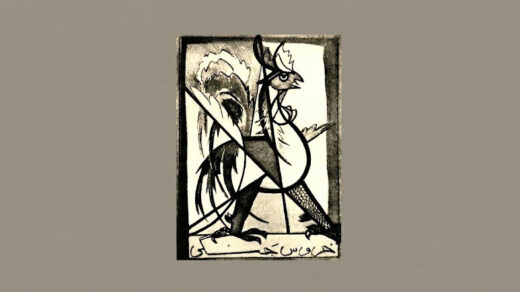
by Text of the lecture by Master Jalil Ziapour at the Fighting Cock (Khorus Jangi) Art Association, published in the Azarpad weekly, issues 5 and 6, 22 and 29 April 1950

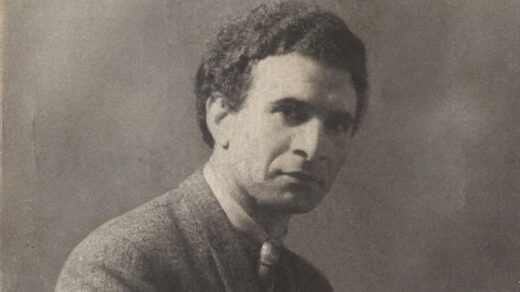
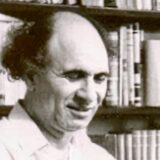
Self-portrait of Master Jalil Ziapour; 1949
This artistic stir which is currently seen in painting has arisen by the effort and endeavors of a certain number of young painters after a long period of stagnation or the repetition of painting, which is itself a kind of stagnation. If, far and near, painters were to be found, they would engage in painting like people of taste (not like a craftsman); and if it went very far, one of these very people of taste who spent more time in this art would be called a famous painter, and without having realized the goodness or badness of his own works from a technical standpoint, he would content himself with possessing several paintings in these very fields and would delight in the praise and admiration of a number of haphazard people of taste. Our environment today exists in this very state. Of course, one should not expect otherwise. For it is not possible that all members of a society be possessors of excellent, cultivated taste and knowledgeable in art.
This artistic stir which has recently emerged in Tehran is also active, in some proportion, in other cities of Iran. It is certain that the prelude to this great undertaking will not be without effect on the artistic leap. In the provinces too, as far as I know, a strong interest is expressed in the new art and they wish to obtain information about this art, and we too, as far as has been possible, have placed information at their disposal upon their request. (Even in neighboring countries, an excessive interest has been expressed by a number of people of taste, and in Turkey, India, Pakistan, Iraq, Afghanistan, France, London, and America, Iranians have become inclined toward this artistic stir and are using the materials of the proponents of the movement through magazines and articles published in Iran.)
It is evident that today’s art world, due to international relations and environmental demand, cannot carry on in silence, and curiosity will not allow matters to remain uninvestigated. For some time, we have encountered many complications along our artistic path and are in debate with the group that believes in art for the masses. Even the artists who work in the old style, because they temporarily see their interest in chiming in with the aforementioned group (albeit in another way), they too directly in this midst want to create a barrier to the progress of the new art (to preserve their situational and personal interests)! Although appropriate and logical answers have, to some extent, been comprehensively given to these individuals (who have one ear as a door and the other as a gate), yet it is evident that it does not suffice and such answers must be repeated many times. Of course, we do not content ourselves solely with answering questions, and I will try to show the correct method from the incorrect in painting.
It is not out of place that we should know, in principle, what our contemporary painters who work in the old method are doing. What kind of works they produce and what belief they hold in art, and fundamentally, whether they have any belief in art at all, or if they work haphazardly. This is a subject that must be explained. Since Master Kamal-ol-Molk, the general goal of his students and followers has been to follow nature. Because they believe that nature is the artist’s most excellent teacher. Therefore, one after another, they repeat this matter parrot-fashion into people’s ears, like revelation. There is no objection, and it is also obvious that nature is an excellent teacher, but the student must also be excellent. Nature being a teacher never yields the conclusion that the student is also excellent and that we should imitate nature identically. When it is objected to them that ‘You imitate and copy nature, and you have not understood the purpose of the great masters,’ they reply that there is nothing more beautiful than nature, and everything in nature is beautiful and excellent. Therefore, according to them, whatever exists in nature, in whatever state it may be, if they paint it identically, they have created beauty. For this reason, painters never fail to bring nature, hair by hair, onto the canvas.
One great task that is of great importance to contemporary masters is likeness-making. This work is among the most important displays of skill to them, whereas there are so many artistic secrets and interesting matters under consideration that portrait-making is considered among the elementary and unimportant tasks. In this regard, it can be said that the verse, ‘The assembly has ended and life has come to a close, yet we still remain at the beginning of describing you,’ applies to them.
Following these painters, a great many other followers of this very group (albeit more novice) are at work, with beliefs that are a bit more old-fashioned and a bit less tinged with the color of the times, and they say: ‘We do not, like the respected masters, spend several years to paint a valley and a mountain. We make such-and-such a face quickly and nimbly in five minutes.’ These gentlemen also flaunt their speed of action to the people. If the masters we have in mind at least possessed clean and precise coloring, these novices pay attention to nothing but likeness-making (or, in my opinion, mask-making). Where is the fault in this work?
The followers of natural painting, and also those who speak of truth in this art, are both groups called, in international terminology, “Naturaliste” and “Realiste,” that is, nature-oriented and reality-oriented. Because they believe that reality is in nature, and that nature itself is identical to reality. Thus, painters who follow nature and wish never to deviate from nature and reality must be known by the aforementioned names. But one must know what differences there are between our nature-oriented and reality-oriented painters and the great and famous naturalists: our painters, such as many of those present and, in general, all of them who are in the service of the Ministry of Culture, engaged in performing their duties and guiding the youth in painting, believe in great painters such as “David,” Ingres, Rembrandt, Delacroix, and Rubens, and consider themselves followers of their artistic beliefs and thoughts, and regard their sayings as the best and most excellent guide. By way of example, I bring a few points from the statements of these very same great masters in order to draw a conclusion. Do our contemporary masters really put their sayings into practice the way they describe, or do they make such claims merely to display information, flaunt their knowledge, and feign beliefs which they express categorically on the combined authority of those masters and themselves?
“David,” in a letter to his students, after mentioning various matters, says: “When you stand before a model, pay attention to the principal form of the model, and from among all the forms, choose the best one that is interesting in terms of form and composition. Do not be like painters and sculptors who stand before a single model for years. Whenever their model becomes thin, they change their work and make it thin, and whenever their model becomes fat, they begin anew to fatten what they have drawn.” When I myself was reading this matter in a book written by André Lhote (From the Painter’s Palette to the Writer’s Inkwell), I recalled the days when, according to the master’s method of instruction – at the Tehran College of Fine Arts – we were compelled to fatten and thin our work in obedience to the model upon the master’s order.
Ingres, regarding the use of nature, has said in the words of Nicolas Poussin: “When the painter pays attention to artistic elements, namely color, form, and composition, he can succeed more and better in art than in copying nature; but where is the eye that has precision?” More importantly, Ingres used to instruct his students: “For practice, one must always copy nature, but not for the sake of having copied it; rather, in order to see, to observe carefully, and to learn. If I sometimes insist that you practice from the works of the masters, it is so that at least, through their way of seeing, you may learn the method of seeing and understand how the masters saw nature, not so that you may imitate the masters and place your feet in their footsteps.” (1)
The reason for expressing these words, which are among the instructions of the most select artists of the world, is so that we may know that these masters, who were among the most strict nature-makers in the art world, held such beliefs about how to use nature. They never wanted, nor did they believe, that they should copy nature, and their intention was not to create a second nature identical to ordinary nature. With this in mind, how have our nature-makers followed the masters I named, and which of their sayings have they put into practice? Among the characteristics of some of our painters is that they paint from the poems of poets such as Hafez, Khayyam, and Nezami. They select an opening line and, as they put it, embody a scene.
One day you will learn of the state of my heart, O hunter
That in the corner of my cage there is nothing but a handful of feathers
Or, in heaven, it would be no wonder if, as Hafez says,
The song of Venus brought the Messiah to dance
(and they paint His Holiness Jesus dancing in heaven)
It is not permissible to discuss this group of painters any further. But this much must be said: that these artists should be known as a link that guides us from the art of miniature-making to nature-making, while they themselves are never of that group nor of this one. That is, in reality, their works possess neither the grace of pure and masterly miniature nor the grace of nature. Especially since, in this state, due to a lack of knowledge, they cannot observe the necessary compositions in the image, which are among the required characteristics of nature-making; and without regard for artistic laws, they have done whatever they knew, and have used whatever color was in their mind. Such works are no longer of any use today, except for the common people who wish to enjoy the scene of the battle of Rostam and Sohrab in any manner possible, or to see Khayyam with a book under his arm, biting the finger of admonition while gazing at the sheikh and the prostitute. These artists of ours have, of course, in their own line of work, also trained students who are dispersed in this environment to some degree.
Our nature-makers are divided into two groups, so-called progressive and backward. The backward group, which is of course more limited than their progressive group and, in any case, closer to themselves, has constituted the greater part of the painting environment. These artists separated themselves from miniature-making, but in order to be capable of showing scenes and views, without regard to the ways and methods of nature-making, they apply the brush so much that miniature-making is a thousand times preferable. For this reason, this group of artists must be called “detail-workers.” What has most attracted the attention of this group of artists in nature is pure likeness-making itself; and since they had not realized the value and occasions for artistic display in miniature-making, tile design, and carpet design, they did not grasp the goal of these branches of art. Therefore, they could not utilize the existence of these arts on the path of nature-making.
Our backward nature-makers (or detail-workers), since they had the goal of making things natural, directed their efforts toward likeness-making and often, from photographs, created black-pencil portraits with “Conté” pencils, and sometimes also engaged in coloring. Since such works are popular with the public, ordinary people encouraged them with flattery and cries of “bravo,” and they too took it very seriously. Now if today someone should wish to swear by the verses and the prophets that, “Gentlemen, your works have flaws from a technical standpoint; making a few faces resemble their subjects is not painting,” it is impossible for anyone to accept it; and they remain in the error that has been prepared for them by tasteless people of taste. Stranger still, these artists have prepared little painting manuals to guide the young and placed them at the disposal of students. (Of course, each of these painters has also trained students of their own who are fierce and fanatical opponents of the new art. The work of this group, like the others, is to sneer at the new painting and, without investigation, to reject the new theories in the arena of painting).
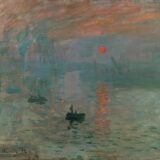
This group is even opposed to Impressionism and the approach of the College of Fine Arts students’ work in painting. Without knowing the method of Impressionism, they express opinions about it, and they have named this method of working “free brushwork”, assuming that Impressionism merely means working with a free brush! For this reason, we see a number of these painters daring to create works of this kind, imagining that they have worked in the Impressionist method! These painters, who for some time had the honor of being the students of the students of the students of Master Kamal-ol-Molk, have not acquired artistic knowledge beyond what their limited artistic minds allowed, and their minds travel toward a vague and incomprehensible point whose separation, definition of boundaries, and quantity and quality are not clear to them. This is why, without having a specific goal and without having cultivated their defective reserve of knowledge or drawn a scientific and logical conclusion from it, they also engage in debate, which is full of contradictions.
1- André Lhote – De Lapalette a – Lecritoire – P – 176 – 182 – Edition Correa Paris. 1946