by
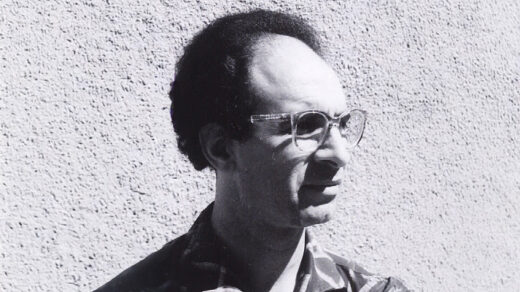
by The text of the speech by Master Jalil Ziapour at the Fighting Cock (Khorus Jangi) Art Association; published in “Post-e Tehran” magazine (No. 546), 26 March 1955

Master Jalil Ziapour; “Quchani Kurdish Woman”; 1960; oil; 200×83 cm
For about eight years now, new art has been on everyone’s lips, and exhibitions of this kind have been organized many times. But viewers have always been upset and have mocked the painters. We cannot say they do not have the right, because mockery is natural to those who are not accustomed to reflection, precision, and inquiry. Furthermore, I am certain that the majority of our modernist painters do not have sufficient and meticulous study regarding new art. For this reason, they do not produce works that fulfill the necessary conditions. Obviously, in the face of the well-founded curiosity and questions of people of taste and those given to precision and research, they fall short of giving firm and acceptable answers.
The art of painting, in essence, means creating new scenes of thoughts, inclinations, and desires, in which technical power is so applied through staging that the themes are expressive in the best possible way, and this is an effort that an artist must exert. In old painting, the artist’s goal was to embody familiar and ordinary natural forms, and they mostly tried to embody their intentions through ordinary forms. Obviously, to express their intentions, they did not go beyond the boundaries of naturalism, and for this reason, the expression of the intention was automatically limited. We know that however much life progresses (or changes), this change comes about due to needs, and needs change thoughts and desires, and we feel new emotions in the face of these changes, and to interpret these emotions, we look for forms that are capable of containing our intentions.
Obviously, if these emotions are still nascent and have not assumed a visible and familiar shape, we are forced to change the usual, inadequate natural forms or the ordinary familiar ones that are not capable forms (or are insufficient) to express the current intentions of our time, and try to embody the content in the necessary manner with a specific composition (in order to improve it). In this, there is no intention or deliberation whatsoever to make the meaning ambiguous. However, the theme and intention that are chosen may be far from everyone’s mind, or in essence, the artist may not have been capable and skilled (in any case, it is not outside of these two states: either the theme is heavy, or the artist is not capable). If the artist is capable but the theme is heavy, understanding it is difficult for the public, and here the artist is not to blame. One must only note that the goal of new art is to reveal precise and internal themes by whatever means possible, and for this purpose, it is not subject to any insufficient law. If one must be bound by artistic law (that is, if one must pay attention to something that can be called a law), I say that in new art, only the new law that the artist themselves creates holds sway (in the words of Beethoven, on this path there is no law that cannot be done away with for the sake of something new that must be said). The purpose of new art in doing this is also to speak better and to show better, and on this path, it makes use of things that people, by custom and habit, do not pay attention to.
In new painting, people fix their gaze out of habit on ordinary and familiar forms, and are oblivious to the language of colors and compositions. Amidst the multitude of painting’s means and expression, they search for faces, bodies, hands, feet, trees, and so on and so forth, and this is where a gap opens between the people and new art. Of course, one cannot be subordinate to the habits and tastes of the people, and it is the artist who is responsible for raising the taste and level of vision of the people, and it is clear that the goal of new art is not to make the theme ambiguous. Nor are the nerves of modernist artists ruined. They have no hostility towards the people either. Rather, because the perception of modernist artists is highly sensitive and strong in receiving nascent occurrences compared to others, they are forced, in order to express those impressions, to employ compositions that, in terms of form, bear sufficient resemblance to the theme, not to the vision of the people. Another point is that in new art, the painter may not be qualified and skilled.
Being qualified means that the modernist has sufficient awareness of the fundamental concept of art, the artist’s own personality, the environmental situation, and the influences of successive centuries on the people and the world, and on the other hand, has sufficient practice and research in the mode of expression of their technical tools of work (which is the psychological understanding of colors, designs, and compositions).