by
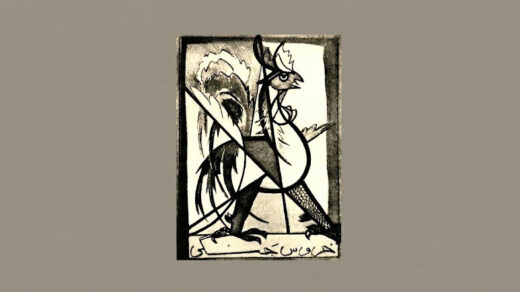
by The text of the lecture by Master Jalil Ziapour at the Fighting Cock (Khorus Jangi) Art Association (1949); published in the weekly magazine “Shahsavar” (No. 3), 9 October 1950

Master Jalil Ziapour; “Quchani Kurdish Woman”; 1960; oil; 200×83 cm
According to the view of Surrealism, Cubism not only technically (except in some cases) included all the conventions of past schools, but was also so bound to some of them (even more than could have been expected) that the expression “falling from the pit into the well” undoubtedly applied to it. Despite all this adherence, the innovations that Cubism brought about were so in accord with the times and representative of the spirit of its artists that no other method but it could express the state of its time so well. I have said before that the era of Cubism was the era of the consolidation of new conceptions, the foundations of which had been gradually laid long before. Accompanying every transformation (economic, political, and cultural), there is always a more advanced mode of thought, in which rank discerning artists usually belong; they pay attention to dissatisfactions and engage in manifestations through art. This group involuntarily makes their artistic manifestations public, and strives in the transformation of their specialized technique in such a way that their works represent the spirit of the times and are, at the same time, decisive, logical, and dignified.
Of Classicism, Impressionism, Neo-Impressionism, Fauvism, and the other “isms” existing in the machine age, none except Cubism was able to represent the manifestations of the era, and it is for this reason that the majority of those of cultivated taste, and all who possess precise and unbiased eyes, look upon it with admiration.
Of course, it is not Cubism (that is, a specific method of painting) that has created the Cubist; rather, the essential condition for the emergence of a Cubist is, first and foremost, possessing a progressive spirit that wants to escape the burden of conventions and attain the form that is the need of the times. It is the existence of this very spirit that causes the inner reflections of such artists (like all progressive artists) to take the form of firm lines and planes, and colors in the form of heavy, material pieces – which is the proof of the artist’s interest in and attention to their surroundings – and it is through this way that the Cubist is created. But there are points of difference among Cubists in terms of the stages of their position. These differences lie in their training and way of thinking at various degrees and stages of progress. This difference begins, in proportion to the upward path, from the first stage of a progressive group’s way of thinking and ends at the peak of the way of thinking of that same group. (These points of difference exist among all groups of artists of different schools). In the interval between this beginning and end, there are three more distinct stages that can be called the periods of doubt, despair, and success.
In the first stage, because of a lack of sufficient logic (which reinforces the desire for progress), the Cubist is doubtful, even while the ground for progress takes a favorable shape within his nature. Therefore, he never accepts anything cursorily or blindly, and owing to a lack of the necessary breadth of discernment and clarity of vision, he naturally enters the goal of art with great caution. This period is, in fact, the period of his intellectual crisis, and it is in these stages that his mindset can grasp a great deal of the necessary knowledge. During this period, the Cubist creates works that are confused in terms of technical manifestations. This confusion and hesitation appear in his works in the form of contradictory, sharp, illegible, sometimes opaque and sometimes transparent colors, and at the same time are combined with irritability and violence, and they also represent a search that is spontaneously awakened in him to comprehend subjects due to possessing a sense of opposition.
The second stage is despair, or the stage of the artist’s aversion and distress. In this stage, the artist sees the surrounding conditions and understands the unfavorable circumstances that cause failure. He wants a new situation to arise that would help the advancement of his views. But since his aspirations, in the face of external conditions, are very far from the stage of action, he therefore often finds himself confronted with failure. Failure leaves a reflection in him, clouds his emotional grounds, and awakens a sense of hatred in him; and hatred, in the end, breeds him as an audacious, rancorous, and generally aggressive individual. The reflection of this kind of feeling and audacity is clearly visible in his works. Namely, the former firm and brittle lines, due to his suppressed hatred, take on a greater wrathful power. Colors become thicker and more material (especially dark and gloomy, and at the same time steely and firm).
In some cases, spirits are found in this stage who seem to have emerged from the depths of the mire and hidden animosities (which are the result of successive, frustrated, and dormant despondencies). Here, in the existence of these artists whose hands are cut off from any hope (except forced freedom of action), complete pessimisms reign. For example, among the Fauvists one can count Vlaminck, who wrought havoc in the composition of colors, especially gray, black, and brown. Among the Cubists one can name Picasso in his black-gray period, and also Braque in his blue-brown period; and most Surrealists as well (especially painters from this group who are more negative) can be counted among the complete pessimists. Such as Félix Labisse in the piece (The Happiness of Becoming Beloved), through which one can clearly perceive the pessimism of the aforementioned artists: (In this painting, Labisse shows a naked woman seated in an anguished posture on a sofa. The head of this woman is that of a defeated lioness joined to the woman’s body. The state given to this head and body in the form of a predatory and despairing animal bespeaks a world of desires. Desires that have mostly revolved around possessions, and all of them having collapsed like a lightning-struck palace. Nothing seems more heartrending and more repulsive than the howl of an animal that has been struck by calamity. This head that Labisse has chosen for such a woman well shows his belief regarding love and his conclusion about women’s excessive desire to become beloved, and it illustrates how, if these women do not attain their desire, their inner nature – which has always appeared with a good outward aspect – reverts to a bad state, and it shows how Labisse sneers at this reality with biting irony.
The final stage is success, and it belongs to the one who is equipped with complete perseverance and a correct way of thinking (in accordance with the latest necessary method of work). In this state, a Cubist undoubtedly comes into being in whose worldviewing thoughts the periods of doubt and despair have no foothold, and who is accompanied by evolution, and who knows that through struggle and by paying no heed to conventions and objections, he can at last create the necessary environment for future generations (even if it does not attach itself to him). In the works of such artists there are lively colors that are fresh, sonorous, and brilliant. The compositions of lines are also very expressive and powerful.
What has passed was a glimpse of the manner of thought and work of a painter who has entered the field of action of geometric design. (Of course, one must be aware that the Cubist must be known in his various stages and in the correspondence of his spiritual states with the general mode of thought, and judgment must be made about him and his way and practice accordingly. But this is a path that can be reached, and for ease of work I have distinguished these three definite stages from one another so that at least its general recognition may become easy; otherwise, a doubtful, despairing, optimistic, or pessimistic Cubist, in addition to the three definite stages, passes through many other stages – from the standpoint of analysis, synthesis, and intellectual inference – during his life, the entire account of which manifests one after another from his works by itself, not deliberately; and in these stages, there are fine threads that create a sensitive relation between two modes of thought or two opposed feelings, which may affect the artist only in a moment or in particular moments. Since the course of these stages is very interesting for the curious artist, for this reason too he strives to show those precise and difficult moments skillfully by means of the elements and factors he has at hand, and to bring them out of the state of a purely emotional and weak feeling into the form of possibility and reality).
This is why, most of the time, those who are in search of obtaining the intellectual and spiritual grounds of such artists often, because they lack the power of comprehension and strong vision in artistic fields, and because of an absence of breadth of discernment, cannot distinguish the relation between an artwork that is in the house of the artist’s thought, in the process of taking ground in order to come into being, and the result of the work, which is material and has external existence. For this reason they encounter difficulties and mistakes in analysis and judgment. (Especially if a non-specialist wishes to do this). Thus, discerning the spiritual states of such artists (whether pessimistic or optimistic, or from which group and class, with what manner of thought) is difficult even for a psychologist, let alone for non-specialist claimants and the masses, for whom it is altogether beyond their level of discernment. For this reason, if a viewer stands before the works of such artists, he will certainly be confronted with two heavy and unfamiliar ambiguities:
One is “formal ambiguity,” in that he does not know why they have not been presented naturally, and he does not know that whenever an artist has a particular manner of thought and perception, he seeks a particular kind of form; and at times it is also possible that his themes, in the customary form, are not fully suited to what he needs to say. In this condition, by transforming, distorting, and changing the form of nature, the artist makes his own suitable theme. The other is the artist’s “intellectual ambiguity,” in that the uninitiated viewer does not know what he wants and what he says.
Taking these accounts into consideration, it is concluded that all Cubists continue their work at the forefront of the progressive society of their age, and express the machine age. For this reason, no artist from past schools can ever consider himself the equal and contemporary of the artist of the Cubist age and place himself on the same temporal level with him. Because in specialized practice he has no sort of contemporaneous resemblance to them, and if he has more or less proximity to the machine age, it is insufficient and he is reactionary. Therefore, knowing that since the correct manner of thought of a class or an individual from society is in orientation and motion at the forefront of others in the form of a child of the society of the age (not the past, not the future), the artist of such a society, if he is an artist whose worldview and clarity of vision are greater, can be a better guide from the standpoint of mental and intellectual training and may bestow abundant spiritual power upon artists or upon society with its particular ideology (provided that in employing the technical factors of his art, he has acquired the necessary technical power and skill).
With this view, the artist is someone who handles the artistic factors well and has dealings with them more than with anything else. It is quite possible that a subject connected with the general issues of the human spirit (and fortunately it is so) is entrusted to an artist who is a pessimist, and from the standpoint of technique he can accomplish it in the best possible way; whereas an incompetent optimist may not be able to accomplish that same matter artistically, yet because of partisanship toward him, he is considered the artist. The history of the evolution of art, and the more enlightened society, always considers the artist an artist in every manner of thought; but if a specific class selects specific artists for the advancement of its own purposes and gives the name of artist only to them, that is another matter. Here it is expediency that is involved, not artistic judgment. In my view, the progressive artist is the artist who is progressive regarding the artistic advancement and evolution of his society and a correct worldview.
I have said many times that the “artistic factors” must be known. It must be known how each school introduces each spiritual disposition. If certain persons or a class do not know art and do not discern the artist’s aim, that is no reason that an art not favored by them should be a deviant and decadent or reactionary art. One must know, for example, what the Cubist’s artistry consists of and how he is progressive in his work. Or it must be understood whether, in painting, it is only form and theme that identify artistry? Or whether, apart from form and theme, there are other issues that are directly related to artistic display? It must be understood whether a work becomes artistic because form and theme are shown as natural, that is, clear, and in the words of the class in question, “real”? Or whether, because it is mute and ambiguous, that becomes proof of its being artistic.
Knowing these points is important and very interesting: that a work is art neither solely in form and theme nor in muteness and ambiguity, because for artists, ambiguity has no meaning and everything is manifest. Even though, without exception, all schools, even the latest modern school that has come forward with the most logical weapon, have so far, in their specialized technique, not been bound by form and theme or by their precedence and postponement relative to each other. Nevertheless, the existence of form and theme, or the reason for their postponement and precedence to one another, is for the purpose of creating a suitable form for the presentation of inner contents. Otherwise, painting in the true sense (that is, where it must be near the aim) is altogether separate and far removed from such stages (that is, playing with the formal factors of nature or in the form of form and theme).