by
by The article by Master Jalil Ziapour, titled “The Aryans and the Manner of Their Migration to the Iranian Plateau”, published in Honar va Mardom magazine, No. 81, pp. 7 to 13, July 1969.
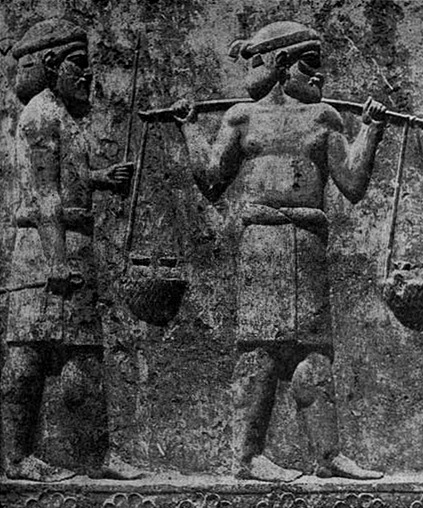
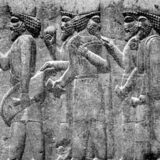
General appearance of an Indian Aryan, Persepolis
Some scholars considered the original abode of the Aryans to be Europe, and a group considered it Asia and in northern Siberia.
Archaeologists and geologists (whose findings and insights are the most authoritative basis for identifying the people of any region) are the most competent persons who can deliver more suitable and accurate statements regarding the state of affairs. For this reason, to become acquainted with the situation of the Aryans, we seek assistance from their views.
Most scholars call the Aryan migrants “Indo-European”. But Henry Field in his book “Anthropology of Iran”, under the title “List of Tribes and Racial Groups”, has written: the word Aryan is strictly applicable only to the Indo-Iranian group, “not Indo-European”.
Concerning the Aryans, the principal dispute was initially over the original point of migration of this people.
Some considered the original abode of the Aryans to be in Europe, and a group said it was in Asia (northern Siberia).
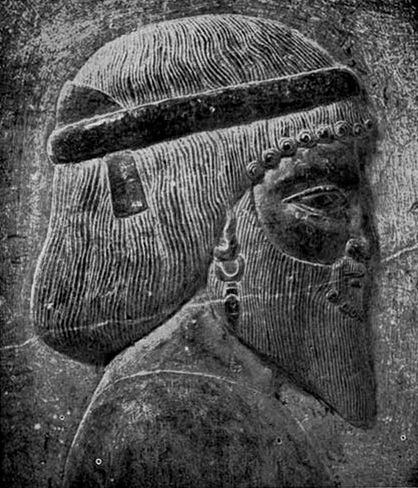
Example of an Indo-Aryan face, Bactrian, Persepolis
Now, most scholars, for certain reasons, consider the point of migration to be northern Siberia itself, and have completely set Europe aside.
Henry Field and Sykes, both citing scholars, state the original homeland of the Aryans to be the vast deserts of northern Khorasan and the plains of southern Russia.
And in the book “History of the Ancient Nations of Western Asia”, under the title “Origin of the Indo-European Peoples”, it is stated: that the existence of Indo-European dialects in certain parts of Chinese Turkestan (which persisted until the ninth and tenth centuries AD) has convinced some: that the center of the Indo-European peoples was in Chinese Turkestan or Russian Turkestan.
And the “Tocharian” dialects in “Turfan, and Qara Shahr, and Kucha” and the Eastern Iranian dialect in “Kashgar and Khotan” are specific to the remnants of these peoples (who remained in their original land).
This view, along with other evidence at hand, leaves no doubt for accepting that: the birthplace and original seat of the Aryans was Asia.
But on this subject: whether the migrants occupied the regions of India and Iran by way of Central Asia or the Caucasus, each has offered an opinion.
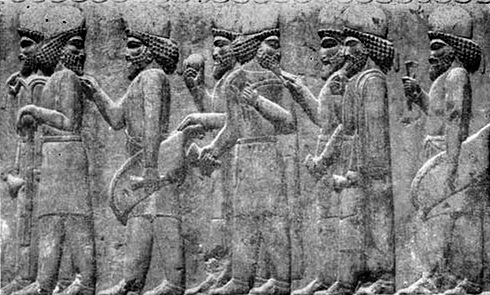
General appearance of the Aryan people “known as Median”, Persepolis
Richard N. Frye has written:
It appears that the Aryans came to the land of Mesopotamia by way of the eastern mountains. It is only not clear from which side of the north of the Iranian Plateau they entered there (by way of the Caucasus or Central Asia, or both), but it is probable that they came by way of Central Asia (The Heritage of Persia, page 37).
Regarding the cause and manner of the migration of the Aryans, in History of the Ancient Nations of Western Asia, citing scholars, it is stated:
That at the end of the Quaternary period, Siberia was separate from Europe. The means of this separation was the existence of the great Aral and Caspian lake, and the remnants of the Russian and Scandinavian glaciers, as well as the glaciers of Iran and the Altai.
As soon as the drying of the Aral and Caspian marshes and the melting of the glaciers of the Urals and the Hindu Kush began, and the climate of Siberia turned cold, these peoples set out on migration, and moved in groups toward Russia and the west, or toward Iran.
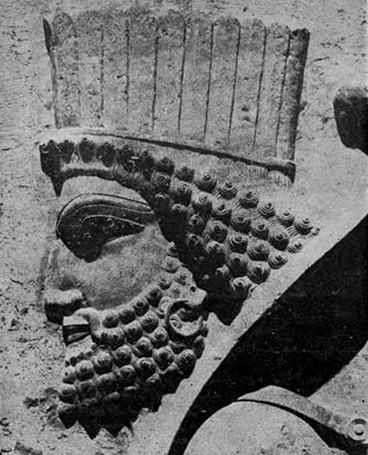
Example of an Aryan face from the Persian people, Persepolis
Sir Percy Sykes has given a comprehensive view and further information in this regard, under the title “The Original Land of the Aryans”, and written:
Among the questions that are the ground of great dispute is the location of the Aryan tribes (from where and from what point they departed).
And he has added:
It is obvious that natural indications and evidence exist for discovering this truth. This people, with certainty, inhabited a land that possessed a continental climate, and as is apparent, they had seen and had no more than two or three seasons.
It is evident from their language: that they were dwellers of plains, and had neither mountains nor forests.
This people possesses traditions that clarify the cause of their migration, and they say: the evil agent made their territory frozen and uninhabitable (perhaps the meaning of this statement is: that by reason of climatic change they were forced to change their location).
In their own particular traditions (Vendidad), they have referred to a lost abode (Airyana Vaeja).
And since, owing to the cold, they were forced to migrate from there, they went to “Sughdha” and “Mouru” (of which the former is now called “Bukhara” and the latter “Merv”).
Then, on account of locusts and enemies, they were forced to leave Sughdha and go to “Bakhdhi”, the country of lofty banners (Bakhdhi was later called Balkh).
And from Balkh they went to “Nisaya”, and from there to “Haroyu” (Herat) and “Vaekereta” (Kabul) (and this latter land they described as evil-shadowed).
Henry Field, citing “Wilson” Arnold Wilson, has written: that around two thousand years before Christ, the northern Aryan-speaking nomads (in eastern Russia) absorbed into themselves the original and indigenous inhabitants of the Iranian Plateau.
And citing “Herzfeld” Herzfeld, he has written: that the first Aryan group (who migrated) was the Indo-Aryans, and then the Iranians, and after them, the Scythians (who, after a brief period), entered the Iranian Plateau by way of the heights near “Sarakhs” in the direction of Herat.
And quoting “William Worrel”, he has written: that the Aryan invasion was from the northeast, and on account of drought and population increase, and they went from Iran to Mesopotamia. And this took place shortly after the year two thousand B.C. And after they had settled for a time in Turkestan and Iran, a branch (which is called Aryan) divided into two groups: one group remained in Iran, and the other group (the Indians) went to India and mixed with the “Dravidians”.
At approximately the same time, the Aryan chiefs of “Mitanni” established themselves in Armenia, and in the middle of the eighteenth century B.C., the Aryan “Kassite” dynasty captured Babylon.
Henry Field, regarding the time of the Indo-Iranian separation, has written: that until the year one thousand three hundred and fifty B.C., the Iranian and Indian elements of the Aryan people had not yet separated from one another (Anthropology of Iran, page 715).
Ghirshman has written: The event that appears significant in the history of Western Asia (during the second millennium B.C.) is the appearance of elements of Indo-European origin, who left their homeland (in all probability, the Eurasian plains, Eurasique, which are in southern Russia) under the pressure of other peoples, and in the course of migration, apparently divided into two large groups: the western and eastern groups.
The group that we call western skirted the Black Sea, and after crossing the Balkans and the Bosporus, penetrated into the interior of Asia Minor, and soon constituted the dominant and ruling element, and brought into being the confederation of the “Khatti or Hatti” Hittites.
The eastern group (which is known as Indo-Iranian) divided into two parts: one part of it moved toward the east of the Caspian Sea, and the other part set out toward the west of the Caspian.
The major portion of that part which took the east of the Caspian Sea gradually crossed Transoxiana and the Jayhun (the present Amu Darya), and after a short halt in the plain of Balkh, ascended the passes of the Hindu Kush, and followed the ancient road of the invaders toward India, and descended along “Pandi-shir” and the Kabul rivers.
The other part of the eastern branch (who took the route west of the Caspian Sea) crossed the Caucasus, and descended as far as the great bend of the Euphrates River.
These people (most of whom were apparently warriors) mixed with the native “Hurrians”, and formed the kingdom of “Mitanni”, and not only expanded their rule in northern Mesopotamia, but also restricted Assyria, and by annexing the valleys of the northern Zagros (the dwelling place of the Guti people) to their domain, consolidated their power.
The finest period of the kingdom of this people was around one thousand four hundred and fifty B.C.
From these very warrior horsemen, a group moved toward the southeast along the central folds of the Zagros mountains and encountered the lands of “Urartu, Mesopotamia, and Elam”. The peoples of these lands, for centuries (or thousands of years) prior, as a result of sedentary life, possessed an extensive culture.
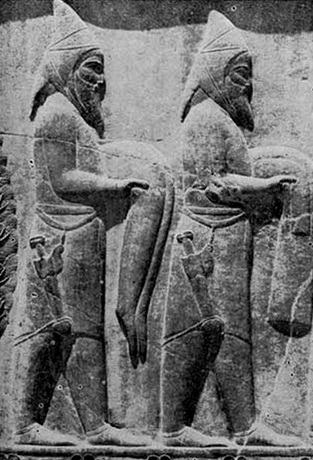
Example of the general appearance and face of a Scythian known as the Scythians with pointed caps from the northern peoples, Persepolis
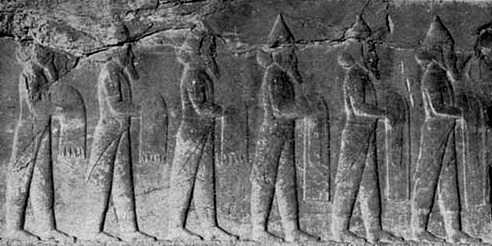
General appearance of the Sogdians
The Iranians, over the course of the following four centuries, absorbed the original native populace, and founded their own distinct civilization upon that aforementioned civilization (the neighboring culture).
Ghirshman has written: The penetration of the Iranians into the plateau, at the beginning of the first millennium B.C., was of a character different from the first invasion (a thousand years earlier): the invaders entered by force and in successive waves, and apparently traversed the same two previous routes (which they had traversed in the first invasion, “the Caucasus and Transoxiana”) this time as well.
The eastern branch of the Iranians, this time (the recent invasion), could not expand from Transoxiana toward the south of the Hindu Kush. For all the regions of “Arachosia and the Punjab” had previously been occupied by the earlier Indo-Iranians (the future Indians) in prior invasions. Hence they were obliged to move toward the west (the Iranian plateau) and along the natural road (which advanced from Balkh toward the heart of Iran).
Concerning the arrival of the last Iranian groups (the Medes), Percy Sykes, citing the opinion of scholars, has written: the belief is that the “Medes” migrated from southern Russia and took possession of the western part of the Iranian plateau.
The other branch of the last Iranian groups (the Persians) entered eastern Iran from the northern deserts of Khorasan, and having passed through the region of Kerman, made Fars their dwelling place.
Following the Persians, the Carmanians came and settled in Kerman.
The Drangians (or, Drangians or Zarangians) and the Arachosians remained in southern Afghanistan.
The Gedrosians settled in northern Baluchistan.
The Hyrcanians, in the rear of these groups, chose the region of Astarabad (the present Gorgan) for settlement.
In the opinion of de Morgan, the invasion of the Aryans into “Bactria” occurred two thousand five hundred years B.C., and the Medes people, around two thousand years B.C., turned toward northwestern Iran.