by
An article by Master Jalil Ziapour, titled “With Heydarian, We Came to Know Nature Once Again,” with the overline “Commemoration of Master Ali Mohammad Heydarian, the Renowned Painter, at the University of Tehran,” published in Ettela’at newspaper, “Visual Arts” section, No. 15496, page 17, Monday, 5 Dey 2536 of the Imperial calendar (1356; 26 December 1977).

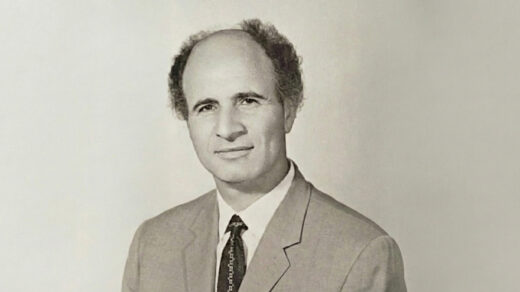
Master Ali Mohammad Heydarian, painter and student of Kamal-ol-Molk
With Heydarian, We Came to Know Nature Once Again
The commemoration ceremony for Ali Mohammad Heydarian, the famous Iranian painter, was held at the University of Tehran Club, and a group of professors of the University of Tehran and well-known artists of the country were present at this gathering.
First, Engineer Eshragh thanked Dr. Houshang Nahavandi, Dr. Motamedi and the professors and artists present at the meeting, who had gathered to honor the famous Iranian artist, and stated that Master Ali Mohammad Heydarian was unfortunately unable to attend this gathering because of the sudden death of his brother. He then asked Jalil Ziapour, painter and researcher, to read the text of his address on the characteristics of the works of Master Ali Mohammad Heydarian. Then Sadegh Barirani recounted a memory of the master, and at the end several slides of the master’s works were shown.
The commemoration of Master Heydarian is a tribute to a cultured professor of the university and an expression of gratitude to a man of art who has spent his life in the service of the art and culture of Iran.
Ziapour, who is himself a student of Master Heydarian, has spoken carefully in his article about the moral qualities and the characteristics of the works of his master, and you can read its text here.
Master Ali Mohammad Heydarian, may his life be long, is now in the eighty-first year of his life.
I came into the master’s presence from the time when the university’s Faculty of Fine Arts was established under the name of the College of Fine Arts at the Marvi School. We saw a figure of commanding presence, neatly dressed, with a dignified and serious face, who at the same time would speak, and we were thirsty for every word that would add to our awareness and help us in advancing our work.
During the few years that I was in his presence (whether at the Marvi School or at the university), I came to see that he was striving to familiarize our vision with nature, by which he himself was captivated.
From the tenor of his words it was clear that from the time of his youth he had been among the youngest of the few students of Kamal-ol-Molk and had been painting.
And from that same time, too, he had an understanding and a vision of the world of life and nature beyond the vision of the people of his time, and he traveled in a realm other than the realms we know. It is as if he belonged, and belongs, to another world, far from this desperate world. While speaking, with the utmost spiritual strength and self-mastery, he showed that he suffered from this turmoil of the lives of pitiable human beings.
Until the establishment of the College of Fine Arts and the move there, he had been one of the valued masters of the Kamal-ol-Molk School. Later, too, when he guided art students at the College of Fine Arts and then at the Faculty, with complete love, early in the morning of every appointed day, like a man of God and one charged with guidance (in every season, and regardless of wind and rain, age and circumstance), he would walk from Farhang Street (in Amiriyeh) to the university, and when he entered the studio he was met by the expectant gaze of the art students, who, knowingly or unknowingly, bowed in their hearts before their pure-hearted guide; and with a smile that spoke of his inner purity, he would greet each one with nobility, and with passion would sincerely offer, as guidance, what he had gathered over long years and with great hardship.
It was clear that he himself had an unequaled vision in his attention to nature, recognized the slightest shade of difference in color and knew how those colors were composed. Effortlessly, he would break down the compound color of nature and recompose it exactly, and he believed that “if the eye of the artist is trained, all the proportions of his work will also be right. But this work requires love, and the artist must be in love with his work and, on the path of art, make inner purity and love the source of progress.” He himself looked at nature with an eager eye and saw in it a thousand and one secrets and mysteries, and sought them too, and the outward appearances of nature, although they were a door to another world, seemed superficial in his eyes. For this reason, what he found made his work more delightful, more colorful and more captivating. In his eyes, bad did not exist. It was man who saw badly.
The master prepared each of his works with the utmost precision, sincerity, patience and delicacy, and with faithfulness and reverence. At those times when, following his personal taste, he intervened in nature and moved something as he wished, setting a tree, a branch or a bush from one place into another, he fitted them into so suitable a place, and so in harmony with their surroundings, that no thought of strangeness, misplacement or separation arose about them.
In the master’s works, features and effects are more alive; taste, touch, sight, hearing and smell are intensely perceptible. The bitter and sweet tastes, the murmur of running water and the scent of grass are felt. Mud walls and every other phenomenon reveal their own age, and the landscapes indicate the hours of the day. The clearness of the water seems clearer than it is, and the plants show how much they have benefited from moisture and damp.
The heaviness of heavy air and the lightness of thin air (with which one could eagerly fill one’s chest) are felt in his works. The degree of vitality of every being brought to life by the master’s hand does not appear less than it is; rather, he has observed and presented gratitude and esteem toward the Creator more vividly than it is.
The master has such intimacy and familiarity with all the elements of nature that between him and them there is no distinction of self and other; he regards life as continuing in all of them, and with an inquisitive gaze he lives in a secret harmony with all those elements. It is for this reason that his creations have a distinction greater and more eloquent than that of renowned and conventional painters of nature.
The master did not like fastidiousness, yet he believed, and believes, in the soundness of the work. He accepted simplification to the extent that it did not kill the intention or lead to inadequacy. In his works, strained effort to reach the goal is never to be seen. His coloring seemed immaterial, and like condensed space, his colors are vivid yet intangible.
Following the master’s work is very difficult even for veterans (let alone the newcomers of this age, who are grappling with a thousand and one troubles). For centuries pass before one who has given up life and wealth, tempered in the crucible of trial like Master Ali Mohammad Heydarian, succeeds in shining at the summit of artistic glory, and not everyone can travel this path to its end.
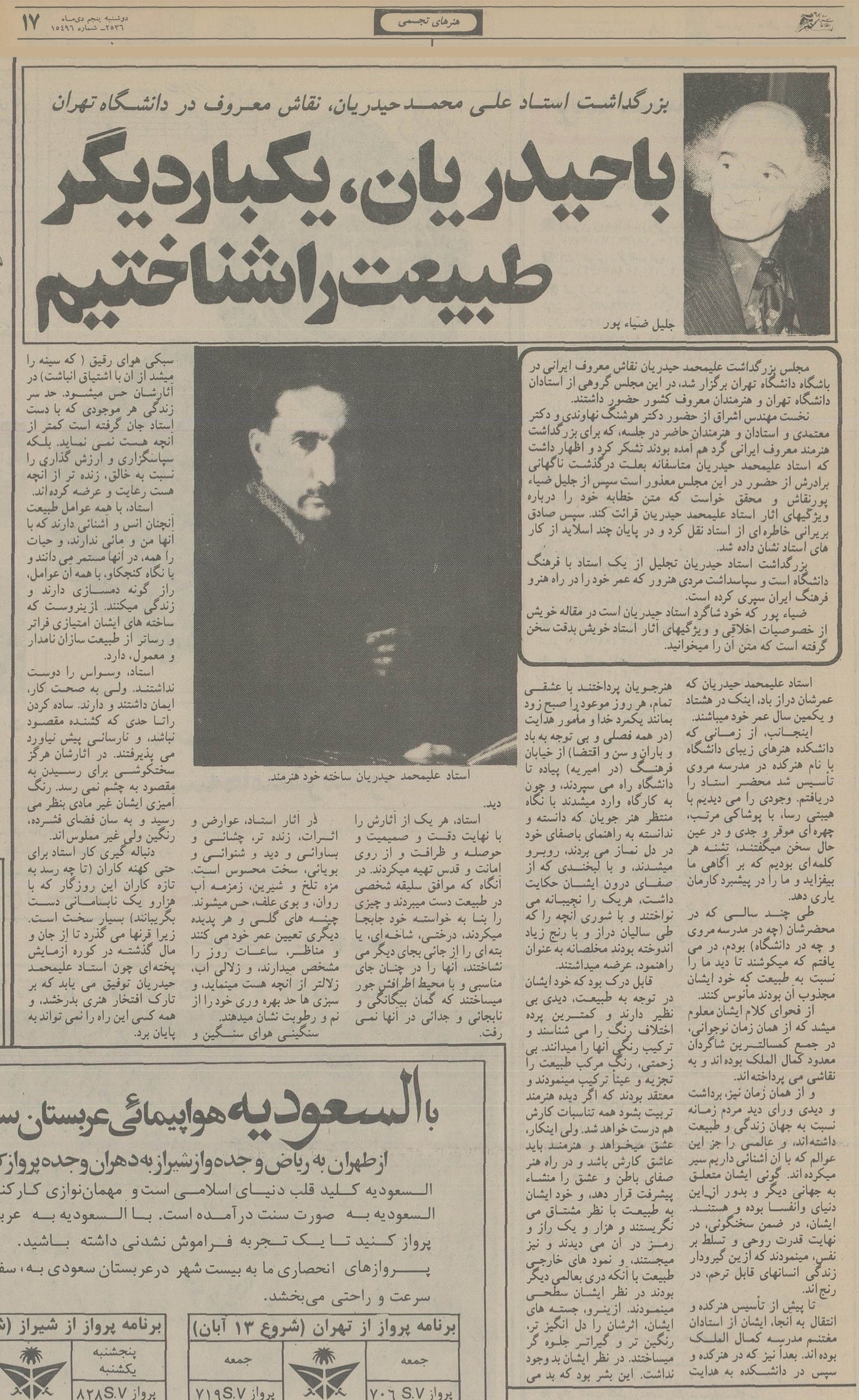
Master Jalil Ziapour’s article in Ettela’at newspaper, No. 15496, Monday, 5 Dey 2536 of the Imperial calendar (1356; 26 December 1977), p. 17