by
by An article by Master Jalil Ziapour, titled “Clothing and War Gear in the Shahnameh,” published in Honar va Mardom magazine, Nos. 153 and 154, pp. 69 to 73, July and August 1975.
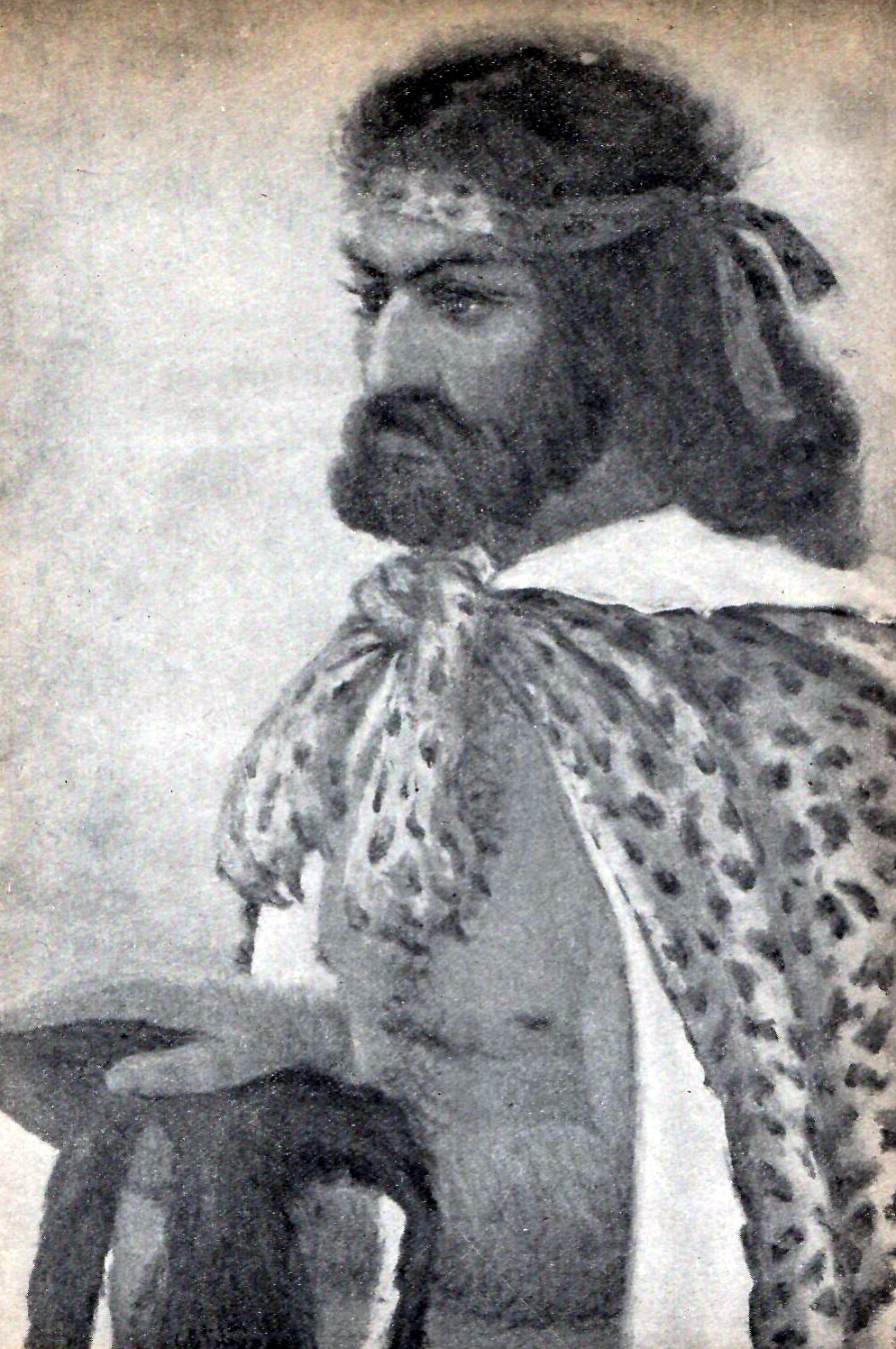
Portrait of Hushang Shah (prepared in the Art Research Department of the Ferdowsi Shahnameh Foundation)
Ferdowsi’s Shahnameh is another of the precious documents which, one may say, by itself reflects all aspects of the life of our people’s distant past, and in it every subject is spoken of, and nothing worth saying (of emotions and of the hows and whys) has been left out.
The zest and vitality of life are so embodied in it that, like the reliefs of Persepolis, it has relief and radiance; therefore, the materials for research in Ferdowsi’s Shahnameh are available in matchless abundance (of legends and realities).
However, like other matters of life described in the Shahnameh, the matter of clothing and war gear is worthy of reflection, examination, and comparison. For the implements described in it belong to the time of Ferdowsi or to his own near past.
Chroniclers contemporary with him, or those who several centuries before him have an account of some of the stories that appear in the Shahnameh, provide information on the basis of which one can consider the tools of the legendary and historical periods as one ought (to some extent).
The first figure of the Shahnameh is Kayumars, about whom Ferdowsi has written:
(Figure 1)
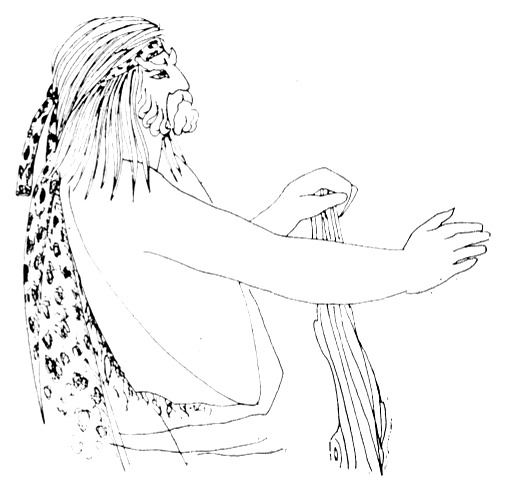
Figure 1
In this account, aside from the “leopard skin” (or the skin of other animals), which is the clothing of the cave-dwelling period, mention is made of “throne and crown”, by which, as a rule, his throne must be taken to be a slab of rock in the cave, and his crown as made of the skin of animals.
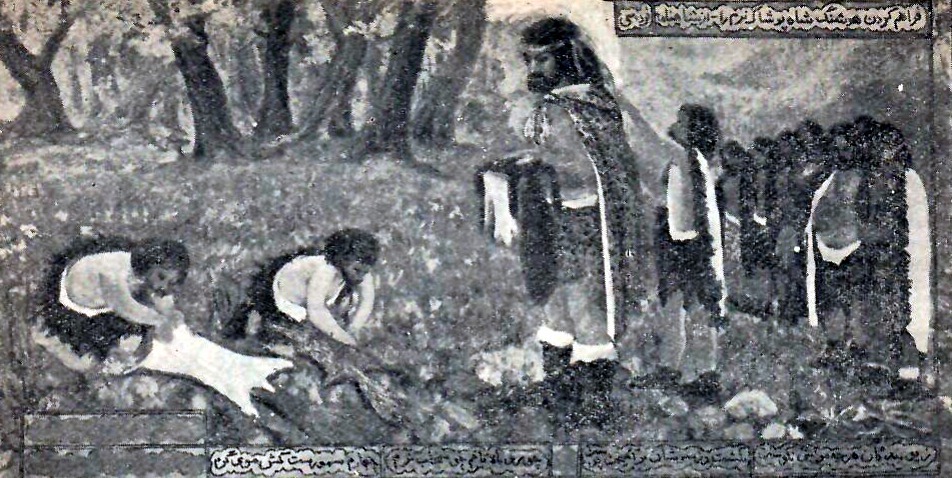
In the “Bundahishn”, an account of the clothing of the first humans and the manner in which they made use of nature from the Paleolithic period up to the time of the use of iron (and iron tools) appears thus: Hormazd said to Mashya and Mashyana: you are human beings. You are the father (and mother) of the people of the world. Both of them, when one thought about the other, first thought this: that the other was human. As their first act they did this: they walked forth. For thirty days their food was plants, and they slept on a bed of plants. After thirty days in the wilderness they came up to a white-haired goat, and with their mouths they sucked the milk of her udder. (Figure 2) Then after another thirty days and nights, they came to a sheep, black-colored and white-jawed. They slaughtered it, and from the konar (= sidr) tree and the boxwood tree, under the guidance of the spirits, they struck a fire. For those two trees are more fire-yielding. They also kindled the fire with their mouths, and first burned the firewood of kahanj (= hawthorn) as well as the olive tree and the konar and the branch of the date-palm, and roasted the sheep. First they covered themselves with a pelt garment. (Figure 3) Then they wove hair and thereafter “sarmak” (= perhaps “wool”), and covered themselves with that woven garment. They dug a pit in the ground and smelted iron, and beat it with stone and bone, and then made a blade from it and cut the tree with it and fashioned that wooden “padashkhwar” (= plate, bowl). (p. 94, from line 12, of Mehrdad Bahar’s book “Iranian Mythology”, quoting the “Bundahishn”).
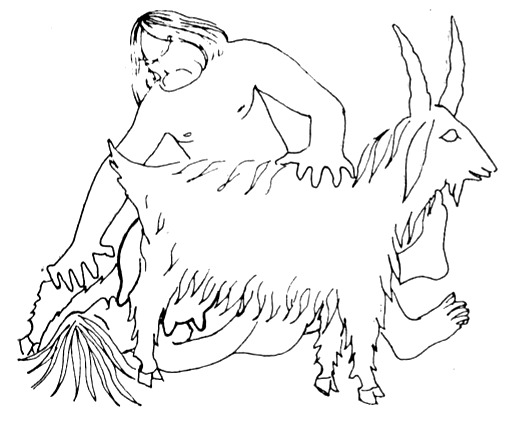
Figure 2
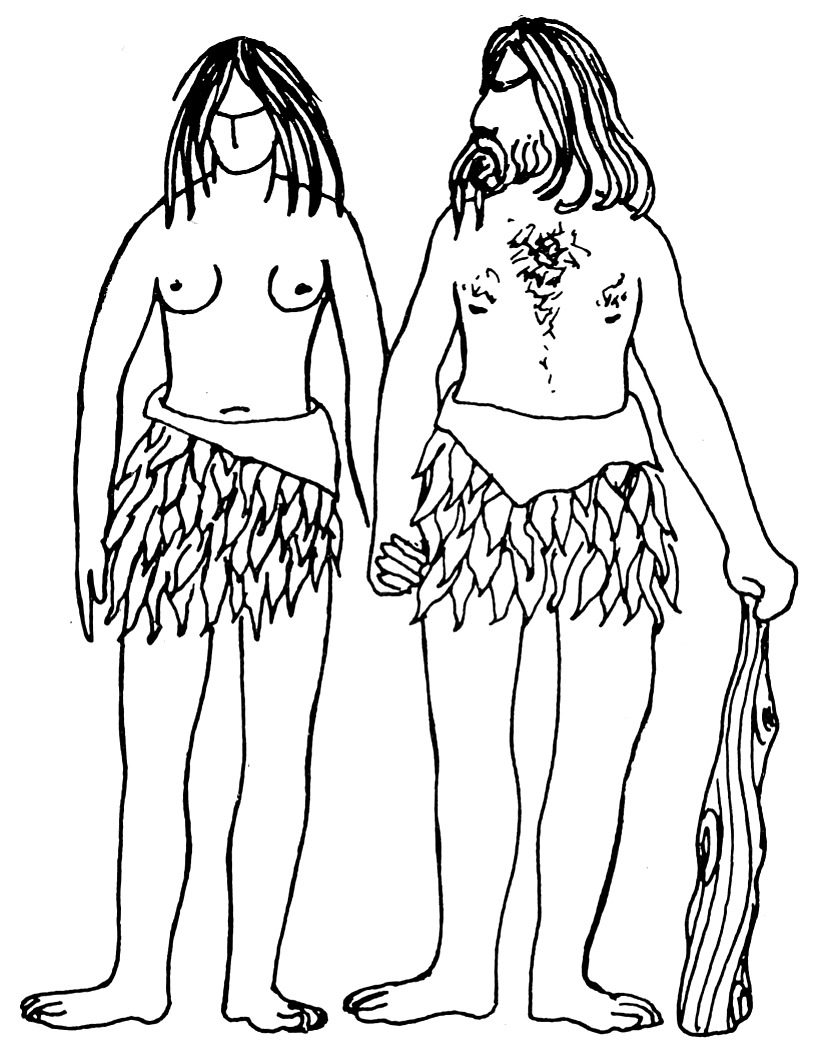
Figure 3
This account of the “Bundahishn” makes clear the use of skins and pelt garments by the Aryan Adam and Eve. Kayumars, according to the account of the “Avesta”, existed before these two; and these two, from the seed of Kayumars (which was in the earth for forty years and then grew up out of the earth in the form of two stalks of rivas “ribas” - like two humans joined to each other -), took the form of human beings and became the father and mother of the people of the world. (Figure 4).
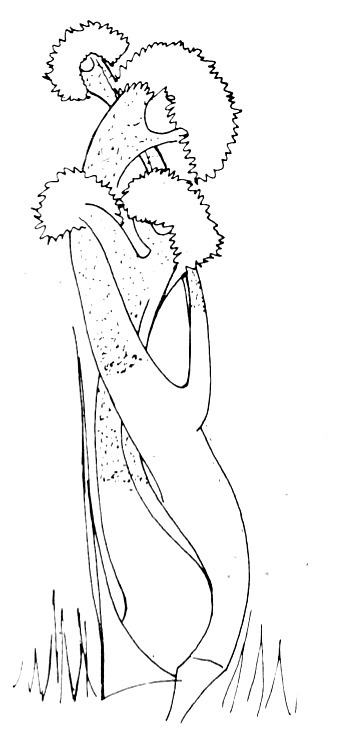
Figure 4, the two stalks of rivas
Ferdowsi has no account of the tools of ancient times (the time of the Kayumarsids). Only in the place where Hushang, to avenge the blood of his father Siamak (the son of Kayumars), goes in the company of his grandfather to war against the div Kharuzan, has he written: “He flayed him from head to foot, all into strips / The commander cut off that peerless head”, and here, the name of the tool with which Hushang severed the head of the div Kharuzan is not given, and it is not clear what sort of thing it was.
Bal’ami, who lived about a century before Ferdowsi, has an account on this same subject and has written: “Kayumars had raised an army, and Hushang had become aware of the manner in which they had killed his father; he brought forth iron [by wisdom] out of the mountain, likewise in his youth, and made weapons from it. He made a fearsome mahari, and made a shield, and made something in the manner of a knife, and he did that by divine inspiration, not from seeing and hearing” (p. 126, line 4 of Tarikh-e Bal’ami, edited by Malek o-Sho’ara Bahar).
Another painting of Hushang Shah - based on the research of the Art Research Department of the Ferdowsi Shahnameh Foundation
On the basis of the account of the Bundahishn as well, it has been stated that: “Mashya and Mashyana dug a pit in the ground and smelted iron and beat it with stone and bone”.
According to this account, the two tools of work and defense of the first Aryans (prior to the metal age) must have been “stone” and “bone”.
Bal’ami, in his history, in describing the tools of Kayumars, has recorded: “And his weapon was a big stick and a sling, and wherever he saw a div or a pari, he would rout it with stone and with that, and they would all flee”. (p. 114, line 6 of Tarikh-e Bal’ami, edited by Malek o-Sho’ara Bahar).
From this account one can know that the tools of work and defense of the Kayumarsids were “stone and bone, as well as the sling and the big stick” (or club).
Julien, in his book “Fossils of Stone Age Man” (in the section on toolmaking), has written: “From the time the hands were freed from the task of moving the body, they found the possibility of making and using tools. For a long time, man met his needs with pieces of wood and bone in their natural form. Later, the thought of cutting, carving, and shaping wood and bone sprouted in his brain. The simplest stone tools were river cobbles that man would break with a blow, creating a rough surface in them”.
John Pfeiffer, in his book “From Galaxies to Man” (in the section on prehistoric humans), considers the tool to be like a necessary additional organ.
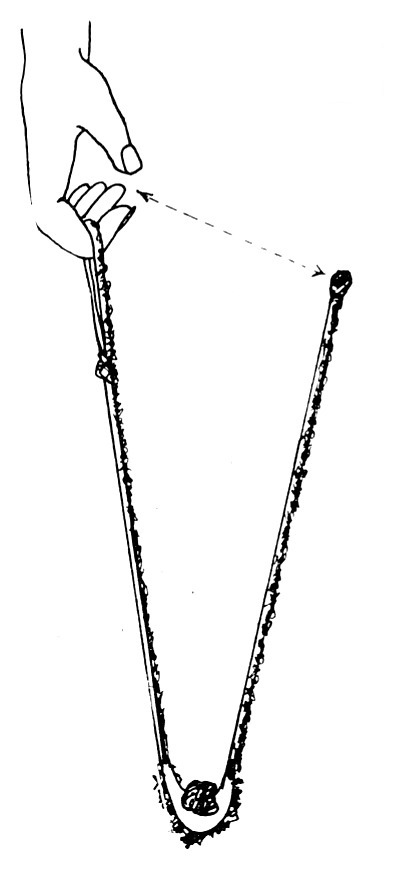
Figure 5, sling
Stone, bone and wood (or club) in the time of the Kayumarsids are three tools of the type of tools of primitive humans. The sling (a tool of which it has been said that “Kayumars had it”) was a tool of the long-range type, and as a rule, given the structure that it has, was a non-natural and invented tool, (a tool, in which the hand of man has intervened). This tool is composed of two cords and a pouch (of the soft bark and fiber of trees, and later of the skin of animals). To assemble this long-range tool, man certainly needed a period of relative evolution of consciousness and an adequate span of time (in order to reach up to this stage of invention), and it is evident that this tool could not have been invented in the time of Kayumars (who himself was on the one hand the first human being and also the seed of mankind). (Figure 5).
Jalil Ziapour, Ferdowsi Shahnameh Foundation