by
by This article was machine-translated from the original Persian and may contain inaccuracies.
An article by Jalil Ziapour, titled “An Outlook on the New Art of Iran,” published in “Art and Architecture” magazine, Issue 27, August 1975
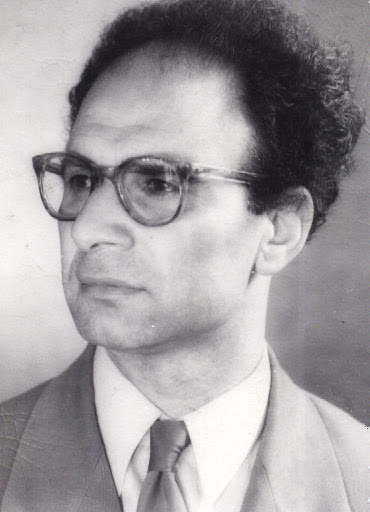
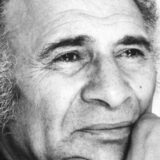
Master Jalil Ziapour, the Father of Modern Iranian Painting
The magazine “Art and Architecture” published, quoting me: “Following the events of life, new artistic forms appear, and various isms make the world of image-making a field of experimentation, and the immense transformations of today’s life do not leave individuals to themselves, free from thought, no matter how ordinary they may be.”
The art of image-making, which found its way into books during the Islamic period (and to which foreigners gave the name miniature), continued after its peak in the Gurkanid period (in the ninth century AH) until the end of the Safavid period. Then, as a result of contact with foreigners and encounter with their images, which had taken nature as their model, our artists also set to work making use of nature.
In past periods, nature was for our artists only a means and a pretext for expressing an intent, not the intent itself. Our artist took whatever he needed from nature and depicted it together with what his imagination added to nature. Therefore, in miniature painting, because our artist, in addition to using nature, also added something of his own imagination to it and did not content himself solely with the imitation of nature, the value of his works was superior to nature-making; and in this same manner, they would take a new path and set a newer style in motion.
Certainly, these artists also strived in their works to be as close to nature as necessary, and often they made images more expressively than nature. But because there are differences and technical conceptions (with distinct thinking) between decorative works and pictorial works, our artist, due to paying attention to the decorative style of his environment, was mostly subordinate to the decorative style and observed it in his image-making. (Such as the tile patterns on the walls of religious buildings and the patterns of carpets, which have natural shapes but in a simplified form).
These simplified shapes, which lack sufficient shading and consequently lack relief, assume a decorative aspect (the two common crafts, tile-patterning and carpet-patterning in our environment, possess these extraordinary decorative characteristics).
This characteristic exists in our miniatures as well; however, they also feature very delicate, thinly applied shading. For this reason, they convey to the mind a sense of distance from the shallow space of the story’s setting. The repetition in creating decorative works and the necessity of attending to two artistic crafts tied to the economy (carpets and tiles) had almost so closed the path of pure imitation of nature that our artist was obliged to devote his efforts solely to creating decorative works.
Although coloring followed a delicate path, and our artist addressed the content of legendary and epic themes (which occupied an important place in the life of our society), and his artistic faculties, through inspiration, sought to employ colors and designs for the better expression of the themes, how long could one continue on this path, weave oneself into oneself, and ignore the needs of the environment and the surrounding world?
Finally, in the late Safavid period, our artist was able to cast his eyes upon the outside world too, and became interested in striving to render nature as it is, and in fact (unfortunately) to imitate it and make a copy of it. Meanwhile, our other artist (the artist who had pursued the art of image-making outside of its connection to crafts such as carpet, tile, and textile patterning) did not abandon the path that had a greater commitment to the imitation of nature, and strived to depict themes in a natural form that would also enjoy the subtleties of decorative design and colors. This artist now paid less attention to the repetition of colors or shapes. He drew the images out from between the pages of books and added to their breadth. Yet these shapes and scenes were as if a magnifying glass had been placed over the shapes and scenes of the miniature, enlarging them with all their details. Although our artist strived to create relief and three-dimensional space on a flat (or two-dimensional) surface and engaged in creating strong shading, he could not accomplish it. Because he did not have sufficient practice in this work; certainly, no fault was directed at him (nor was it a matter of regret), because our artist had for centuries set his hand to creating decorative artworks and was familiar with them, and had not acquired the method of natural shading due to a lack of need for it.
Our artist, in using nature for image-making, had employed a higher artistic consciousness and utilized nature only as a means. Therefore, he did not bind himself to the restrictions of nature-making, and had understood that pure nature was not capable of clarifying his desires, except for some of them. (Precisely contrary to the artists who showed eagerness for nature-making or the imitation of nature.)
In the era of Shah Safi, an artist named Mir Afzal Tuni and another image-maker, known as Sadeq Mosavvar, produced works following nature, and in this way, the style of image-making gained life and continued.
The works of foreigners, which possessed natural forms and the necessary techniques of shading and the calculation of distance and nearness, were themselves another model that enthralled our image-makers in their effort to gain complete access to the realm of pure nature-making. For this reason, our bold artists altered the traditional work. Of course, they did not abandon flower-and-plant depiction and gilding. They also sometimes covered the sky with gold so that it might speak of a golden sky. They used autumnal, mountain-like clouds in place of Chinese “tashis” (clouds made in the manner of Chinese nature-making artists), and the summits of mountains, which had always been treated with the effort to ornament them with stone wonders and the heads of beasts and to make them a land of wonders, were now treated with the effort to depict them without subjective additions (only with objective and real appearances). Thus, each work was inspired by the two grounds of nature and the use of tradition (a so-called mixture of old and new); and our artists, as a result of great attention to proportioning, were compelled to create exact likenesses, and remained distant from other artistic characteristics which at one time were considered the very basis of craft and art and to which they never failed to attend.
At this very time, foreign artists had brought nature-making to an end and had turned their attention to deeper points, and they resorted to natural form-making only for the purpose of expressing intents, and gradually, like our former artists, they came to recognize nature as a means of expression rather than the main goal, and abandoned nature-making, pursuing this purpose of theirs in various ways. But from the moment our artists’ eyes became familiar with the foreigners’ style of nature-making and imitation of nature, and their skill in nature-making was deemed remarkable, they no longer thought about the value of their own past work, and turned their backs on the time when they had made nature merely a means for expressing intent (which the foreigners were now newly realizing the importance of and pursuing), and became diligent in imitating nature. From then on (from the Afsharid, Zand, and Qajar periods), image-making in larger pieces, imitating nature as much as possible, and also using the traditional method (decorations and gilding in more spacious dimensions), became customary. But alongside these kinds of works, other artists (up to the time of Kamal-ol-Molk) brought themselves closer to pure nature-making and its exact, item-for-item imitation; furthermore, another group of artists did not abandon miniature painting in those same traditional pieces, and still followed the style of the Safavid period and earlier. (It is obvious that this style, and other styles of continuing the miniature according to past methods, and image-making in the fields of miniature and nature together, in larger pieces, and nature-making and its exact, item-for-item imitation like color photography – none was in accord with sound artistic thought.)
Of the three existing and customary styles among our artists, two styles – which were “the inclination toward nature plus traditional art” and the other, “the continuation of old miniatures” – had a greater presence up to the time of Kamal-ol-Molk, and also up to our time (with the utmost weakness), and nature-making had still not arrived anywhere.
Kamal-ol-Molk and his students strived greatly along this path, but the world of nature-making at its origin had for some time become otherwise, and new forms (far from the ordinary forms of nature) had emerged, and many “isms” had made the world of image-making a field of experiment and practice.
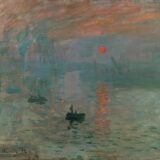
With the establishment of the Faculty of Fine Arts at the University of Tehran (which, in contrast to Kamal-ol-Molk’s art school, engaged in the style of Impressionism), and with scientific acquaintance with the new ideas and styles of foreigners, a transformation appeared, and it became necessary that, taking into account new molds (for expressing new ideas) and while casting a glance at the authenticity of past Iranian art, a movement should arise for presenting new paths.
The immense transformations of today’s life do not leave individuals to themselves, free from thought, no matter how ordinary they may be; and it is evident that highly impressionable artists do not let a moment pass without being affected. For this reason, whether they wish it or not, they will recount the inner fluctuations and the thoughts born of events. It is following these circumstances that new artistic forms appear among any people.
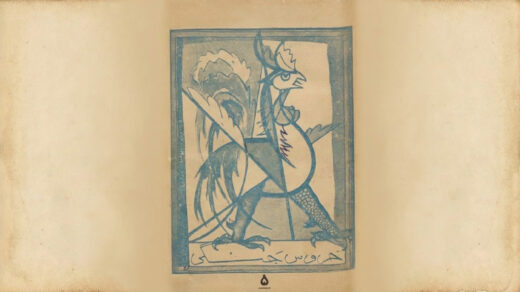
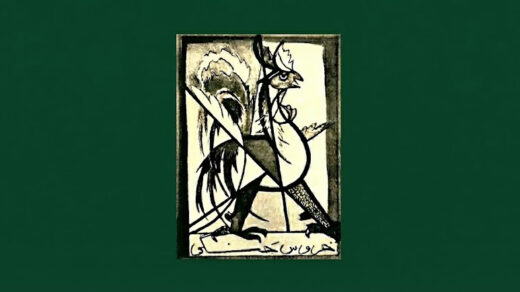
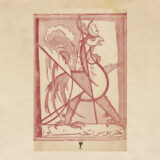
In our country too, new styles made inroads. From the year 1948, and over fifteen years and more of the Fighting Cocks (Khorus Jangi)’ struggle against fanatical traditionalists, and the delivery of lectures and publication of magazines such as “The Fighting Cock,” “Desert,” and “The Cock’s Claw (Panjeh-ye Khorus),” and friendly encounters (as well as hard striving against opponents unfamiliar with the art world), and with the help of the newspapers and media of the capital, new art, that is, (the true principle and goal of new art) took root. The modernists set to work, and the traditionalists, along with their customary styles, gradually departed.
The putting forward of the controversial style of Cubism as a demand for the new was because this style, on the one hand, was geometric in the form of traditional patterns (such as carpet, tile, and fabric patterns), and in fact, still carried broken, truncated forms of nature with it; and on the other hand, it was indifferent to pure nature; and furthermore, it seemed close and familiar to the existing artistic elements among our people. Thus, this style, in principle and probably, appeared more acceptable. (Especially since it also had the advantage that, with its own particular design, it was also reflective of the mechanized life of our present age.) But this style, despite all its advantages and all its closeness to the styles existing in Iran (styles in which our artists had had centuries of practice and with which they were familiar), was not acceptable to those who, because of their infatuation with nature, did not want to forget past styles. But modernists and enlightened publishers and thinkers aided this movement and gave it strength; and during this period some artists found new and acceptable paths on the basis of the authentic styles of the past, and established the connection between the old world and the new; and others too, by presenting so-called “modernist” works and ideas, displayed themselves and feigned modernism, and still do so, and this does not seem unlikely. For in every movement there are extravagances and improprieties.