by
by The article by Jalil Ziapour, titled “Let Us Criticize Correctly” (regarding the paintings of Javad Hamidi and his critic), published in Shahsavar Weekly, No. 1, Monday, 25 September 1950

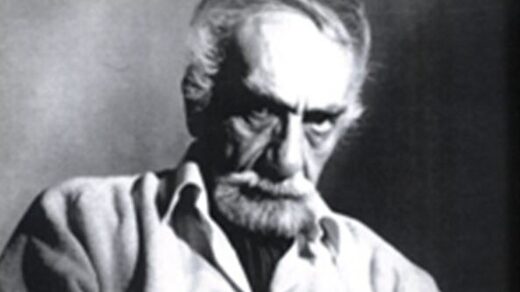
Master Javad Hamidi, one of the pioneers of contemporary Iranian painting
It is truly strange that a number of our youth resort to all kinds of tricks and flattery to show off and flaunt their incomplete knowledge! During all this time that Cubist painting has become current, all kinds of people have come to me for a more precise understanding of the matter. Of this group, one faction truly desired to understand, and fortunately, with the sufficient favorable background they had ready, they grasped as they should the purpose of this method of painting and its special beauty, and set out in harmony and progress with me. Another group made conservative displays, and yet another group turned to negativity. The conservative group, in gatherings where progressive artists and people of taste were present, pretended to understand modern art, Cubist painting, and the like (solely so that they would not be rejected by the progressive, intellectual, and pioneering group)! This same group, in another place, joins groups of their own level or lower, and engages in mockery and slander. The negative group basically did not and do not believe in any forward or backward progression for art, and called those same backward arts eternal art. My address is only to the second group, namely the pretentious youth who wish to make themselves noticed by any means; these are opportunistic, sycophantic people who, as I said, stop at nothing. They memorize word for word from the mouths of this and that person and deliver it to others under their own name, and if these very individuals have pretensions of showing off beyond what their capacity warrants, and engage in displays that end up detrimental to rightful persons, it is obvious that the matter must not be left unaddressed, but rather the reality and truth must be clearly revealed.
A while ago, Messrs. Hamidi and Engineer Aghiqi, who had found their way into the current of modern art, displayed some paintings at Apadana. For a time, these paintings were on display at Apadana. No one from the media of ‘our betters’ went to see them, and the newspapers wrote nothing about this. Peyk-e Solh, too, which would rear its head during painting exhibitions and fill its pages with pictures of vulgar and populist paintings, holding forth and fashioning undeserved favorites, remained silent here! Iran-e Ma, which has an art column, did not make a sound! A few others, who would write at least a few words on this subject if they could, did not utter a word! In the midst of this, only Mehregan wrote an article in its 17th issue (second year), which was a matter of regret. Because the existence of such articles destroys the spiritual value of the newspaper in the eyes of art experts and causes regret. Although I must congratulate the staff of Mehregan newspaper for the interesting article they published on Cézanne’s life, in return, I reproach them for publishing the article concerning Hamidi. For they entrusted the critique of Hamidi’s work to Ms. Fakhri Nazemi, who is not versed in this field, and this lady, in the said commissioned article, opted for people-pleasing and showed a ridiculous bias in favor of Hamidi, which was unbecoming.
Of course, for many reasons and considerations, such an appearance by a lady was forgivable; but since this article went to extremes in speaking out of place, I consequently found myself compelled to make some points of reminder.
Truly, why do people who do not have the necessary background for analyzing and explaining a subject undertake criticism? What do they think? That expressing an opinion and criticizing is an easy task? And does not require sufficient substance? Where does a graduate in physics and chemistry, who deals with retorts, alembics, and stone plates in the laboratory, find the opportunity – like an expert and researcher in painting, in literature, in cinema, and theater – to attain artistic secrets? How does someone who does not possess sufficient knowledge of the rights and laws of property and economic conditions, as they should ‘like a specialist,’ allow themselves to translate a book on property? (Like that inexperienced youth who has absolutely no knowledge of art history and has not trodden that path, yet translates Louis Hourticq’s book on sculpture from the publications series of I-don’t-know-what, and due to a lack of mastery of the two languages and unfamiliarity with artistic circumstances, contents himself with incomprehensible and literal expressions, and…) You who are not versed in specialized matters (not general matters), why do you fundamentally interfere in matters that do not concern you and enter into details from a technical standpoint? For example, one must ask the aforementioned female critic: what need is there, without sufficient knowledge of art, to undertake writing art criticism in painting, and even go a step further and express opinions about theater, cinema, and directors as well? You, who do not have that much of a favorable background to explain painting and perforce publish my article under your own name as “Death of a Friend in a Distant Land” in Mehregan, Issue 6, Year Two, without even mentioning that this article is adapted from the views of so-and-so, why do you not stick to your own specialized work? You who talk of being a friend of society and this and that, and beat your breast for sympathy and cooperation to secure rights and avoid exploitation more strongly than others, and imagine yourself an encourager of artists and those possessing taste and enthusiasm, why then did you claim the fruit of my labors in your own name? (Of course, I know that not mentioning these matters would subtract nothing from me, and I could have let them pass and ignored them, as I had indeed passed over and ignored them. But the lady’s second transgression compelled me to draw the public’s attention to such treacherous displays and the self-ingratiation of individuals who seek to make themselves undeservedly favored in these ways). I know that no blame lies with her; in a country where everyone is a jack-of-all-trades and no one observes ethics, boundaries, and their own duty, why should not everyone be a critic? Undoubtedly, it is this very situation and this very attitude that has emboldened a number of substanceless show-offs to interfere to this extent in matters that do not concern them.
The point to mention about her article is that contradictions exist in several instances. Inevitably, these must be recalled so that the weakness of the critique becomes apparent in people’s eyes. She has written:
“In the paintings rendered in the style of Cubism, an influence of a pessimistic mindset is observed. The lack of a main subject and a clear goal is among the obvious defects of Hamidi’s works in the style of Cubism.”
We know that as soon as a pessimistic mindset or any other thought is felt in a work of painting, this is itself proof of the existence of a main subject. Therefore, saying that Hamidi’s painting lacks a main subject while at the same time conveying a feeling of pessimism is exactly the case of the beardless man with a broad beard, and thus the groundlessness of the matter is clearly evident.
Following this, she has written: “But setting this point aside, these paintings have another color; a beautiful and poetic color, a color that rivets the gaze to its place, and the heart never tires of beholding it. These paintings are a sign of sufficient study and exploration in new painting styles. The designs and deformations are very harmonious and calculated, and are a sign of the painter’s power and mastery of his craft. What is more interesting than that is the novelty-seeking observed in finding color and its harmony. Hamidi’s colors are unique to himself and have no precedent in the works of any of our painters so far. His colors are the colors of Picasso, and some of his paintings are considered a genuine and wise imitation of Picasso’s works.”
If all this praise has been applied to Hamidi’s works in coloring, harmony, deformation, mastery, and skill (especially novelty-seeking), and if even Hamidi’s colors are unique to himself and have had no precedent in the works of any of our painters so far, I do not know, with all this unprecedentedness, skill, and mastery, how Hamidi’s colors become Picasso’s colors, and how some of his paintings are even considered a genuine and wise imitation of Picasso’s works?! I do not know what kind of explanation one should call such explanations. Someone for whom they acknowledge so much character, skill, technical power, and artistic consciousness, and then, from the standpoint of coloring – “which coloring itself is in fact all of painting” – they present as an imitator of Picasso? Does writing criticism in this manner not prove that either the writer has mocked Hamidi, or, without realizing it herself, has shown her own lack of knowledge regarding the nature of art?