by
by Article by Master Jalil Ziapour, titled “Painting”, published in Fighting Cock (Khorus Jangi) Magazine, Issue 3, pp. 13 to 18, year 1948

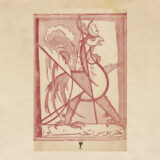
Master Jalil Ziapour, cover design of Fighting Cock Magazine (Issue 3), year 1948
Painting
It is true that the Impressionist school, with the step it took in coloring, created a great revolution in the world of painting, yet with this advance and the creation of new color, it was never able to soothe the artist’s thirst and turbulent spirit as it should, and to manifest what he had to say and his desires more explicitly. In the Academic school, where the painter for many years had clung firmly to easels at the foot of paintings, constantly shifting his eyes in turn from the canvas to nature and from nature to the canvas, observing design, color, and light in a vexing manner, and, without the intervention of strong feeling and knowledge, depicting hair by hair whatever he saw – all this blind compliance of the painter with the outer appearance of nature was enough to become the motive for a sharp rebellion. For this reason, the Impressionists, thirsty and weary of the working method and mindset of the Academics, like iconoclasts who have grown weary of the intellectual stagnation and continuous dullness of idolaters, overturned the foundation of everything academic and established the method of work upon a newer path. The beginning of this reaction undoubtedly had the character of rebellion and destruction; solely because an end had to be put to this manner of thinking and working. It was from here that rapid brushstrokes begin, and for a time, canvases become the field of careless wandering and the rampaging of rapid brushstrokes, nervous displays of power, and rich applications of color. Gradually, however, this school finally achieves its stability, and that agitation and nervousness “which had seized it from the Academic” subsides, and working in this school, with the help of physics and greater knowledge about painting, settles upon a correct formula and a firm conviction. Nonetheless, the negligence of this school in some artistic principles was not so minor that their repair could be achieved so easily; due to the existence of a revolutionary and turbulent environment prior to the past war in Europe, which was preparing the ground for the world war, and both to resolve the Impressionists’ carelessness in drawing, and because their cheerful style of coloring did not correspond with the agitated and mechanized mindsets of the artists of that era, a need arises for a more expressive and dialectical language that would correspond with the spirits of its time. For this reason, in the year nineteen hundred and eight, the school of Cubism advances in parallel with Fauvism. This school becomes specific to those who possessed fiercer and harsher feelings, and a more passionate and searching mind. The school of Cubism, which had arisen from the working method of two great figures of the Impressionist school named Seurat SeuraT and Cézanne, initially begins its activity through the Frenchman Braque and the Spaniard Picasso. “Roger de La Fresnaye” Roger de la frenaye, who was one of Braque’s friends and walked in the same territory with him, dies immediately after the war of nineteen hundred and fourteen. From his works that remain, it appears that: La Fresnaye wished to render all the objects around him geometric, that is, into spherical shapes, pyramids, parallel lines and planes, and to simplify nature as much as possible, and at the same time in such a way that the utmost power and will would be manifested in his works by means of these very shapes, lines, and planes. The French Cubists set to work out of natural instinct and the need to continue the experiments of the Impressionist painters, and deemed it necessary to cast them into the mold of plastic designs. “For Seurat and Cézanne, darkness and light were two good pretexts for placing these two colors (that is, darkness and light) slightly over each other or beside each other.” For others, too, it was from here that the idea of constructing the objects of nature simply (after years during which painting lived under the minute details of the Classicists, Academics, Impressionists, Pointillists, “and other -ists”) arose, and it was from these stages that this manner of working becomes the source of a great effect for the Cubists.
Later, the Cubists, in addition to simplifying the general and external appearance of objects, also set about simplifying their internal parts. Of course, constructing and simplifying the internal and external parts of the objects of nature was not without difficulty; furthermore, in truth it began working like the Academic school: in the sense that if the Academic constructed every small piece gently and with a slackened chiaroscuro, here Cubism turned those same things into geometric shapes and corners. Despite this, this act in any case had the grace that at least, instead of the confused mingling of the colors of nature into one another, whose limits and identity were not properly specified, here they become specified and determined. Colors no longer dissolve into one another and do not mysteriously sink from light into darkness; rather, each color, with its own definite identity, places itself beside another. The indifference of the Impressionists and Pointillists was not so slight that it would not leave behind a severe reaction in its future. It was for this reason that it caused the Cubists, in order to vent their resentment at all those indifferences, to draw the firm ramparts of designs all around each determined color so that the function of each would be specified. These very divisions and the analyzing of the simplest form of objects cause innumerable planes to be colored, and as a result the art of coloring advances more than ever by continuing the Impressionists’ experiments in color. And it is at this moment that the subject of passage Passage comes in. Passage, which played an important role in the previous school; this passage, that is, something of which in Classical and Academic paintings no example is clearly understood or seen; this same passage, which was fundamentally a great secret and in truth was like the old Egyptian knowledge that was told only to a small number who had the capacity to understand the matter, and whose existence no teacher except a great master could ever perceive, here becomes manifest and emerges from the veil of mysteries. This same passage, after its explicit manifestation in the Cubist school, “which had awakened the need for it in the beginner Cubists,” removes this defect, that is, “the coming over each other or beside each other of two contrasting colors without an intermediary.” (Of course, according to the Academics and the conservative Cubists, whose roots had neither yet been completely torn away from the past “for the most part,” nor had they yet completely entered the field of Cubism.) The absence of passage in painting no longer causes the eye to rest upon colors and planes only in a single moment; rather, its presence causes the eye to move gently through all points of a canvas. And by this means it became possible for the eye to go from one color to another color and from one plane to another plane, from one corner to another corner of a canvas. The eye could once again continue its ordinary movement and glide, in any case as usual. Since the conservative Cubists could not completely let go of the past, passage, this bridge of salvation, therefore becomes for them a heavenly manna and a sedative for their trembling hearts and scattered thoughts. And again, at least it makes them travel through poetic and heavenly realms. This was why they would say with interest and ardor, “If these passages do not exist, the works are superficial and without depth!” For example, André Lhote A. lhote says at this very time: by driving the combinations and compositions of designs, planes, and colors toward dry geometric lines and planes, without bringing these passages into play, it is never possible to perceive the grace of the airs surrounding the objects of nature. Despite this, the very presence of these passages finally made the conservative artists accept the rightness of Cubism. They had well understood that Cubism was a more complete and more necessary school than the other schools, but they had no pretext in hand that would hurl them entirely to this side. When they saw that now all the laws of the past schools exist powerfully in Cubism and that it lacks nothing from the past, they accepted it with ardor. (Gauguin used to say: a thousand grams of green color scattered in different places of a canvas naturally has a greater effect than ten grams of that same color in one place. Van Gogh, unlike Gauguin, collected the totality of one color scattered in the canvas and placed it in a broad field, and with this work showed that the existence of a thousand grams of one color in a wide field, provided that it is within one enclosure, certainly has a greater effect than a thousand grams of that same color spread throughout a canvas.) And by this very path he opens a newer road for the pioneers of art and brings the school of Fauvism into being, and Fauvism too gives effective help to the advancement of Cubism. And finally the intervention of the mind and calculation causes the emergence of order, arrangement, and precision in painting, and a new technique comes into being and gives the artist complete freedom. Since the subject of deformation Déformer, changing form, had arisen, and at that time this act was a transgression against the rightful rights of the honor of nature, the conservative pioneers could not accept deformed nature. Van Gogh and Matisse, or better said master and pupil; “Matisse, having come under the influence of Van Gogh’s works, made abundant use of him,” showed through their works that even without much intervention and alteration, pleasing beauties and proportions can be created. That is, despite all the feeling for advancement and innovation they possessed, they still could not renounce the past and the proportions and moderation and so forth and so forth to which they had long been accustomed, and step into the circle of Cubism and its demands. “Although Matisse, as is evident from some of his works, shows that from time to time, by way of study and as an example, he tried to show a work in the Cubist style, it is quite apparent that his claws seem to have been bound in lead and that he does not have the power to tear them away and move them.” But the Cubists brought audacity to the point where they finally were able to carry the work beyond the bounds of rules, laws, proportions, and conventional and conservative pleasantnesses, and seriously to consider a greater freedom within the limits and forms of nature, and instead of separating colors and placing them beside one another without exaggeration in form and movements “which became more like chessboard squares and deprived painting of the salt and sweetness of the work,” they demanded the complete deformation of nature as far as their feeling permitted. That is, in the form of a small object in relation to itself, and also in its general tonality throughout the whole canvas, life, tumult, and movement were observed more than before. By this means the reins of choice are completely taken from the hands of the moderate and cautious Cubists. Here, rhythms and states come into being that soothe the tireless curiosity of a relatively large number. And finally they leave open for painters the path to showing the secrets of nature and the spirit of life. Especially when the life of intellectual beings comes into question, the miracle of abstract “ambiguous” Cubist painting Abstrait begins. And by means of it, the painter, with a clearer and more eloquent expression, begins to explain his inner events and feelings. The painter no longer paints everything that exists and is seen in nature in an ordinary manner in that same ordinary way. And he is also repelled by whatever exists in nature as pure fantasy and fantasy-weaving, or by explanations that the writer, not the painter, must be capable of undertaking. For the Cubist seriously considers himself obliged to observe the truth of nature, and personal nature however he feels it, in any case with regard for the principles of specialization. Cubism comes forward more truthful, more expressive, and more possessed of truth than deceptive truths and appearances. And if an absolute truth exists in nature, Cubism remains more faithful and more trustworthy in observing it than the other schools.
Ingres ingre, who is an older instrument and source of influence for Cubism than Cézanne and Seurat, points to the necessity of considering drawing and probity in art and says: “le dessin et la probité de L’art” The past schools more or less, and incompletely, taught this trustworthiness to the artist, but Cubism entrusts it to a curious artist more completely and sooner than any other school, and sooner saves him from the thirst-provoking and false mirage. Cubism brings into being a fantasy that deals with the material truth of bitter and sweet, passionate and ardent life. This kind of fantasy is given to a person by nature created by the artist’s hand, not by unmade and ordinary nature. It is for this reason that Braque says: a canvas must be a living and exciting machine. “un Tadleau est une machine à emouvoir” Cubism never appears from behind the eyes of people who see nature conventionally, but manifests itself through the aperture of eyes that are precise, sensitive, truth-seeing, or, to put it plainly, hidden-seeing; that is, it makes appearances the means of finding a path to what is hidden. Cubism is both fantasy and material: it is fantasy because it speaks of thoughts, feelings, and imaginations explicitly and pleasingly. It is material because the colors and designs tell of a material world and of life and will and effort. Cubism assigns to a small object of nature the same value that a materialist philosopher assigns to it. In the eyes of Cubism there is no ordinary peace and well-being, nor any simple-minded honesty and correctness. Cubism provokes nature so much and changes its form so much that finally it comes to know the essence and truth of its existence and explains it in a complete and expressive manner. Cubism pushes this false mask and outward form away from the face of nature and shows its true shape. Cubism looks upon the world and its essence with suspicion and always sees nature as an old-hand, deceitful, and at the same time wretched and pitiable clown; it is at this moment that the Cubist embodies its image and lifts the veil from the spirit of life. In order to embody, Cubism makes that which is thus even more thus; that is, it exaggerates, diminishes, eliminates, so that what it wishes to say may be better said. This is why “Lhote,” the great theoretician of Europe, the very person who used to say: driving dry geometric lines and planes to a place where, if passage is not observed in it, the grace of the air surrounding the objects of nature is not shown to us, “although he himself has not completely abandoned this belief,” but we do not know what happened?! that here at least he gives up a little on the airs surrounding the objects of nature and says:
Exagerer, Diminuer, Supprimer, sont les Trois operation que L’Artiste doit constamment pratiquer.
Painting – by Ziapour