by
by The text of a lecture by Master Jalil Ziapour at the Fighting Cock (Khorus Jangi) Art Association; published in “Andisheh va Honar” magazine (Issue 7), year 1955
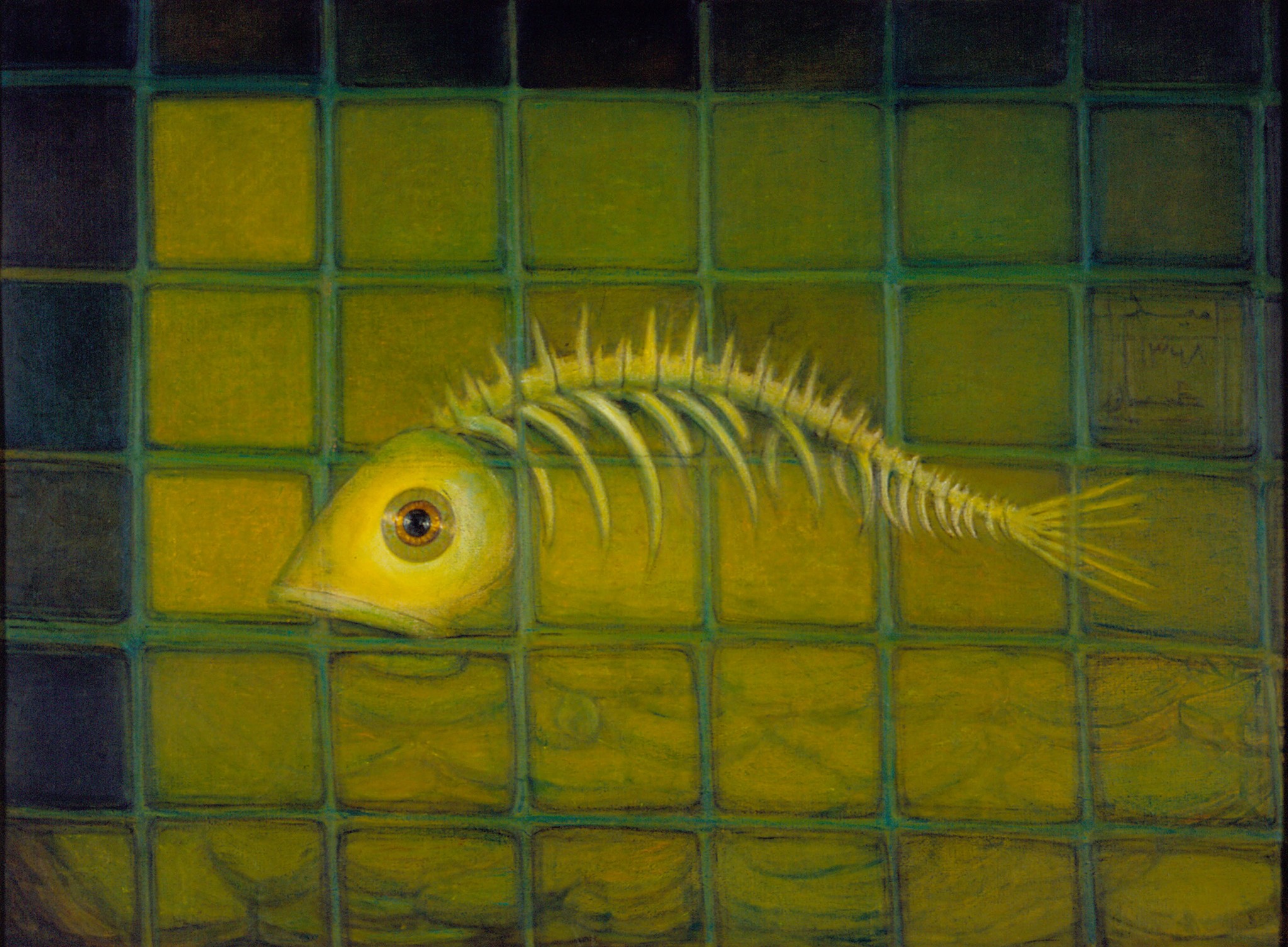
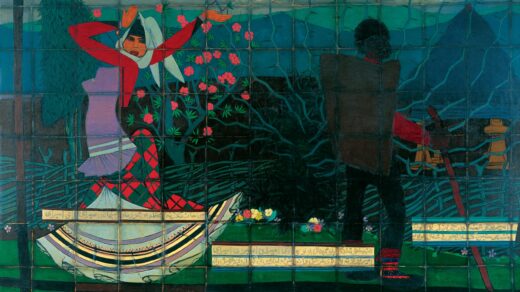
Master Jalil Ziapour; “Hope”; 1989; oil; 135×100 cm
The crisis of the First World War completely destroyed the mood, spirit, and patience for “go slowly, come slowly.” It was not long before the eternal artistic rules shattered, and freedom of expression (that whatever the heart desires must be said) brought about a rebellion against the past. “Dadaism” (Dadaisme), which was the vanguard of the new literary style, took up the burning torch to illuminate the inner world, and in this way, laid the foundations first for Surrealism and then for the supreme school of Supernaturalism (which carries the concept of art above reality and superior nature). It gave no thought to any rule or law, to any minor or major premise, and in principle, to any achievement.
For the Surrealist was thinking of two matters: 1. In every circumstance, the constraint and limitation of speech, and the compulsion to heed artistic laws and their adherents, who had brought the soul to the lips and the knife to the bone, and had prevented cries, wails, and rebellions. 2. The ideas of Freudianism, which had ushered them into a vast inner life and made them understand what reservoirs, overflowing with things to be said, existed in their subconscious, and what a wealth of the highest and deepest themes lay hidden within them!
In this way, the Surrealist had understood what suppressed wails and what deprivations had, over time, slept inside him in the form of a tail-tucked, poisonous dragon, strangely desiring to manifest; but moral constraints and conflicts, and so-called necessary expedient disciplines, had reined them in, and only outward inflammations of them were revealed. And these themselves are entirely the excitement and rebellion of a chained madman (a sharp and fierce being) whom the file of constraints has blunted. This is why the Surrealist considered freedom of expression and the manifestation of accumulated melancholias as his first means of salvation. Unlimited freedom (an unlimited freedom that he would inhale like air in order to survive; he could only live in this unlimited freedom, and could find peace of mind) could say all that was to be said without constraint. It could say what sufferings he had stored up within himself and why, in essence, he should have stored them up.
The necessity of obtaining this freedom was not something that left the Surrealist any room for reflection or consideration of its necessity or non-necessity, so that he might weigh themes according to an artistic rule and judge them bad or good. In attending to the necessity of this freedom, he was like a hungry person who, without the opportunity to think about hunger, felt the need for food within himself. The Surrealist, to satisfy this need and obtain this right to life, in the face of the mockeries of the people who did not understand him and were themselves the cause of this abjection of his, answered mockery with mockery and seriousness with seriousness, and in essence, mockery and seriousness had both already become one and the same for him. For he had understood and knew that the manifestation of complexes takes some form in every environment and at every time, and manifests however circumstance requires and however it wishes, and reveals the reality of its existence (whether in the guise of the serious or the mocking). He had no concern for the ridiculousness or seriousness of the matter; he wanted their manifestation in any possible form and in whatever form it demanded.
The Dadaist was a superb saboteur. He sounded the wake-up call in the most excellent manner and kept going, and by this action, he did not intend to obtain a positive and rapid result. (In principle, he did not think of this.) He did not want to push matters to the point where literary idolaters would praise him! And he did not want to gather followers for himself, but rather wanted to open a path for an eloquent freedom of expression leading out of limitations; and this was never possible without disrupting cumbersome elements and committing sabotage. (For until it is destroyed, it will not be built anew).
The Dadaists, these so-called brave madmen, these leaders of the art world’s movement, finally succeeded. For the Surrealists took up the continuation of their actions. (This itself was the greatest progress.) They were judged in every possible way. But what was the harm in that? Have not all the avant-garde artists of the world, in the eyes of the people, been in principle nothing more than madmen and deviants? Tristan Tzara was also one of them. Breton was another, and Picasso, Dalí, and Tanguy were each like the others. The way of thinking of the new world always had a foundation, but torchbearers were needed to be in advance, so that by discovering the refuge-seeking stores of the inner world, they could recount frustrated realities.
Painters, with the help of this way of thinking, began to manifest inner themes. They set free their melancholias (contrary to the people’s wishes), which the lid of constraints had prevented from manifesting. They gave life to them and, by this means, recounted chained stories. All the Dadaists and Surrealists (whether painters, writers, or actors), like schoolchildren (or prisoners who have been in captivity for some time), rushed forward, and each manifested whatever they could and in whatever way possible. I called these the necessary and liberating manifestations of art from the chains of captivity, and I always salute those who have shown such courage. They became the object of hatred, envy, and accusation. But these brave souls of the field of art were not ones to accept weariness and fatigue in the face of adversity. Dadaism, followed by Surrealism, and then Supernaturalism, passed the torch of victory from hand to hand like marathon runners.
The Surrealist, even after obtaining freedom, could not yet place himself in the scale of a necessary order in art and realize that inner themes should not be accepted solely for manifestation. For at this time, everything seemed to him in need of manifestation. These were a heavy burden, and to unburden themselves of them, they resorted to the manifestation and expulsion of all of them (even if without order and arrangement). Inevitably, they had to take refuge in forms that were familiar. Therefore, the Subjectivists (who paid attention to introspection to excess and, in fact, as they should) altered familiar forms at their own will. (These artists were also called “Ultramodernists”, Ultra Modernistes). In the midst of all this turmoil, the result was that artists succeeded in setting aside forms familiar to the eye and mind of the masses (which had been insufficient for expressing intentions) and freely engaged in manifesting the necessary themes of the subconscious.
It must be admitted that: “The halt of art is the death of art, and the worshippers of old art are the destroyers of the buds of new art.”