by
by Text of the lecture by Master Jalil Ziapour at the Fighting Cock (Khorus Jangi) Art Association (year 1949); published in the weekly “Azarpad” (Issue 2), 1 April 1950
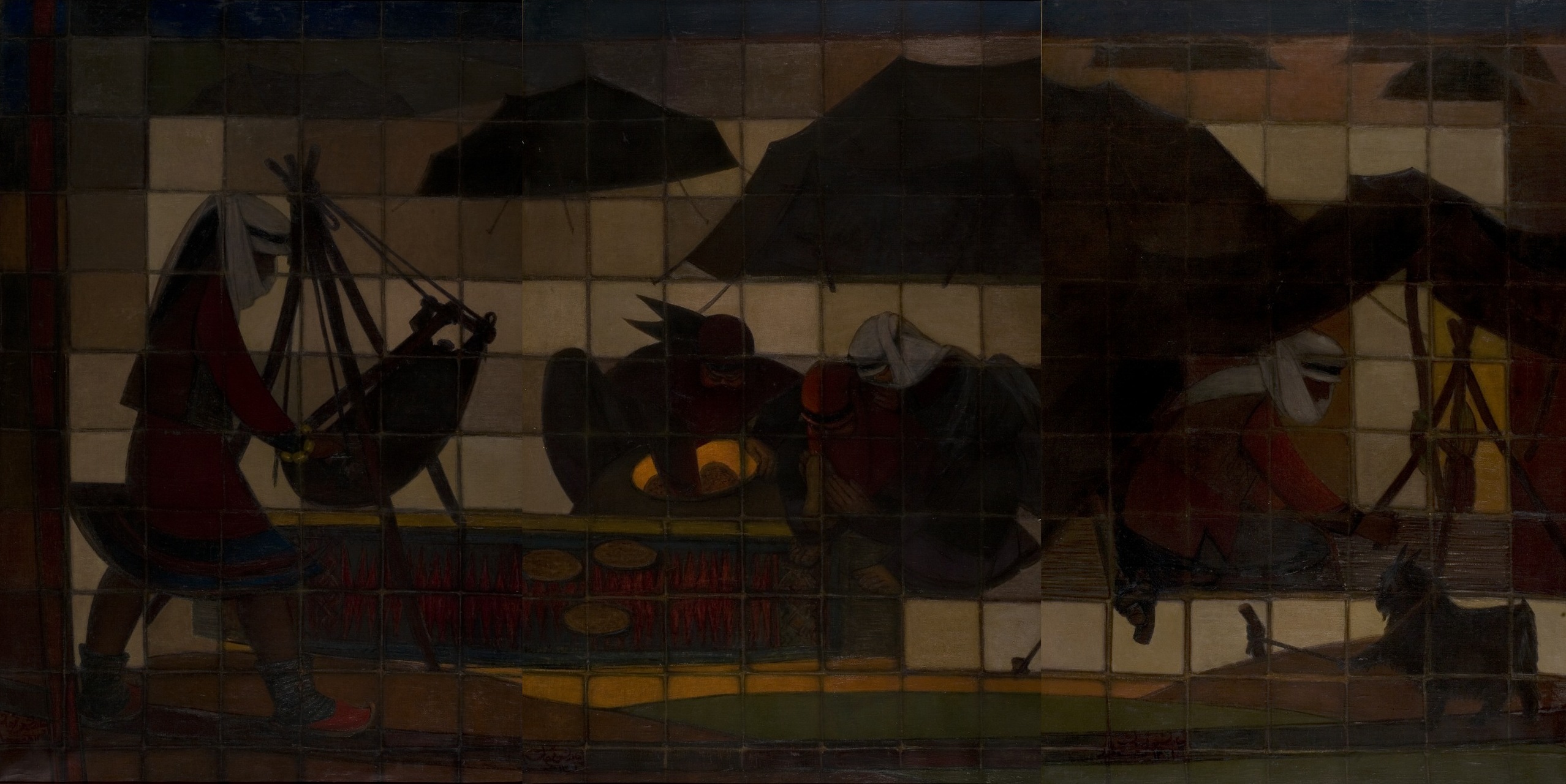
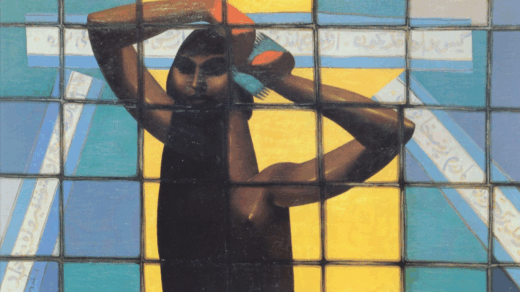
Master Jalil Ziapour; “Life of Tent-Dwellers” (triptych); 1983; each panel 120×80 cm
Until now, most of our people have believed that painting is merely a craft of taste and is done so that, without exception, it may prove pleasing to the minds of all classes of people; but today, holding such a view regarding painting or any other art is no longer correct due to many reasons (which lie beyond the scope of this topic). Sooner or later, more numerous and more precise studies must be conducted for the true recognition of the craft of painting.
The fundamental difference that exists between the painting of today and yesterday is that, in principle, old painting was more indicative of the outward appearances of nature, showing objects, humans, and animals just as they were, and expressing its purpose in this way. But today’s painting does not content itself with this limit and strives to show inner intentions as well. This fundamental difference is important in terms of the goal of artistic perfection in the craft of painting. This basic divergence has distressed and bewildered most people of taste and those who had another concept of painting in mind, causing severe objections regarding new painting. But it is certain that these objections will not last long, and the sufficient reasons of new painting will gradually show that the course of this art is not as astray as the objectors pretend. However, for the recognition of new art, of course, precision and discernment must be employed, and one must not rely solely on the stores of the past (which are not sufficient for understanding our art today and can only be used to evaluate the arts of the past).
I said that old painting, in any case, has this difference from new painting: that old painting paid attention to the outward appearances of objects and creatures. But new painting, in addition to the appearances of nature, also pays attention to the inward reality of matters (especially, it pays more attention to expressing deeper purposes). In old painting, if they created a portrait, all the painter’s effort was to make it resemble the outward appearance of the person, so that the eye would be his eye and the lip and mouth would be just as they are; and also, in addition to resemblance, they endeavored to manifest the character of the persons on their faces and forms with the help of extraordinary skill, and in this work they were successful to some extent (of course, they succeeded to some extent, no more, and not like today). This effort and their slight success, in any case, show that displaying the spiritual states and the inner nature of persons was also intended by the artists, and this is the very main intention that new painting pursues today (for the time being, we are not concerned with this matter: whether new painting, with all these claims, has been able to show its purposes well or not? Whether it has succeeded in its aim or not? And, assuming success, to what extent it has succeeded). We must pay attention to this point: that, in any case, the goal of new painting is correct because it pursues the continuation of the views of the painters of the past, and we know that in this task, it intends to define precise spiritual and psychic states (can the interpretation and definition of precise views and showing them be considered a deviation of the art of painting from its main path? Undoubtedly not). But it is also not the case that, in the course of this work, it has not engaged in much excess and deficiency, or that, in most points, it has not taken misplaced actions and has not been affected by negative and unnecessary reactions. Despite all this, it generally follows the main course (which is the very interpretation and expression of precise purposes).
Since artists are involved in the flow of the work, they properly pursue the continuation of their work and do not neglect anything in recognizing the details of their work. But for the people, it is not so. The people are people of taste, and people of taste, due to the numerous difficulties of life, cannot be constantly in the flow, and it is possible that in most points of artistic works, they do not advance alongside the artist. Right here, a gap is created between the works of new art and the lagging people of taste, and in this state, the result becomes such that if the people do not have the necessary contact with the arts and do not recognize and know their fundamental changes (which occur gradually), they will therefore lag behind in understanding and enjoying new art.
Although it has sometimes happened that I have given the exact same reminder about this point that I wish to bring as evidence, nevertheless, because it is a living witness, it can well emphasize my statement for the umpteenth time. We all have contact with Iranian paintings, meaning we may have seen many miniatures (if I said “we may”, it is because for the most part it has not been possible for us to pay attention to our own paintings and to be informed of the art of our country as we should. But in any case, we deal with tile patterns, and we also see the carpets that are under our feet and that decorate our rooms every day and every moment, but we do not pay attention to them). Now, although we always deal with these factors (meaning tile patterns, miniatures, and mold patterns), have we ever asked ourselves for what reason these unnatural designs have been drawn on tiles and carpets? And has it ever happened that we understand anything from these changes? And has it ever happened that we know the reason for all these strange and highly imaginative, yet at the same time harmonious, colorings? Certainly not. Because we have not pursued them in order to understand, and we have also not had cultivated people of taste to explain to us the causes of the principal or secondary changes in the art of painting in different eras. We do not even have a book on the developments of the specialized craft of Iranian painting that could at least give us explanations like a history. It is obvious that with the absence of means of explanation, the people also cannot be informed about the art of their country and cannot know that the art of their environment was for a time the highest art in the world and is indeed today the greatest foundation of new art.
New painting, apart from the secondary reactions that it carries with it, must be examined carefully, and during the examination, we will come upon this point: that all the means employed in it for the presentation of a subject (from colors and lines) have a deep acquaintance with your being, with your views and desires. But this acquaintance is not such that, as soon as you encounter them, you immediately recognize them and see all the precedents of acquaintance visualized before your eyes. For complete acquaintance, it is necessary that you inquire further into them and be more curious. Bring the precedents out of the house of your mind, and draw them out from the dark-light corners of your memories.
If you take pleasure in old naturalistic paintings, it is because, in any case, in terms of form, you have no need to think, and due to prolonged habit, there is no need to refer to precedents and call upon mental reserves for help. Because you have a continuous and ordinary acquaintance with them, and they have been repeated for you a great deal. This is why you understand the concept of form without any trouble, but of course you do not notice the colorful purposes of an old naturalistic painting in the same way as you do the images of that same painting. There is no harm in testing this reminder on yourself (meaning, see what you enjoy in a painting?). In this case, surely your entire focus is directed toward the image, and colors do not hold for you that pleasure which images resembling persons or story-like scenes do; other matters are placed in secondary degrees.
It is natural that for uninitiated people who do not have an acquaintance, even from afar, with the current of new paintings, it is not comprehensible or pleasurable. In order to enjoy and understand, we must first, gradually, become initiated into our own paintings (miniatures, mold patterns, and tiles). We must know the changes and transformations of their patterns, and understand the reason for the transformation of ordinary and natural images into unnatural ones in the paintings of carpets, tiles, and miniatures of the past, and recognize the nature of the colors in the cases where they have been used; after passing through these stages, we will also recognize new painting.
What is more interesting and necessary to point out to people of taste is the importance of Iran’s past paintings in inspiring the craft of new painting in the world. For the power of creating forms and colors among our artists of the past was to such an extent that whenever I focus on a small piece of miniatures, tiles, or carpet patterns (of the excellent kind, of course), in addition to the artistic depth that I find in them, I see that they instill a creative power in the viewer to produce even more excellent artistic pieces.
Regarding new painting, it must be noted that before everything else, we should carefully know the old painting of Iran. After this recognition, one must grasp the intention and goal of new painting and proceed to action. On the condition that the cumbersome shackle of the past is cast off here, and these works are used for practice only as a basis for progress, not that we actually pursue and imitate them.