by
by This article was machine-translated from the original Persian and may contain inaccuracies.
Article by Jalil Ziapour, titled “The Role of the Fighting Cock Movement” (Khorus Jangi), Farhang va Azadi newspaper, 1979

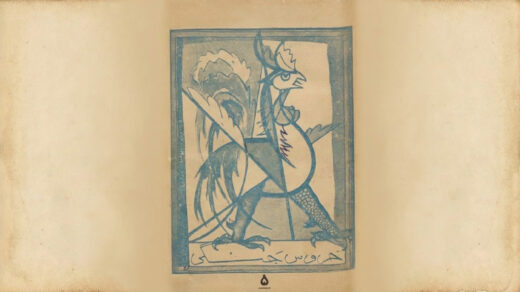
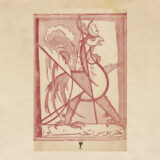
Logo of the Fighting Cock Art Association, work of Master Jalil Ziapour, 1948
Art, too, like any other social factor, gradually undergoes transformation through communications and mutual influences, and becomes representative of the desires and the manner of life movements of individuals and societies. The artist, too, senses this gradual transformation through cultivation and self-improvement, and reflects it in recounting the conditions of his society. But for these transformations to proceed in the right direction and also enjoy the proper and necessary freedom, qualified and aware individuals lead them.
The “Fighting Cock Art Movement”, noting the necessity of dynamism in the arts, took shape in 1948 under the leadership of a few industrious individuals. The intellectuals and seekers of the new, who were burdened by the repetition and imitation of traditionalist artists, accepted (inquisitively and skeptically) the encounters, however bitter and sharp, of the movement group in response to their modernism (since, in any case, the existing artistic atmosphere was intolerable due to repetition and imitation). The concept of being an artist, for naturalist artists, was the exact, point-for-point imitation of nature, and any alteration in the so-called authentic nature was, in any case, attributed to the inattention, lack of skill, clumsiness, and unfamiliarity of its maker. The master artist was one who made something as similar to nature as possible. Therefore, the utmost effort from student to master was to make the appearance of faces as similar as possible, and the appearance of landscapes as close as possible, to nature. There was another group who, imitating traditional methods, repeatedly copied illustrations from books, making them sometimes more elaborate and colorful (with greater detail) or creating simpler works (with raw and insipid rainbow colors), and from master to student they laid claim to innovation. The Fighting Cocks group went to battle with these two groups, who had in their work a large amount of memorized and monotonous technique (minus artistic literacy), employing only their hands and giving market popularity to banal subjects. The supporters of these two groups were not few. All the people, the so-called tasteful and tasteless alike, followed them and gave their hearts to their works. But the movement’s activists strove both to raise the awareness of this vast crowd regarding the state of art, its inevitable transformation, and tradition and traditionalism, and also to make it clear that they should not mistake the authenticity of national art for the repetition of traditional elements, and to know that “tradition” itself (however slowly) transforms over time under the influence of various social factors, and that the repetition and imitation of traditional elements is itself stagnation and the creation of a void in artistic creation. The effort of the Fighting Cocks group was to warn the tasteful and tasteless people alike to discern the expressible and presentable elements of their own era: (to be modernists and leave the past to the past). To this end, over the years, they engaged in debate and discussion in all branches of art. They persevered, making it their motto that “The tale of Alexander became legend and grew old; bring forth new speech, for the new has a different sweetness,” and in the visual arts they utilized national traditional geometric forms (in fresher ways), considering the utilization of national assets (of course, in new forms appropriate for the times and synchronous with the progressive world) to be the path of progress, and they condemned archaism, imitation, and repetition. Yet the archaists, imitators, and traditionalists unfamiliar with how to preserve traditional principles did not want this. For they not only failed to recognize the correctness of this goal, but in addition to their addiction to past-orientedness and living with the past, if they were to accept and desire it, they would have had to ignore their incorrect learnings of many years, and confess to the deficiency of their work and the deficiency of their artistic and social thought. Nonetheless, the vanguards of new art, through awareness, vigilance, and the support of their few proponents, enlightened publishers, writers, modernists, and intellectuals, transformed the closed artistic space into an open artistic space, and established the freedom of artistic work through persistence in hard work (and enduring deprivation, and accepting accusation, slander, ridicule, and sarcasm). Their labors bore fruit, that artistic space was achieved, and today we have cultured and renowned artists (in all branches of art) who always call out in unison from Nima Yooshij’s “City of Morning”:
Cock-a-doodle-doo! The rooster crows
From within the hidden seclusion of the village,
From the descent of a path which, like a dry vein,
Runs blood through the bodies of the dead,
Weaving upon the cold wall of dawn,
Permeating every corner of the plain.
With its song, the path has become filled with it,
It brings glad tidings to the ear of the free,
Showing the path to flourishing lands
For the caravan in this ruined abode.
Softly it comes
Warmly it sings
It beats its wings
It scatters its feathers.
The ear is alert to the bell of its voice’s caravan,
The heart is set on its exquisite melody.
Cock-a-doodle-doo! On this dark path
Who is it that has fallen behind? Who is it that is weary?
Warmed by the breath of its singer,
Was the cold-bringing winter night
It revealed unspoken secrets
The bright adorner of luminous morning.
Breaks kisses with the body of the earth,
The coquettish morning, the slow-traveling morning
Since it released this song from its very core,
And drew it out through the burning of its soul.
Cock-a-doodle-doo! From the visible realm,
The blind night flees toward the hidden,
Like the impurity of the Druj which at the threshold of morning
Is driven away by the melodies of day.
The horseman hastens on the way,
Even though in the darkness his horse bolted,
The sneeze of dawn caught in his nostrils,
The heart-opening design of the white day.
Now to his eyes,
Just as the day,
The path before him bright,
Has brought joy,
He rides his horse.
Cock-a-doodle-doo! Heart and mind have opened,
Morning has come. The rooster crows.
Like a prisoner of the grave-like night,
The bird has escaped the narrowness of the cage,
In the desert and the long, far road,
Who is it that has fallen behind, who is it that is weary?