by
by Article titled “A Review of the Life of Jalil Ziapour, Painter and Cultural Researcher, a Man of the Fighting Cock Generation”, Tehran Emrooz newspaper, 17 November 2009.

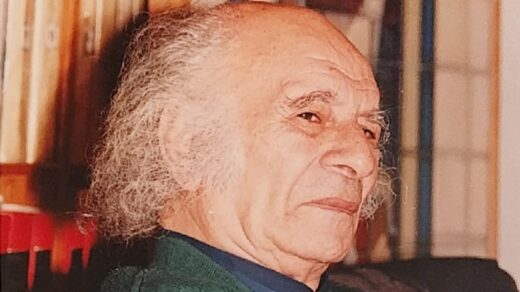
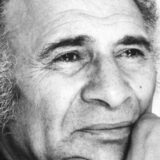
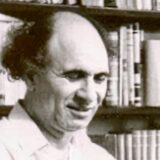
Master Jalil Ziapour in the final years of his life
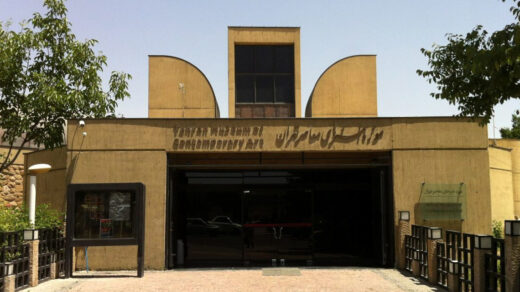
It is interesting that one of Iran’s most controversial contemporary painters has not left behind many paintings. No more than 30 paintings remain from Jalil Ziapour, most of which are kept in the Tehran Museum of Contemporary Art, a few are in the possession of his family, and a number of others have left Iran, and even his family has no knowledge of their fate.
Ziapour was born on 25 April 1920 in Bandar Anzali. He, too, was born in a region of our country that has introduced many influential and famous figures to the world of visual arts. Bahman and Ardeshir Mohassess, Aghdashloo, Hossein Mahjoubi, Sadegh Barirani, and Alireza Espahbod are all children of that region who, due to their connection with neighboring countries and awareness of the currents of the day at that time, were placed on a path that allowed them to bring about many innovations and trend-setting movements in this artistic arena.
Ziapour, like others of his generation who dreamed of taking great strides, came to Tehran in the year 1938 to find a way to make his dreams come true. He first went to the Music Conservatory, and after passing the entrance exams, he gained admission to that school. However, his artistic path changed very quickly because he was fascinated by the field of composition, and with the change in the conservatory’s management and the elimination of this field, he also gave up on continuing his studies at the Music Conservatory. Nevertheless, he continued to pursue artistic fields and went to the School of Fine Crafts; a school founded by Kamal-ol-Molk, whose students, who ran the school in those years, were also recognized as representatives of the country’s official art. There, Ziapour set about learning traditional arts such as miniature painting, illumination, carpet design, and traditional painting, but the fate destined for him in the following years turned this young painter into one of the enemies of these arts, and Ziapour became known as one of the leaders of modern art in Iran.
His first encounters with aspects of modern art were at the Faculty of Fine Arts, which he entered in the year 1941 to study painting. The opening of the Faculty of Fine Arts, which coincided with the presence of foreign professors, led to the training of a generation that differed from the graduates of the School of Fine Crafts and was thinking of other patterns and designs. Ziapour graduated in the year 1945 and was very soon able to go to France on a government scholarship and find his way to another center of modernism in the art of that time. Just as the Faculty of Fine Arts was one of the leading art centers in Iran, the Beaux-Arts in Paris also played such a role on the global stage. He studied there up to the doctoral level and thereafter returned to the country in the year 1949.
Upon returning to the country, Ziapour was probably confronted with a severe duality, as he saw modernist painters in a very small minority who did not even have the chance to breathe, let alone easily exhibit their works and discuss them. But he had no intention of submitting to such an atmosphere, and for this reason, from the very beginning, he and a group of his like-minded associates gathered together and engaged in holding lectures, discussions, and reviews of modern art in all fields of literature, performing arts, poetry, painting, and music. Painters like Hossein Kazemi and Javad Hamidi shared his views, and Mahmoud Javadipour’s gallery also became a space for them to exhibit their works and clash and argue with their opponents.
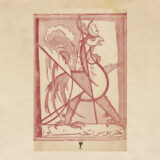
In that same year, Ziapour, who harbored many ambitions in his head, founded the “Fighting Cock (Khorus Jangi) Association”; an association that is now recognized as the first organized and collective movement to take steps toward modern art. This association was not dedicated solely to painting, and even Ziapour himself did not lecture in it only about painting, but also addressed topics such as literature and story writing.
In the early years of the 1950s decade, and with the change in the cultural atmosphere of Iran, Ziapour was also invited to some government positions in cultural sectors, and in this way, he was able to lay some of the foundations of modern art in the country, one of the most important of which was the Conservatory of Fine Arts; a conservatory that in the subsequent years was able to train several generations of artists, and prominent figures emerged from among its graduates.
Ziapour, who had a great interest in the popular culture of Iran, spent several years traveling to remote parts of the country, the result of which was several volumes of research books. Another part of the research he conducted during these travels also remains today in the form of detailed sketches that he drew of the ornaments on the clothing and apparel of the people of the country’s various ethnic groups, thus recording them. Perhaps it was this very interest of his in researching Iranian culture that caused him, more than creating paintings, to travel to every corner of the country and author several books on Iranian cultures. Of course, this indigenous culture is also manifested in his paintings, and one can see the black tents of nomads, and Baloch, Kurdish, and Lur women in the works of this artist, whose opponents accused him of Westoxification.
Ziapour retired in the year 1978, but he still continued his work at various art universities and, in addition to teaching art, continued his research. The result of this artist’s years of investigation, travel, and research in Iranian and world culture led to the writing of 28 volumes of books, 70 articles, and the presentation of 85 papers, which are still recognized as references on various subjects.
Ziapour passed away in the year 1999 at the age of 79, and perhaps his death on a night that has deep roots in the folk culture of Iranians is not unrelated to his interests and love for this culture. Yalda Night is the death anniversary of this renowned artist. In an interview in the year 1977, Ziapour said: “With great regret, I wished I could do whatever was in my power. But how long should I shout? 19 years is enough. I have a goal of my own and I must also attend to my work, and one cannot always go on shouting. I have heard that some artists who cannot justify themselves and their works say, ‘it is what it is’, and this is the claim of foreign artists, and it shows that they are indifferent to the education and cultivation of their own people.”
Editor’s note: In the original text of this article the name “the Mohassesses” appeared in the plural; to make it possible to link to the Wikipedia entries of both artists, we changed it to “Bahman and Ardeshir Mohassess”.