by
by Article by Engineer Taherzadeh Behzad, entitled “Artistic Discussion and Criticism, Concerning the Criticism of the Paintings of the Apadana Exhibition”, Mehr-e Iran newspaper, No. 2184, 4 December 1949.
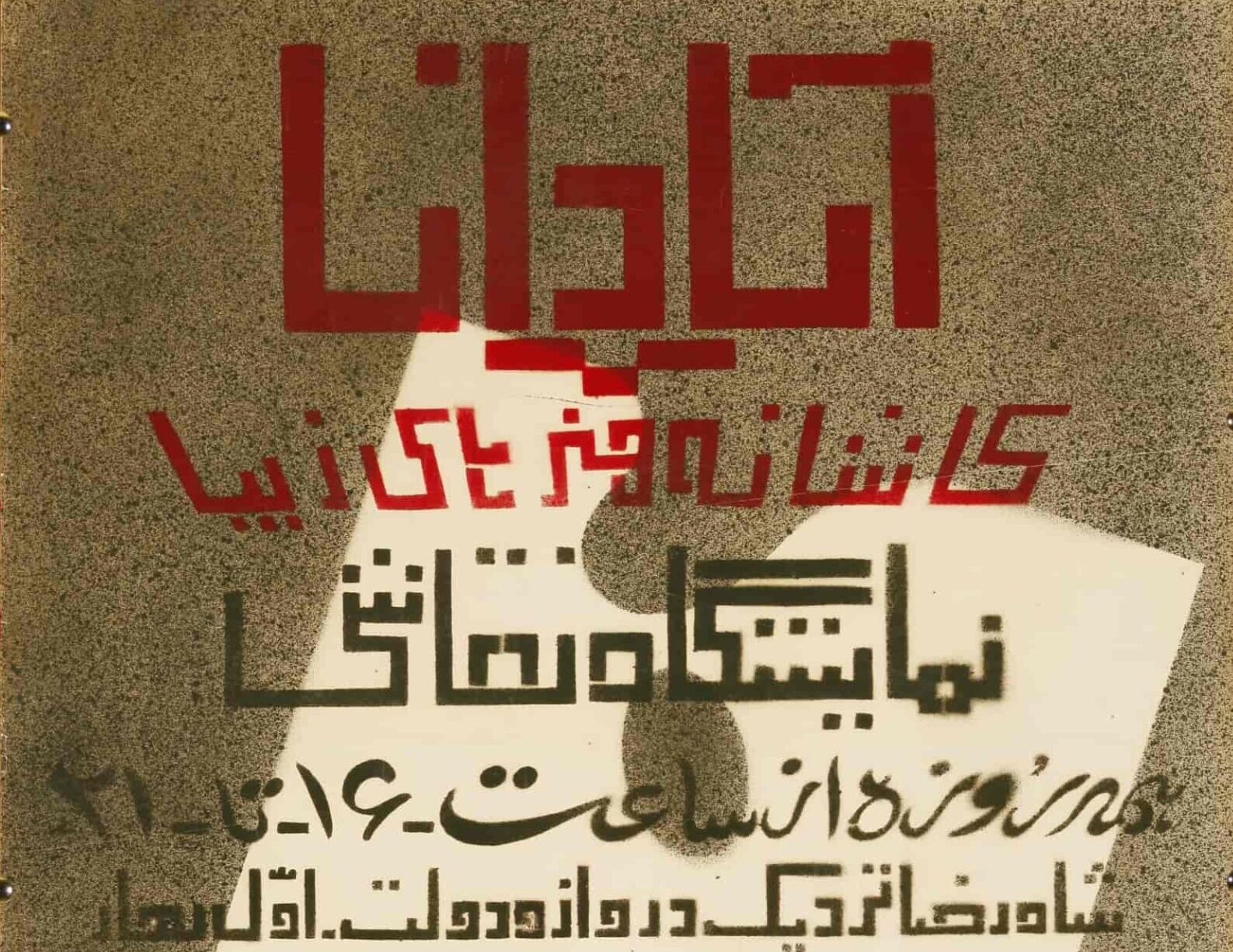
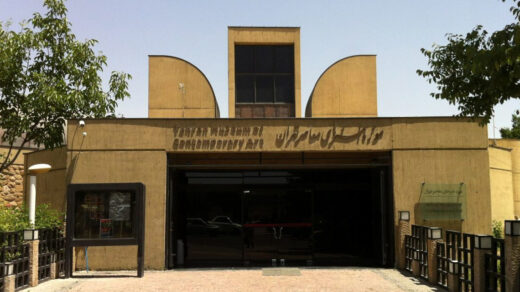
Apadana Gallery; host of the exhibition over which this debate broke out
This note is Engineer Taherzadeh Behzad’s reply to the article “The Solicitude of the Likes of Messrs. Engineer Taherzadeh”, which Master Jalil Ziapour had written in the Mehr-e Iran newspaper. Taherzadeh, who defends Iran’s traditional arts (miniature, illumination, and the work of the old masters), takes a critical view in this piece of Master Ziapour’s modernist opinions on the fine arts and warns against haste in transforming the national crafts. He begins his words thus:
A lip that, with a sweet smile, can carry off the heart
Why should a bitter answer come from such a mouth?
Mr. Ziapour’s article in the honorable newspaper Mehr-e Iran dated yesterday (28 November 1949) prompted me to write a commentary concerning the fine arts. Some of the respected readers of Mehr-e Iran may imagine that in these turbulent times, when dark political clouds have darkened the world’s horizon, discussion and criticism concerning the fine arts is out of place; but in my opinion, the Iranian nation, before anything else, must learn the art of distinguishing the ugly from the beautiful, and I am grateful to Mr. Ziapour for having given me an opportunity to engage in a brief conversation with artists and artisans. Works of art can be considered the spiritual impressions of artists, and it must be known that all painting, or poetry, or musical plays, and the like, manifest in the world of existence. Therefore, the emotionality of artisans and artists is a natural matter. Some artists possess a strong spirit and look at the world through the window of the philosophy of certain scholars, such as the famous German writer Freud. These kinds of artisans derive most of their inspirations from canvases, and through their works, strive for the moral reform of mankind. Some artisans possess intense emotions, and the degree of their desire to work having overcome their patience and composure, they are quickly affected, and this group does not like criticism. Severe emotions cause this group to be deprived of those celestial attributes that fall to the lot of artists. This group, as a result of weak nerves, resorts less frequently to logic and is not bound by any reason or proof. And as a result of a lack of correct judgment, they do not recognize any right for other artisans, and do not even consider the influence of past circumstances, and do not keep in mind at all that for the last two thousand years, hundreds of times, some of the branches and leaves of the works of the fine arts have changed form, changed principles, and changed names, but their foundation has never changed; and as group after group of children have reached maturity and become youth, and the youth have grown old, this cycle of succession has continued, but the root of the craft has remained. Furthermore, if in past days the principles of the fine arts were other than today’s principles, and a group of people worked according to those principles and created works, we should not regard them as the shrine-saints of art today. Among the nations of the world, service is held in respect. In my opinion, the Iranian nation will never forget the services of the late Kamal-ol-Molk and Messrs. Colonel Vaziri, Abolhasan Vaziri, Mir Mosavvar, Rokhsar, Sheikh, Arjangi, Ashtiani, Heydarian, and the like, and in the future, too, it must appreciate the services of today’s artisans.
In the previous article, having offered a few reminders regarding Mr. Ziapour’s critical article, I had even tried to prevent those emotional agitations of his that had flowed from his pen. But Mr. Ziapour has misinterpreted this matter. In my article, I used words like “dessin” and “anatomy”; in fact, I had wanted to speak a few words in Mr. Ziapour’s language as well, so that the words “exposition” and “composition” would not be left alone, and he, not paying attention to the jest, took it seriously. It is right here that I am again forced to answer in the words of the Tongue of the Unseen, as he says:
When you hear the speech of the people of heart, do not say it is wrong;
You are not a connoisseur of speech, O beloved, the error lies here.
If attention is paid to the end of Mr. Ziapour’s article, it becomes clear that he still insists on presenting coloring as prior to all the mysteries of the art of painting, and has claimed that my views are old and no one pays any attention to this old method. Therefore, according to his statements, someone who wishes to paint from a human model or scenes of nature must first apply colors and then carry out its drawing. This too is a method; what is wrong with it? But it must not be forgotten that, as I wrote in the previous article, we have been the masters of the nations of the countries of the world in some of the fine arts, such as miniature painting, illumination, carving, bookbinding, and the like, but in oil painting, and even in watercolor painting, we have been very poor and insignificant, and still are, and it is a matter of regret (I hope some of the youth will abandon the whim of changing miniature painting). During the time of Fath-Ali Shah Qajar, having observed the works of European fine arts superficially, and under the guise of creating an Iranian artistic renaissance, they inflicted severe blows upon the national craft of Iran, and paid no attention to the fact that destroying a grand building in a short time presents no difficulty, but for a new building, one must reflect deeply on designing its plan, preparing its construction materials, and choosing a site and location suitable for this building; in other words, hasty and hurried actions in this regard will have no result other than regret.
The Iranian nation has played a great role in the world of the fine arts, and famous scholars and writers such as Professor Sarre, Dr. Schmidt, Professor Christensen, Professor Pope, Dr. Goel, Professor Massé, Pascal Auguste, Flandin and Spiegel, Gallet, and hundreds of other scholars, in the important books they have written, have considered these works effective and beneficial in the progress and growth of world civilization. Have they made a mistake? The Iranian nation cannot, on the thought of new principles, renounce all these glorious works of civilization.
Now, a matter that cannot be passed over without mention is this: since ancient times in Greece and Iran, which were the only civilized and great nations of the world, artists and artisans emerged and, by creating their works of craft, made future generations indebted to them and, leaving the field to the youth, departed. But the youth, too, have always expressed gratitude for their efforts and artistry, until they themselves also reached the stage of being esteemed and appreciated; but unfortunately, in present-day Iran, true toilers and artists have become the object of address and reproach by their own students. The world of the fine arts has had a winding path, and this path passes over spiritual bridges named fairness, justice, sound judgment, the spirit of sincerity, the expression of courage, philanthropy, self-sacrifice, moral refinement, and the education of one’s fellow humans; and any individual in the caravan of this path who wishes to reach the world of the fine arts must cross over these bridges and acquire these good qualities. If, God willing, I find the opportunity, I will write an account of the nature and spirit of the fine arts in another article. But Mr. Ziapour must know that I have spent a lifetime defending the group of Iranian artists, and in the remainder of my life, I have no desire other than wishing for their success in national artistic services.
For a time, like a flame from this censer, we became eloquent,
Again, like a hidden ember, we went beneath the ashes.