by
by Text of a lecture by Master Jalil Ziapour at the Fighting Cock (Khorus Jangi) Art Association; published in the journal “Andisheh va Honar” (No. 3), June 1954

Henri Matisse, Portrait of Madame Matisse (The Green Line), 1905
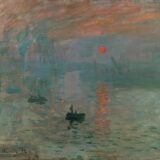
It was said that Impressionism, with its artistic way of thinking and its own particular mode of reasoning, finally, through endurance and intense struggle and with endurance, pushed back Realism and its supporters and took the initiative of operations. Colors in the world of Impressionism took on a new soul and life, and found an unprecedented freedom and brightness. Various colors, which had a cheerful appearance, through their diverse combinations caused the emergence of captivating scenes. They manifested tastes and imaginative worlds peculiar to themselves.
Cold scenes, because they had remained so much in memories, like a compulsory demand (which is considered a natural need), drew minds with greed and avidity toward Impressionism and the various methods of this school. Simple Impressionism (which must be called naturalism unconstrained by classical rules), in passing beyond its limit, reached “Pointillism” (Pointillisme). The Pointillist placed different colors side by side with the tip of the brush (like “stippling”), observing proportion and slight distance and proximity, and the new Impressionist placed colors side by side within a wider field. If in simple Impressionism colors were placed side by side in small surfaces and more diverse colors were employed, in the new Impressionism the diversity of colors did not have much intensity, but each color “in terms of intensity and weakness” was stronger, yet applied within a wider field. What received the most attention in this school (which, it must be said, arose from this school and became the motivation for greater expressiveness) was the concepts of color and their mental-spiritual effect, which the artist in this school encountered in a better and clearer way. The avidity to grasp pretexts and find a new mold to express these intentions of the day led the Impressionists down a path where, inevitably, an important foundation of the art of painting remained neglected, and that was “drawing”.
It is obvious that this neglect was not from Impressionism, but rather, weariness of the lifeless drawing of past schools, and attention to color and its concepts and effects in this school, so occupied novices in the search for color that they consigned drawing to oblivion. Color, drawing, and composition are the three main elements of the art of painting. Color is the first element. Drawing, in the second stage, gives it power. Composition, in the third stage, gives strength to its meaning.
Fauvism (Fauvisme) paid attention to this lack of drawing and defect in Impressionism. Especially with the enlightenment of public opinion, which in principle brings forward social struggle, it realized that it had to use all technical elements for the benefit of better expressiveness. At this time, the war of ideas and class conflict, the taking root of violence and communist ideas, possessed intensity of action, and it had to be expressed by intensifying the technical elements in painting. Thus, the new Impressionism, willy-nilly (and in fact drawn by the pull of public need), rolled onto the almost paved road of this purpose and found its way toward a suitable and necessary space of the new style (which had been created and prepared long before through radical ideas), and at this opportunity, Fauvism came into existence. (“Fauve” means wild.) The display of the bold colors of this school was exactly opposite to the moods and tastes that sought beauty in peace, unconcern, and a quiet life, and accepted sensitivity only within the limits of their own taste and interest. Everything about this school was offensive to them.
Impressionism was still forming images of the quiet life of peace-seeking people and of indifference toward the lives of others, used pleasing colors, and by this means kept memories at ease. But in Fauvism, these colors were not used; rather, bold colors, striking and whip-like drawings, and compositions outside conventional taste were employed, and naturally they were not pleasing. The existence of the preliminary concepts of colors in Impressionism was used in favor of expressing distresses in Fauvism (what so-called unpleasant colors were not used, and what so-called drawings lacking in elegance did they not employ!). It was darknesses, torments, spiritual tortures, and suffocations that were recounted in this style, and in this way they expressed sympathy and raised cries.
Of course, Fauvism was a school in which colors, drawings, and compositions manifested themselves harshly and wildly. Nevertheless, its wildnesses revealed a school that, by re-employing drawing in a newer form, taking inspiration from the diverse colors of the Impressionist school, and employing them for weighty themes (and also with greater introspection than in the past to express its intensities), placed a more open world in terms of expressiveness within the artists’ field of vision and taught a broader way of expression to future generations. This school was at the height of its power until about fifty years ago.