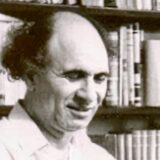
by
by Text of a lecture by Master Jalil Ziapour at the Giti Cultural Association; published in the weekly “Shahsavar” (No. 2), 2 October 1950
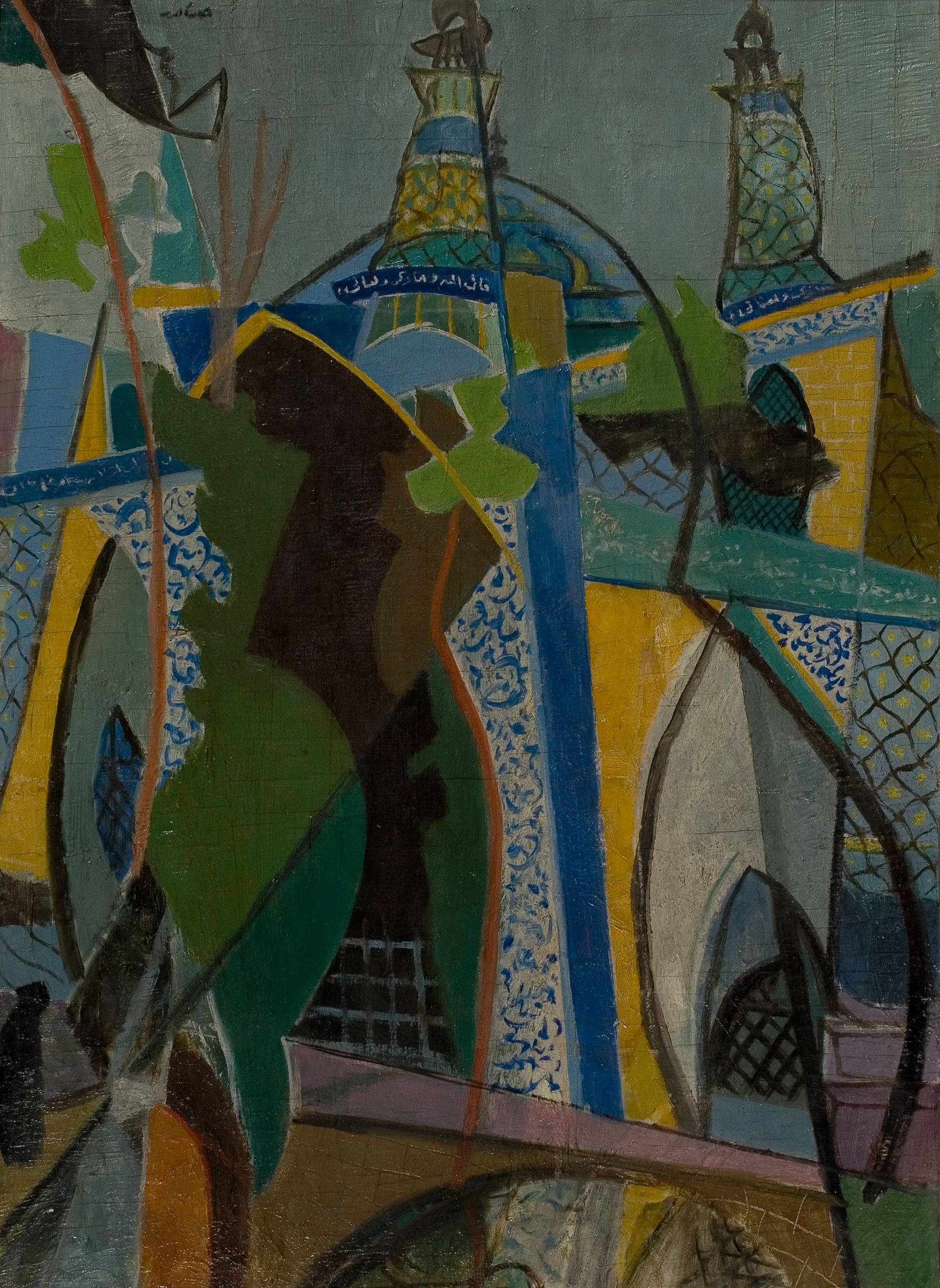
Master Jalil Ziapour; “Sepahsalar Mosque”; 1948; oil; 120×80 cm
Identifying two fundamental matters in modern art is necessary and imperative: one is the manner in which society confronts modern art, and the other is knowing the aim of modern art. Those who are more enlightened in the general affairs of life and its course can better discern what the manifestations of the people are like in the face of an art that is more or less incomprehensible to them. It is clear that countless groups stand before modern art and express opinions about it. Undoubtedly, the measure of their opinion is proportional to the amount of knowledge they have accumulated about the concept of life. From among this number we can separate several quite distinct groups.
One group is bound to the old method. Another group is entirely progressive. One group is conservative. Another group stands between the two groups of conservatives and progressives. Another group makes a show of modern art. The opinion each of these expresses about art differs from that of the other groups. Some of them attend to subject matter. Some speak of beauty, and some express interest in both to an equal degree, and still others believe in the technical method.
The first group, who are bound to the old method, due to being unaware of the vastness of the field of art and not recognizing the essential concept of beauty, are attached only to the works of art to which they have grown accustomed. These people have an attachment to the past. (Although they live today, the thought of the past is more active in their minds than any other thought.) They express their purpose with the similes and metaphors of those gone before, and if they wish to speak of beauty or faithlessness, they immediately recite an old ghazal by this one or that one and bring up words of faithlessness, although we know that, in principle, the era of expressing one’s state in this form has passed, and except in the books of the ancients and old poems, we do not find these similes in daily life. This group themselves, in ordinary circumstances, if they wish to give a report of life to someone, never explain and expound in the old form and, for example, do not say, like in the era of Saadi: “Go, stand at the head of the portico and behold”; and in similes of beauty, although the cypress-like stature and the bow-shaped eyebrow no longer have a place, still the reader and listener must accept beauty through old words, bound to the use of the words of the ancients and composed of scenes from the past, and we perceive well that our poet is not a man of today and is not contemporary.
Of course, the artist of every age must be responsible for displaying the intentions of his own time with the language, morals, and customs current in his own age. Those who employ the language, morals, and customs of the ancients and cannot turn away from the past, without doubt have the past in view in everything, and this compulsory following applies in the same proportion to all the intentions of this group. In poetry and words, and in compositions and themes, in taste and selection, this group is bound to the views of the past. In painting they are bound to the scene-making of the past and of old times. Therefore, the principles of the past are the substance of this group’s work! The greatest proof of this past-seeking is the absence of publications and means of discussion for directing people’s attention to the present time (naturally, if the entry of machines into this land had not occurred, we would still have been content with the same carriage and cart, and would have traveled with a caravan that took months to reach its destination). Thus, as a rule, lack of awareness is the basis of backwardness, and in this state the effect of looking backward is always more lasting than looking forward.
The second group are the progressives. Because of the effort they make to understand, they know that life is never at rest and that, whether one wishes it or not, need draws man toward progress. This group, contrary to the previous group, keeps forward-looking in view and strives to fulfill for themselves the requirements of the most progressive civilization. For this reason, they adopt the most necessary method. This group is attached to none of the groups I have named, and is attentive only to meeting necessary requirements.
The third group are moderate and conservative. That is to say, they take the middle between the old and the new groups. They do not attend to the old so much that they remain unaware of the current of the day, nor do they look ahead so much that they are separated from the world of others. Rather, they adopt a kind of interpretation that keeps both groups satisfied. In reality, this group is the link between both groups, and since the backward group, in the event of becoming progressive, is content with reaching the middle limits, for this reason, together with the group who are conservative by nature, they form a large majority; and naturally the artists of this class create works that accord with the taste of this large majority, and they themselves are introduced within society as the artists of the majority or the artists of society.
The other group (the fourth) has its knowledge founded essentially on conservative principles, but it inclines toward the progressive group. With this difference: they do not accept the rapid advances of the progressives and merely call themselves progress-seeking. (Like all those who make a show of being leftist and say: we do not want art within the four walls of constraints and conservatism, but since we think more about society and want to be together with society and bring them into the current of life and art, it is for this reason that we do not accept rapid advances.) For this reason they call the ordinary advances of the progressives extreme. We must call this group the progress-seeking conservatives. For in relation to the progressives, by virtue of their own compulsion, they are conservative in every case. (It is from among this group that pretenders are often found, and they roar in advocacy of the arts they themselves require.) This same group, in cases where they deem it expedient, introduce themselves as fiery progress-seekers and also harmonize themselves with the theory of the so-called extremist progressives (that of course one must create transformation and move forward). Such statements of theirs occur when they come face to face in person with progressive artists. This double-dealing is so that they will not be introduced as backward and conservative; and since, on the other hand, they do not see the natural course of advancement of progressive artists, they therefore give the names rapid advance, deviation, extremism, and decadence to their natural progress. Behaving in this manner is among the characteristics of unenlightened leftists; otherwise, very prudent leftists never have such raw and illogical manifestations. Those who show interest in the first group (the conservatives) do so because the point of support for their general knowledge is there, and they know well the measure of general knowledge at this level, and they advocate the artistic levels of this group (of course, in each of these groups we can recognize a number of pretenders).
The first group has for itself a number of loudspeakers and supporters who, when necessary, attach themselves to the second group and make a show of progress-seeking; and the second group likewise has loudspeakers who, when necessary, attach themselves to the third group; and likewise the other groups, all of whom make a show for reasons of expediency. In the face of all these groups, there is a group of true progressives who are never conservative, and who know well all the groups and their loudspeakers and pretenders, and have sufficient and clear acquaintance with the course of society and also with the manner of evolution, and know their own place as well, and observe all the operations and measures of the groups.
Now let us see whether, in one environment, these multiple groups can in principle exist together, or whether they are all at one level and think in the same way. If an environment has been so cultivated that all possess one level of thought, there will still exist a point of difference among them, and a number, because of having greater quickness of mental apprehension in grasping needs, are ahead of others. Thus in either case we inevitably encounter a number of people who are ahead of others, and it is this very group that directs the social and artistic affairs of its age.
What are the characteristics of this number? Before everything, they know the different groups. They distinguish the loudspeakers of each group from one another perfectly well. They specifically point out all backward persons of taste and artists. (Especially the second-rank pretenders among the conservatives, those who prescribe backward methods in society.) Modern art can get along well with each and every one of them, and with the arguments and works it presents from those very people, it compels the followers of past methods to concede, without question.
What is termed danger is the scattered talk and idle talk of the second-rank pretenders (the conservatives), who disturb minds. For example, in issue 34 of “Payk-e Solh,” an article titled “Decadence in the Art of Painting” had been written by Dr. Khalatian. The author of this article expressed some interest in Impressionism, although I am certain that the author does not understand even Impressionism, for a reason I shall give, and meanwhile, with this same deficient capital, had even come to battle Cubism. He had written: “What does an ordinary spectator expect from the work of an artist? He himself answers: if the artist’s work has an attraction and can produce excitement in the viewer and be the intelligible language of the subject’s state, the artist has been able to achieve his creative purpose and satisfy the desires of the ordinary spectator.”
A person with a high educational title (although an educational title is no proof of literacy) ought at least to have enough knowledge to know that one must not ask an ordinary spectator to understand a work of art, and must not expect a work of art to provide the satisfaction of an ordinary spectator, and should know that a work made for the ordinary spectator is not a work of art! The matter does not end here, and to emphasize the point he continues: “If the viewer had been asked which of the paintings in this exhibition pleased him, no answer whatsoever could have been heard. In the view of all the spectators, a kind of irritation and dissatisfaction was seen.” Mr. Khalatian takes the work of art so far as to say that the artist must create works that are pleasing to the mind of the ordinary spectator, and otherwise the work is not a work of art. Works of art must be passed before the eyes of the ordinary spectator so that this spectator, unaware of art, may say whether the work pleases him or not. If it does, then it is a work of art; and if not… in that case the artist must strive so much that he creates a work in accordance with the liking of the ordinary spectator!
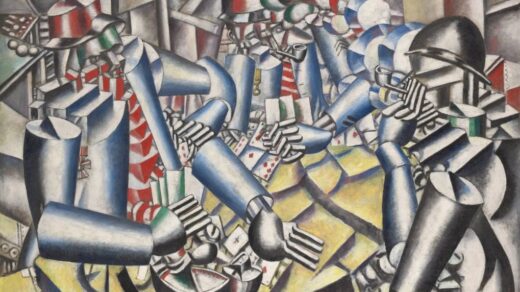
Someone whose level of thought and artistic consciousness is this low plainly does not know the artist in principle and, naturally, does not know what Impressionism is, so as to wish to express interest in that method or to approve it, and even to go beyond that limit and wish to reject Cubism! Regarding Cubism he says: “In France Picasso and Georges Braque gave cubic forms to shapes and views and used simple and unmixed colors.” And then he begins to state on what date and where Cubism became widespread. But he does not say why the Cubists changed natural forms and what their purpose was in this work. He says: “They used simple and unmixed colors.” This statement is entirely baseless, for in none of the colors they used is there any unmixed color. Because the basis of Cubism’s work rests on the mixing of color in order to create a particular effect and feeling. Thus, without the mixing of color, a precise feeling and effect cannot come into being. This insubstantial statement is from the personal inferences of someone who is not acquainted with the technique of the work and has no knowledge of painting.
In one place he says: “Certainly, insight in painting is wholly dependent on the degree of intellectual growth and the capacity to study the circumstances and conditions of the environment.” And following this statement he says: “The basis of a painter artist’s work is indeed the correct creation from truths that are seen by the eyes of the public”! If the painter’s insight is wholly dependent on the degree of intellectual growth and the capacity to study the conditions of the environment (which, of course, is quite logical in its own place), then how must one accept, for a progressive artist, that he should place the basis of his creation on truths that are seen by the eyes of the public and show ordinary truths that everyone sees? Do truths that are seen by the eyes of the public need the artist to show those same things to people, and even to create in them, that is, to do what?
The artist must create the truths that are not seen by the eyes of the public. He must show those novel truths that are hidden from the view of imprecise persons. The intellectual carelessness and idle talk of the author of the article are so unexpected that a logical person, without hesitation, ranks such persons in the circle I said were pretenders and who do not have clear awareness of what they say, and whose chaotic information, without arriving at a conclusion, has remained idle across the expanse of their thoughts. More importantly, in this same article, in one place, he mentions: “The best explanation of Cubism is the theory Picasso himself had about it.” They say: “When he was asked what Cubism is, in reply he drew several unrelated lines and said: this is our art, and you must accept it without criticism or expression of opinion. (Quoted from Image)” Bravo to Picasso for giving such an answer. Do you not perceive that Picasso’s answer in the form he gave it to the questioner was because, for the most part, objectors like the author of the article and newspapers like Payk-e Solh and others, with their lack of information and limitation of mind, had been troubling Picasso and those like him, and Picasso was forced to give such an answer, which is like a slap in the mouth, to such people? It is clear that the answer to such people (who, without having sufficient scientific and artistic grounds, allow themselves to object) ought to be nothing but this. And these people are the very ones who disturb the thought of society. They are the ones who prevent society’s progress. In my opinion, instead of objecting, before anything else they must, without question, be questioners like a school pupil (whatever position they may hold). The second matter is our modern art. What does modern art, above all arts, want? Modern art says: the old arts gradually strove, as far as possible, to display those themes that, by virtue of environmental needs, were necessary to manifest. Each of the methods made a progress proper to itself. But in the meantime, each also had defects that later methods corrected in accordance with the need of the time, and adapted themselves to the age and its requirements (of course not easily. For pretenders have always been obstacles to work and parasites on advances). But the ears of progressive artists are never indebted to the petty warblings of the loudspeakers and backward conservatives.