by
by The full text of Master Jalil Ziapour’s lecture at the Museum of Contemporary Art (Second Biennial of Painting); January 1994

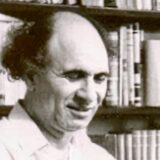
Master Jalil Ziapour, the Father of Modern Iranian Painting
The work we do is based on a goal that is proportionate to the thought of each one of us. To the extent that our thought possesses breadth and insight, to that same extent we will have better work. Better thought lies in a worldview. Therefore, the work we do must possess the characteristic of better thought. This depends on the artist: how much he knows and feels, and on what path he proceeds. Our work pursues two characteristics: one, the outward elements of the work, and the other, the expression of the goal. The first is external, and the second is internal. To reach the internal, we deal with the external elements, which are the primary means; in our work these consist of the comprehensive design, including: design, color, composition, and “suggestion,” which are the means of establishing communication and express the subjectivity and the goal.
My speech concerns examining the state of the comprehensive design in painting and identity in art. Recently, in thoughts and the media, the subject of setting aside Western art and turning toward traditional and national art has been raised. If we have now turned our minds to this again, it is a source of great joy. Since forty-five years ago (from the year 1948 onward), my cry was always loud in the media and art salons that we should not imitate, and that we should act consciously so that we may be ourselves. If the goal is to be recognized globally, I used to say, and I still say now: “Even while preserving identity, one can become global.” Was Saadi not an Iranian artist whose humane utterance, “Human beings are members of one another,” has become universal above the entrance of the United Nations? Do we lack such universal national figures who were not imitators? But in any case, we have the heavy presence of foreign art in our midst, and this presence is due to our unfamiliarity with, and neglect of, the history of our own art.
In this world, all societies, for the creation of their visual arts, each have principles dependent on themselves. If the Far Eastern artist pays attention to the new world, he also pays attention to his own time and identity, and by referring to his achievements and environment, we recognize his identity in the new work. A program has been implemented in our art universities under the name of the “Comprehensive Design,” the goal of which is a comprehensive examination of the learnings that our art students have carried out during their work. That is, they should have a final and all-encompassing review of what they have learned, in order to arrive at its quantity and quality: whether, during the execution of the program, they have drawn inspiration from our own design, color, and composition, and if others see the works of our time, will they say that these works are Iranian? Let it not be as it happened before, becoming a source of embarrassment.
Before the Revolution, our so-called modernist artists, who paid no attention to authenticities, wanted to assert themselves at the New York International Exhibition. One of our friends, in remembrance of that undertaking, wrote a sharp critique of the result of their work in Sureh magazine as a lesson: “When the person in charge of reviewing the artworks approached, he asked, ‘Which are the works of the Iranians?’ Our artists pointed to their own works. The reviewer of the works said: ‘But these are the works of us Westerners! Which are your works?'”
We must know: “that imitation in art causes the decline of individual character and national identity.” We still carry with us the artistic influence of the era of Genghis, the Mongols, and Timur up to this date on which I am speaking to you, and this imitation spans more than eight hundred years. I am speaking of this very insignificant Chinese cloud-making which is known as “tashi.” A convoluted cloud that speaks of storm and wind, we still do not let go of it! Why? What is there in this cloud that has captivated our capable artists? Nothing except to say: it is our own weakness that we are captives of imitation. Once, Kamal al-Din Behzad and his associates (about four hundred years ago) rid our artists of the nuisance of this imitation. But it returned again. This has been, and is, nothing but our addiction to imitation in order to be noticed. If we want to act consciously, its prerequisite is familiarity with both our own art and foreign art, wherein paying attention to the contrasts will cause an awakening to being oneself and possessing creativity.
In the comprehensive design, one of the aspects of familiarity with the required design in curves and other compositions is a design (taking into account suggestions) that must arise from the entire foundation of the work of the comprehensive design, and this suggestiveness must be the goal throughout this design. Because, without the element of “suggestion,” every work will be devoid of content. The state of the designs (or expression, as our practitioners call it) must never be empty of subjectivity. Because the artist deals with subjectivity, lives with it, and is the second creator. Let us not forget that color, design, brush, and canvas are the artist’s tools, and the artist himself is also a tool. His eye is the tool for seeing, his ear the tool for hearing, and his hands the tools for employing and applying. The entire existence of man is a tool that receives commands to present contents through his existence and his auxiliary tools. Where are those contents that we must present? Does any artist try to become acquainted with more valuable contents?
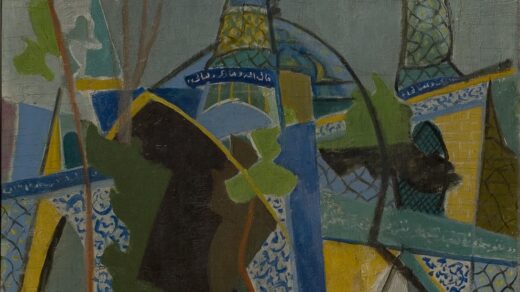
The artist is a being who makes the history of his people; if his art is of a high level, authentic, and related to his own time, it fosters character and identity for his people. The living environment of every society has its own specific coloration. Our works must, in terms of color, be representative of our living environment. We must know our own specific coloration. Faced with this vast desert land, which I have traveled across for at least five years, we arrive at this realization: how, and from what source, the colorations of the Islamic period, alongside our lofty and profound desert colors, manifest brilliant visions. Look at the colorations of historical mosques. What connections, harmonies, and spiritualities surge within them.
I do not forget the questions that were asked of me at the seminar of the Islamic Art University Complex in the year 1986: “What matters can expand artistic understanding, the blossoming of the artistic nature, and artistic education?” My response regarding the latter question (artistic education) was: “Giving life and expressiveness to the comprehensive design, and expressing the intent in a deceptively simple manner. In fact, adhering to ‘how to say and make,’ which is the effective factor in artistic education.”
In examining the final comprehensive design, regarding what we have learned, the question is: what have we learned? Are this design, color, and compositions in relation with our life and environment? Or are they alien to this important characteristic, and bear traces of China, Italy, Germany, Mexico, American Pop Art, and everywhere else except our own land? Design, in principle, means planning. Planning in the visual arts must ultimately lead to form-making with content, and must emphasize this goal and view. We still do not pay the necessary attention to the coloration of our own land. I especially emphasize that we are mostly alienated from the art of coloration of the Islamic period, and have no perception of it. In the works of the Islamic period, objectivities were transformed into a unified, suggestive subjectivity, and design, color, composition, and suggestion assumed a special quality. Our mosques, amidst the warm-climate colors of the environment – whose color covering is generally yellow, gray, and light ocher – became the means for the expansion of thought due to the attention of fresh-spirited artists and men of religion (drawing inspiration from the turquoise and lapis lazuli sky, which inspires zenith and ascension). The most important thing that our artists achieved, from their experience of several centuries in the Islamic period regarding the comprehensiveness of artistic design, was the presentation of the necessary unity and harmony at the highest level of artistry. For the presentation of every glorious color upon carpets, minarets, and mosques, which drew its glory from minute colors, settled upon the soul and spoke of similarity and harmony. This harmonious integration, like a grand ensemble, struck a beat upon the pulse of life. In the comprehensive design, which looks toward all the factors of an artistic composition, our warm-climate and desert color combination had, within itself, another coloration which, by linking mild, decisive, and harmonious cool colors, altogether like a jewel set in the background of the warm color of the environment, suggested sanctity – and these were our mosques.
Our world is colorful. But every place has its own color. Color is capable of expressing the most sensitive state of mind, and design is its powerful assistant; and composition (in whatever style it may be) accompanies them shoulder to shoulder for the better expressiveness of the purpose. By environmental necessity, any artist who is the child of his own time and environment, if he recognizes these obvious characteristics, will never mix schools and will not be absorbed by imitation, and will keep his own design, coloration, and composition in mind in order to elevate them, and will pay attention to innovation in forms related to his own time; and he will not imitate France and Mexico, nor, in Surrealism and Expressionism, Germany, Belgium, Italy, and other countries. Rather, he pays attention to what is his own and makes them fruitful, such that it may be universal.
Therefore, understanding the comprehensive design in native and foreign schools leads to an acquaintance with global identities, and the qualified artist emerges who, through the understanding and application of authenticities and by drawing inspiration from native themes, enters the new era; and in this way, he realizes the character and identity of himself and his society, and preserves it ever-renewed and universal. Understanding the comprehensive design and having a scientific and technical view of it is, in fact, a conscious review of the principles and working situation, the evaluation of identities, and finding a way to one’s own artistic level in the world of art. We must know: “raw presentation on the canvas indicates an unawareness of the world of art. Artworks, like a mirror, reflect the offerings of the time of every society at every level. In the work of art, one must always be dynamic like an alchemist, and identity must be sought through this path.”