by
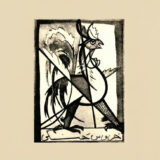
Text of the lecture by Master Jalil Ziapour at the Fighting Cock (Khoroos Jangi) Art Association, published under the title “Painting” in “Kavir” magazine, Issue 1, pp. 8 to 18, year 1949–50.

Master Jalil Ziapour (the Father of Modern Iranian Painting), 1949
(To turn the simple and single artistic matter into the form of two contradictory beliefs, “art for art’s sake” and “art for society”, and to make it into Uthman’s shirt and raise an outcry, is nothing but sowing division in the mind).
. . . . . . . . . . . . . . .
These truths that in an eternal absolute form govern all the affairs of human life, these seemingly immutable truths, are not truths that will remain in their own state forever; for the flood of need and events gradually uproots such petrified truths so thoroughly that, once they are uprooted, we are astonished at all our misplaced attachment: was this that firm truth?! That thing to which we were bound for lifetimes and which was thought to be self-subsistent and eternal?! Yes, it is such faiths without knowledge that we always, after wasting some part of life, sometimes come to realize. It must be known that every truth is always enduring only in the essence of the matter: like the essence of good and evil, which are eternal, while in form and appearance, according to demand and time, they are changeable and convertible. Knowing this matter, a thinker can easily detach his heart from seemingly immutable truths and quickly place himself in the current of a logical mode of thought and lightly fly above all misplaced attachments and bring himself to the necessary zone, that is, the zone free of superstitions, free of unnecessary constraints, free of old customs and banal and mummified habits. Here it is thought that undertakes an important duty. Imagination too, by way of intervention, goes shoulder to shoulder with it, and to a considerable degree makes its way into the course of thought and changes the manner of its movement at will. The importance of imagination in human life is not so slight that anyone could have failed to realize its value. With its causes and basis, what it is and where it comes from, we have nothing to do for now; but this much is certain, that its existence is the greatest motive and the most influential means of creation, and it is that very thing which, after the feeling of need, with the help of thought: which is always accompanied by logic, pushes back ordinary truths and makes new truths accepted. Therefore, if a daydreamer makes no claim to the existence of new truths, his lack of claim never proves the non-emergence of new truths by him or by others; rather, without doubt the needs of the age bring them into being, though perhaps later. In this case, since a claim based on new truths is unusual, and people in general, because of a lack of quickness of comprehension, feel the needs that are sprouting in the course of life later than artists do, for this reason these new truths become hard for them to accept; whereas the mind of artists, through their quickness of comprehension and their encounter with hidden and unripe needs, is aroused, and like a diver in the deep sea of needs, searches for the necessary desires. A. Breton says, “To discover a new truth, one must follow the train of imaginings and excavate the depths of the mind, for only by arousing the mind does bringing newer and more necessary truths into being become possible.” It is with this very belief that Surrealist artists, outwardly without taking into consideration the purpose and meaning of a subject “whereas in the inward reality of the matter a meaning and a purpose are spontaneously in view”, have begun to work and explore. If the Surrealist, under the name of Surrealist thoughts, seeks satisfaction of mind and flees from realism, it is because this realism is an ordinary, insufficient, limited truth, pleasing only to a great many uncultivated and ordinary people. The Surrealist or Supernaturaliste, in order to raise an ordinary realism to the utmost degree of its possible elevation, strives to lay wider fields before limited realists. By this method he naturally gives realists a sufficient power for perceiving the higher forces of nature “that is, the Supernaturalist stages” and turns the mind toward more numerous and more far-reaching truths. It is for this very reason that bringing into being every kind of wonder: “which in every case is the greatest factor in stimulating the mind” is considered one of the notable factors of the Surrealists, and it is in this way that they lay the foundation of a great mental movement.
. . . . . . . . . . . . . . .
I have said before that in order to bring a new work of art into being, it is not necessary for a person to spend all of his powers on following a handful of formulas, or a series of operations under the name of tested things: “which are fetters on the feet of initiative and innovation”. It is these very attachments and immutable, or mutable but slow, conventions, and this very insistence of fanatical critics and art connoisseurs on applying them, that have caused the Surrealists, in order to break this hateful barrier and obstacle to their necessary operations “which had been undertaken for the sake of fulfilling spiritual needs”, to decide upon an effective artistic movement, and in this matter too, all of them without exception to become united in thought that: (the mind can never be bound to anything in life “which appears fixed, immutable, and according to exigencies, expedient and limited”) Therefore Surrealist artists set the subject of mutable truth “which is accepted by every alert person” as a surety for strengthening the foundations of their artistic demands among the other foundations of their beliefs, and for artistic manifestations they themselves claim a wider right against the expedient limitations of the opponents, and wherever they encounter intellectual and mental petrifaction and the hollow criticism of critics and objectors, with weapons and theories of this kind: (“that in principle everything undergoes evolution, and everything that comes into being, it is because of necessity and need that it comes into being” and that: “the desire of a logical mind comes into being out of the hidden, dark, and unformed needs of a needy society” and that: “the mind too possesses a series of gradual evolutions” they charge across the field and say: “No individual and no law can in any way limit the Surrealist in meaning”) Despite all this, these artists meet with many objections and have repeatedly engaged in contention with opposing factions. Maurice Nadeau, author of the book History of Surrealism, says: (the views of the Surrealists are not satisfactory from the standpoint of general conditions, and this subject “as Breton shows in his own book What Is Surrealism Qu est-ce que Surréalisme” is still under discussion among themselves.)
. . . . . . . . . . . . . . .
Yes, they have repeatedly asked what useful thing these artists can accomplish from a social point of view “because the attention of the opponents is mostly on this, that artists too, like other people, should enter political and class struggles, and in this way they want to put their existence, mind, spirit and work to use in politics!” Therefore, Pierre Naville, although he strikes now at the nail and now at the horseshoe, and with partialities of this sort: “that our era is not an era of prophecy; but an era that foresees” takes some steps in favor of the Surrealists; yet in principle from the standpoint of a positive social method he is not all that optimistic toward the Surrealists, and Pierre Naville, on the basis of the artistic manifestations that the Surrealists showed of themselves in the years 1925 and 26, draws this conclusion: that they mostly have mental and metaphysical manifestations, not practical and decisive ones; and following this very subject Maurice Nadeau says: (assuming the impossible, if these artists can in some way acquit themselves in this respect and want to prove that they think materialistically, not metaphysically; and that: “they do not take steps in the domains of abstract thoughts” even then they still cannot set about expressing the essence of their own intention as they should, as to what they say and what they want. In addition to this, up to now they still have not submitted to art in the service of society! It is not clear what their ultimate purpose finally is, and with this hubbub and mental uproar that they have created for people and people of taste, what do they have in their heads?!)
. . . . . . . . . . . . . . .
Instances of objection of this kind are of course abundant, but the point is this: the opponents of Surrealism and of the progressive schools, since for the time being they pay attention above all to a specific society and for the time being have its interests in view above all else, they therefore resort to every means to reach this purpose, controlling everything and everyone! On the ground that they must not accept it, or, as they themselves say, that its aim is not as clear as it should be! they consider Surrealism deviant; and since at times in the midst of this they have apparently grasped something of the truths of the speech of these artists, they come round a little more gently and reasonably and set about thinking, and also in the course of logical discussions, here and there they look for pretexts! Such inferences, as we shall see, are quite evident from the grounds of the claims of both sides.
. . . . . . . . . . . . . . .
Maurice Nadeau says: “These artists do not have the ability to express their intention in a way that is convincing”. Unaware that this claim cannot hold true in any case, for if the Surrealists cannot make a group understand a matter, it is not because they lack sufficient logic and reason; rather it is because the other side either does not have the favorable grounds for understanding the matters, or does have them, but out of expediency does not want to accept it. Despite all this, taking exceptions into account, from time to time they show good taste and finally prepare themselves to understand the intentions of the Surrealist and progressive artists; but, as was said above, since they suppose that Surrealism cannot introduce itself as it is and as it should “just as is the custom of the opponents, who both think and draw conclusions for others” here too, for these artists, they both think and draw conclusions. Maurice Nadeau says: (the desire of the Surrealists has become an enigma for us in life, nevertheless the body of ideas of this group can be analyzed as follows: “The Surrealists have two kinds of thinking, one is its metaphysical aspect, which, according to the interpretation of Pierre Naville, is a kind of theory that may have come into being in a scattered and unorganized manner from the totality of events and experiences accumulated in the affective domains of these artists” and the other is its logical and orderly aspects: (that the manifestations of the second kind may be a kind of gradual evolution of the mind))
. . . . . . . . . . . . . . .
With this explanation, the conclusion becomes as follows: the first point, according to the interpretation of the opponents, is naturally not worthy of consideration, and the second one too, although it apparently seems logical to them and they feel that the claim of these artists may truly be based on a foundation and validity; yet since in any case it is opposed to their purpose, therefore they intend not to accept it and say: (even assuming the acceptance of the gradual progress of a mind toward perfection, must one, for this very reason that the gradual elevation of the human mind is inevitable, accept the freedom of individual minds and beliefs and desires “without taking into account the present situation” and leave free such persons who, without waiting for others, rush ahead rapidly on such pretexts, or, if accepted, can leaving them free be a reason for leaving the human mind free toward perfection and elevation? They conclude that no, none of these is a reason for us to leave the mind free without control on the path of life, in the hope of an upward course. If a mental freedom that brings about elevation and evolution is to be accepted, it is certainly thinking in another manner, that is, thinking only in accordance with our desire and theory, not in a Surrealist and Existentialist way; and again they say: even where Breton in his writings conveys that there are subtle troubles among them, he had understood well that if in his debates he did not observe the necessary care and did not acquit himself of the debate logically and properly as he should, he would naturally fall into danger and be sidelined from the position of his artistic claim. In September 1926, in a publication that he issued under the title Legitimate Defense, without answering the question of Pierre Naville, how well and skillfully he wanted to pull himself out of the field of our severe and crushing criticisms! Here Breton complains of us, the opponents, and calls us bigoted and foul-mouthed and counts our objections as hostile and ignorant! Yes, he considers our method biased and ignorant, but let him not forget that for us and in our method no artistic ambiguity has any value until it is analyzed according to sound logic and its purpose becomes completely clear. We cannot let persons put their inner and mental experiences and stores into practice “without our having controlled them”. These artists want to manifest their inner experiences in complete freedom, without specifying their goal! They want to pour a handful of mental melancholia, in the name of experiential stores necessary to manifest, into the marketplace of society “a society that has enough melancholy-inducing entanglements of difficulties of its own”! After all this talk “which is the gist of the demands of this group of artists” only then does Breton begin to attack and makes the inner and outer worlds Subjectif objectif a means of charging into the field and obtains another means of attacking and turns attention toward the mental worlds and its gradual elevation, and in the end says: “Yes, here two difficult subjects arise, one is science and discovery and its gradual evolution, which is willy-nilly imposed on us, and the other is the tragic deeds of the vast host of human society, in which no individual can consider himself without a part and a share: these two difficulties are instinctive, and neither one can be disregarded.” That is, Breton wants to say and request that despite knowing this matter, nevertheless, solely for the sake of the necessity of the freedom of the mind in progress and evolution “which is practical and logical” they should leave them free! so that in any case they may reach the ideal of their individual benefit, that is, the creation of non-social and abstract works!)
. . . . . . . . . . . . . . .
With these brief yet considerable outlines that have gone before, which were sufficient for a general understanding of the beliefs of both sides in art, it is clear in what manner of thinking each one moves. The general conclusion of the matter is that: Surrealist artists and progressive schools, without taking into account the beliefs of various groups, without particularly wanting to take individual or public interests into account, engage in continuing the reaction that the environment has brought about for them and over whose emergence they have no control, and at the same time they want, by means of this reaction, to advance in art in favor of completing their own logical theories “as has been said”; but the opponents call this kind of artistic thinking and operations abstract and non-social and strongly oppose it, for they want, in any case, whoever brings anything into being to bring it into being for the benefit of the common people in a way that is understandable, not in any other way! Therefore, the advancement of any kind of artistic desire and manifestations regarding which the capacity of comprehension of the common people is low, or which is incomprehensible to them, is wholly rejected and deserving of the severest excommunication! Freedom of action in art too “that the artist must be free”, in the belief of the opponents, is apparently very necessary and inevitable; but a necessary freedom under conditions! “where those conditions, wrapped in love of society, are entirely imposed; for what if he should deviate!” Strange! What a good pretext such freedoms and conditions and such excuses and philanthropies are for the opponents and critics! There is no doubt that, willy-nilly, everyone is subject to social impositions by natural compulsion; but the question is how one must separate social impositions “which naturally rest on the foundations of natural compulsion” from the bullying of a faction; and who must distinguish this natural compulsion from an imposed compulsion of expediency? Who is it that distinguishes the deviation or correctness of an action, the whole of society or individuals from that society? Are these individuals not those same thinkers who, having particular beliefs, “the individual mind”, which they have acquired from the way of life of their society, because they have deemed the application of those beliefs expedient for advancing their life, have given themselves the right of leadership? Is it not the stores of the experienced and individual mind of these thinkers that have made them successful in accomplishing such deeds? If they say: “an individual mind that takes individual benefit into account and an individual mind that has the public benefit in view are two opposing minds, and furthermore it is the stores of the experienced mind that must intervene in the affairs of society, not raw and inexperienced mental stores” certainly there is no dispute in this objection, and an inexperienced mind must never intervene in affairs; but it must at least test this, and for this testing too, must it not explore? Thus it must not be limited and must be completely free. Therefore, objecting to the existence of the individual mind and abstract thoughts and their coming into operation in society “in the event that no one wants the mind to enter the stages of free exploration so that it may become experienced” is not fitting at all; and if the effusions of the individual mind “which in any case are born of the totality of social factors and impressions” are not understood by the common people, that is no reason to stir the common people up to seize the artist by the collar, cast him down from his seat of honor, and roar that: “since we do not understand his art, he must therefore bring into being a work that is pleasing to our mind and taste and understanding, and so long as we do not understand, difficult-to-understand art must not come into being either!” In that case, must the artist advance at the pace of the common people? Then when and how should he bring into being works that draw upward the taste and understanding of his people? For raising this taste and understanding, must he not always show higher stages, and do difficulties not naturally arise in these manifestations? Must these difficulties be removed from the side of the artist or of the people? It is right here that the opponents of avant-garde art, due to lack of necessary attention, have turned the simple and single artistic matter into the form of two contradictory beliefs and have made it a means of criticism and of airing their own personal motives; unaware that if they look closely into the origin and root of these two apparently opposing beliefs, they will find no difference whatsoever except that in order to make a show of taking the side of social rights! they have started an unreasonable quarrel; having fabricated the social and non-social artist, they claim that “the artistic product must be understandable to all and social; and if the artist is avant-garde and progressive, he must be in such a way that he does not have that distance from his own society across which no connection can be established between them; and since the realities of the life of a society are like stores in the brain and soul of the artist, he must therefore return them to his society in the form of interesting and useful works of art” One must ask, which artist is there who, from the standpoint of sound logic, can be considered “even though he be the most avant-garde individual in the world” far from his own society? Or which artist is there whose most important work is not that work which represents his close contact with his own society? Or which artist is there who does not take into account the realities of the life of those around him and of his own environment “to which he has grown accustomed and which have formed his artistic and intellectual backgrounds” and brings works into being out of things that he does not know and by which he has not been affected? The claimants of art for society forget that if the belief of art for art’s sake “which they themselves have coined” finds a meaning among avant-garde artists, in any case its meaning cannot be this: that art for art’s sake means not being in the service of society; rather, its meaning can certainly be this: that art for art’s sake means possessing the aspect of artistry before everything else. Such an art comes into being in painting because the course of art demands it. Because the need of the time brings it about for the artist. Because the artist is brimming with impressions formed in his own affective domains. Service to society too is spontaneously latent in this act; not that it comes into being deliberately for the service of society. No, no one’s heart has burned or burns for anyone else, just as the heart of society had not burned for the likes of the Beethovens, the Anatoles, the Cézannes, the Rembrandts, and others “who during their lifetimes grappled with difficulties and death”. Are those very ones not considered today the leaders and gods of art? Are they not those same ones whose works, because they were far from the reach of the understanding and comprehension and liking of their own people, were therefore rejected under labels of this sort “art for art’s sake and the like”? Are they not those same ones who today are welcomed to the point of worship? Those very ones who in their own time had brought non-social art into being?
. . . . . . . . . . . . . . .
Those who, on the basis of specific beliefs and under various hostile labels, excommunicate avant-garde artists forget that such excuse-making can never become a means of driving true and informed artists from the field. These objectors or followers of Pierre Naville and Nadeau, and they themselves, even if they do not know what great harm inventing art for art’s sake and thereby casting division between artists and society will entail for the artistic understanding of society, it will be a great error.
. . . . . . . . . . . . . . .
The subject of science and discovery and the reality of the deeds of human society “which Breton has pointed out” are two noteworthy matters that can never be denied. No one loses sight of the dragons of oppression into whose mouths mankind has sunk in the course of its life, and of the failures of every kind it has seen; there is no doubt as to the existence of this shared principle. The Bretons and the Picassos never deny human suffering and do not lose sight of the tragic deeds of man throughout the centuries; but in their work they are certain that “the coming into being of a necessary artistic truth is always indebted to fleeing from the imposed realities of the givers of orders and the critics.” These are the very orders and conventions of the past from which avant-garde artists flee to an extreme degree. One must not forget that it has been the existence of these conventions and commissions and unnecessary realities that has always wounded the innovative and creative spirit of artists, becoming the cause of artistic revolution after revolution and reaction upon reaction. Who is it that can discern the truth of this matter as one ought?
. . . . . . . . . . . . . . .
Surrealism, with its necessary mental method “even supposing it goes astray or shows a reaction”, leaves open a wide window for the curious and shows them a way of escape so that they may come out of whatever is intellectual rigidity, the limitation of rules and artistic conventions. For a prisoner, nothing is more valuable than complete freedom; the Surrealist, too, like a prisoner, for the time being demands this freedom. Like a thirsty person who thinks of nothing except quenching thirst, he too thinks of this freedom of action. He madly turns everything upside down. He scatters out every kind of thing to be said, seen and heard from the half-lit house of his mind so that he may be certain that he has freedom of action and has come out of constraint and limitation. His mental effusions make him certain of freedom of action and escape and deliverance from bonds. It is only in this escape, that is, in the display of reactions, that he finally encounters another and more correct truth, though again by way of the mind; and that is: settling from agitation into calm and beginning the correct path of Surrealist art, and this is the very path that the calmer and more thoughtful Surrealists traverse. One must not consider Surrealism a school among the schools in the world of meaning, mental and metaphysical, one must in reality recognize it as a living being that wants, like other beings, to continue its own life. Surrealism, with its mental method, seeks out a higher culture; and since at times it excavates the dark pits of the mind and in this excavation encounters stores of experiences “which appear necessary”, therefore at times it also submits with reluctance to these experiences. Nor does it remain heedless of chance. The Surrealist in any case considers himself wholly avant-garde, and intentionally and out of hatred for ordinary taste and beauty, flees from whatever is taste and beauty, and hates whatever is will and logic and rule and sagacity and whatever has been wrapped in the cover of artistic convention and experiences. His works of this time are discordant wails from a scratched throat, the reflection of which returns once more to the depths of his own uneasy and troubled mind; and he feels pleasure from the fact that this wail is the reflection of his own free voice. The Surrealist knows that it is again he himself who saves him from this distress and uneasiness; therefore he engages in search, knocks on this door and that door, seeks madly and with foam on his lips until he finds his desire. Are not these repulsive wails of the Surrealists, which are reflected in the form of a work, representative of the distress of human society in this era? Why, yes? But in painting, the method of Surrealism, from the standpoint of expertise and technique, is mistaken…
By Ziapour - Aban, one thousand three hundred and twenty-seven