by
by Text of a lecture by Master Jalil Ziapour at the Anatole France Cultural Association (Tehran), published in the weekly “Azarpad”, No. 9, 20 May 1950

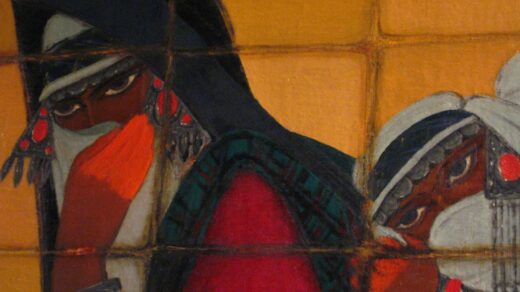
Master Jalil Ziapour; “My Husband Applies Henna”; 1963; national and individual style; oil on canvas; 170 × 120 cm.
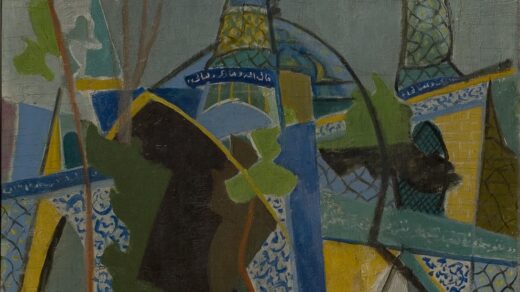
Geometric painting, or Cubism, had taken root, and its opponents, experts, and critics were gripped by an anxiety such that they had nothing to say other than to repeat clichéd remarks, and we too continued our work. Geometric painting was not foreign in our Iran, and if it had been prevalent in Europe for about forty years, in Iran, it had a history, foundation, and substance of more than six thousand years. Every day, we step and walk upon our diverse carpets with their geometric shapes, and we never ask ourselves which of the masters created these patterns, and which of our creative masters laid the foundation for these intricate geometric designs on the surfaces of domes and on the walls of mosques. Perhaps we have never thought about them. We have only opened our mouths and looked at them in astonishment! And no master has ever explained them to us either, and we have understood nothing of their importance. But we have always praised them blindly and without awareness.
Here, I will not explain to you in detail the process of the emergence of Cubism. But I will speak directly, in a brief and useful manner, about the goal of the followers of this school: what does the Cubist say and what does he want? Why does he paint unnaturally, and for what reason does he employ fractured lines and planes or exaggerated colors? The art of every era is subject to the life of that era, and the type of life in every environment has a significant impact on people’s way of thinking, and progresses in parallel with demand. If we look at the living conditions of the people of the era when Cubism was taking shape, we see that it coincided with the taking root of perceptions that became the prelude to war, economic pressure, and the penetration of mechanized life. In the interval between these two wars, you are well aware of how people became uneasy, anxious, and harsh in the affairs of life, and you also know that this century has overall been the century of mechanized life.
Since every work must represent the spirit of the people of its time, today as well, when people are in the current of mechanized life, it does not require that others deal with the tools of past eras. When a new method comes into existence, despite the persistence of some of the characteristics of the past method, the new method advances with maximum penetration and, in proportion to the conditions of life, develops differences from past methods. That is to say, the rose and the nightingale do not always become the means for composing poetry and the creator of literary beauty; rather, the whistle of the machine and the train takes the place of the song of the nightingale, and the massive machines that turn the wheel of man’s life today fill the place of the lily and the hyacinth.
It is natural that one should not expect a flower, for an artist who in this era finds himself at every moment face to face with machines and new inventions, to have the same charm as a delicate cog of the massive apparatus of a machine. Rather, the petals, under the firm brush and harsh lines of today’s painter, turn into a solid, heavy material body and show a life that is entirely mechanized. It is certain that the clamor of the machine age will have a harsh romance. Within these harshnesses, pleasant charms of the exact same nature as those harshnesses lie dormant. These are not comprehensible to those who do not live in the present day and have not been placed in the flow of thought of this era.
Cubism is the representative of the spirit of the people of today. Harsh lines and fractured planes are representative of the work of the people of this era, and are a faithful document of the life of our times, portraying us just as we live. The painter, in this style, does not want to create the likeness of a tree, a human, or an animal. He wants, first of all, to show a general principle, that is, “the era, the beauty, and the taste of his own era.” The painter is also a writer. Only, a writer who expresses emotions through images and designs. He reflects what he feels onto the canvas in the form of color, design, shape, and composition. It is natural that everyone has their own specific way of thinking and outlook. A simple piece of stone lying in a corner may not seem as expressive and interesting to ordinary and common people as it does to a Cubist painter who wants to pour his visions and thoughts into appropriate molds belonging to the machine age. These natural molds are, most of the time, inadequate and cannot convey the painter’s intentions. Out of necessity, he strives to create appropriate molds from ordinary molds. You, because you are unfamiliar with these new molds, of course object to them; but one must never stand before something new with an eye of objection. One must stand before it with an attitude of understanding and curiosity.
The Cubist destroys traditional as well as natural molds, and shatters the outward form of these familiar molds to which you have long been accustomed – these very trees, people, these very appearances that you regularly encounter – in order to create a mold with which to realize his precise purpose. Here, it is the design and color that transform. Now, if you look at the works of the Cubists with this view I have mentioned, you will see that lines have not enveloped every color without reason, and colors have not become exaggerated without cause. Weak and matte colors represent lethargy, coldness, and lifelessness. In such colors, the clamor of this kind of life we are in is not apparent.
The Cubist brings loud and living colors onto the canvas to reflect in them the clamor of mechanized life. Through such actions, the Cubist painter expresses the realities of life and our spirit much more correctly and with greater likeness; and this likeness is general, not particular, profound, not superficial. Artists who flounder in the midst of this flood of transformation, or throw stones of excommunication at us, make a futile and negative effort. For whether they wish it or not, new art progresses. I always say in a resounding voice: “Even though you judge incorrectly, I know that future generations will judge correctly.” Painters who deal with past schools are not the painters of today. They only ruminate on the lives and romances of past eras.