by
by Interview with Jalil Ziapour, entitled “What Is Art and Who Is the Artist?”, through the Anatole France Cultural Association, broadcast live on Gendarmerie Radio, published in the newspaper “Mehr-e Iran”, issues 2145 and 2148

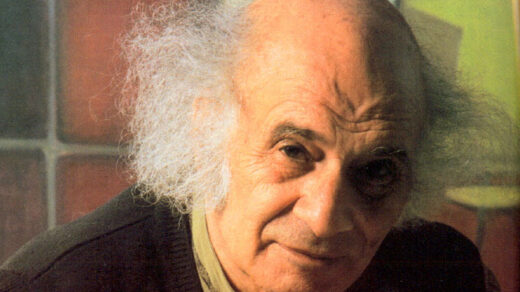
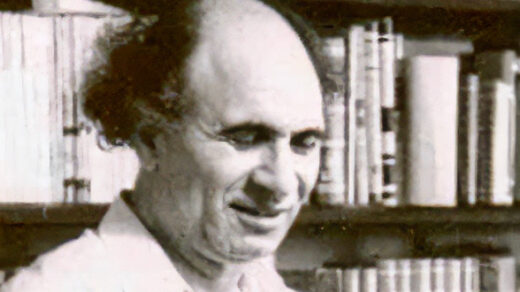
Master Jalil Ziapour, the Father of Modern Iranian Painting
The title “What Is Art and Who Is the Artist?” was a face-to-face artistic interview with Jalil Ziapour which was broadcast live on behalf of the Anatole France Cultural Association of Tehran, via Gendarmerie Radio, on 11 and 15 October 1949, and the exact text of the interview was also published in the newspaper Mehr-e Iran in issues 2145 and 2148 under the aforementioned title.
Q- Mr. Ziapour, it was arranged that we would conduct an interview regarding the art of painting. I wanted to know, what is art and who is the artist?
A- Although I have given many answers to such questions, comprehensively one must say that, in my view, art is a praiseworthy composite work of the whole or a part of the effusions of the artist’s mind. The artist is someone who is capable of expressing the subject of his work (his inclinations, emotions, and the effusions of his thought and feelings – altogether, unusual themes).
Q- Why did you say unusual inclinations and emotions?!
A- Because the expression of usual inclinations, feelings, and themes, being usual, does not require artistic expression. For the non-artist is also capable of describing them, and non-artistic expression does not require artistic precision.
Q- In that case, Mr. Ziapour, why do these new arts, which for some time have been claiming to express unusual and artistic feelings, have no precision of expression at all? For example, these crooked lines and bizarre shapes that they have named Cubist painting, and which have recently become prevalent in our Iran as well, what feeling do they arouse?
A- Madam, the discussion of painting in general, and Cubist painting in particular, is extensive; but know this, that Cubism and its strange shapes are to this date the most expressive mode of the times in painting. No other style has been able to accurately describe the living condition of the people of the machine age with the skill of this style. This style of painting has been founded upon older paintings. These shapes, which seem bizarre to you, have not appeared without cause.
Q- Ultimately, can we not understand this cause?
A- Of course you will understand; but do you not wish, before hastily passing an unconsidered judgment on a method of work, to ask yourself why this method of painting has endured in the world for a full sixty years, and has continued its progress in this very same manner?
Q- Why yes, Mr. Ziapour, but I have found no reasons in answer to my questions!
A- Not finding them does not become a reason for a method to be rejected. You must know that painters who, in the schools of Cubism, Fauvism, and other artistic schools…
Q- Excuse me, did you say Fauvism? What school is this?
A- Madam, I will of course explain these schools to you and tell you the reason for their naming, but for the moment, know that the painters who work in these schools are none of them bound to the ordinary shape of nature; not that they disregard it entirely, no. The meaning is that they do not imitate and copy nature just as it is, but rather, they select what they need from nature, combine them together, and out of this combination they bring a new nature into existence which differs from ordinary nature.
Q- Must it absolutely differ?
A- Absolutely. Because if it did not differ and were identical to ordinary nature, then it would become the description of a normal and ordinary nature; and it is obvious that the description of a normal and ordinary nature requires no artistry, and everyone is capable of it. And I said that artistry occurs when an extraordinary and unusual nature has been described with power and skill.
Q- What is meant by extraordinary nature?
A- It means that nature which the artist creates, and which is not ordinary or familiar to ordinary people.
Q- From what, and how, does the artist create it?
A- To display events, the artist makes use of the outward appearance of nature to the necessary extent by altering their shapes, and brings a composition into being from it. We call this composition extraordinary.
Q- Well, Mr. Ziapour, when a work of art comes to differ from ordinary nature, what happens?
A- What do you mean “what happens”, Madam? I must only say that in this state, this extraordinary nature becomes the sign and representative of the views and thoughts of the artist and the people.
Q- Does a firm relationship exist between ordinary nature and extraordinary nature?
A- Of course, Madam, a very firm and inseparable relationship exists. With the reasons I shall present in future sessions, you will realize that, in essence, extraordinary nature is an extraction from that very same ordinary nature. It is only that for those who are not familiar and do not possess the necessary attention and study, this extraordinary nature is unfamiliar.
Q- Can the artist not find his own views in ordinary nature?
A- No. Ordinary painters, who possess ordinary views, solely make use of the existence of ordinary nature, and describe that very thing, in that very state, and in an ordinary manner. But there are certain painters who have extraordinary and unfamiliar things to say and show, which require further explanation, and ordinary nature is incapable of translating the intentions of these kinds of artists. By necessity, they, through making use of the existence of ordinary nature, create another nature which is extraordinary. (Of course, there is evidence to make these matters clearer: one piece of this evidence is the course of the various methods of painting throughout human life. If a brief review of them were made, naturally this question would arise for you: why have all these various methods in painting come into being? Are these methods, which have come into being one after another, each the complement of the other? Or does each represent the manner in which life flows, or has each come into being out of whim? When we look carefully, we find that nothing has come into being out of whim, but rather it is solely necessity and need that has brought them into being (although whim, too, arises from needs), a necessity and need that has been very transient.)
Q- Then I shall pass over it. Please explain this course briefly to us yourself in another session, but on what subjects was our discussion today?
A- The matter was this: “Art is a skillful and praiseworthy composition of the effusions of the artist’s thought, and the artist is someone who is capable and skilled in expressing wants and describing extraordinary emotions and feelings. Another point is that the painter artist does not imitate and copy nature, and I provided reasons as to why he should not imitate it.”
(The Next Session)
Q- Mr. Ziapour, it was arranged that you would describe the characteristics of the school of Cubism.
A- Yes, that was the arrangement. First, let us know what school is called Cubism. You know that Cube means volume. In this kind of painting, the painter is mostly dealing with geometric lines and planes. For this reason, this method of painting was named Cubism or geometric painting. One of its characteristics is that, in terms of coloration, it is much more vivid and more expressive compared to previous methods (when I say more expressive, the meaning is that each color that is placed beside another color by means of the brush is not mixed with the neighboring colors, and is placed separately beside the other colors without a connector).
Q- Mr. Ziapour, what grace and what logic is there in this work?
A- The question is apt. One grace of the work is that it lifts the veil from the ambiguity of nature, and makes the recognition of mysterious and extraordinary nature easy. (Although for ordinary people it brings about another ambiguity).
Q- Mr. Ziapour, understanding the work has become entirely difficult. We believe that Cubist painting is essentially ambiguous and unfamiliar, but you wish to clarify that it shows the complexity of nature more clearly?
A- Yes, contrary to people’s views, this kind of painting is, in terms of understanding, much simpler and more expressive.
Q- Mr. Ziapour, in this kind of painting, how is the ambiguity of all the colors of nature removed? This painting itself is all ambiguity.
A- No, it is not so. If you look at paintings that have been painted in the natural style, you see that the painter has mixed and blended two colors that are situated beside each other in such a way that discerning the boundary between them is difficult and often even impossible, and your eye glides over these two colors without your eye stopping at the unspecified boundary between these two colors. It is exactly as if you were looking at a dream, a hidden chamber, and a mirage. This itself is ambiguity. But in Cubist painting, this ambiguity, which is not the ambiguity of painting, has been removed.
Q- Mr. Ziapour, you said it is not the ambiguity of painting; what does this mean?
A- It means that showing and describing this ambiguity is currently the work of poetry and literature. In nature, colors are never intertwined and complex. That is, there are points in nature which, from the standpoint of specialization, become more connected to a specific art. That is, literary and poetic subjects, sculpture, music, and painting, have differences, and each is better manifested by means of a specific path. For example, “At dawn the breeze rises softly, so that dew does not fall from the rose leaf.” This subject cannot be expressed with other arts with the delicacy with which the art of poetry has embodied it. Thus, every subject is suited to a particular art, and every explicitness and ambiguity is fitting for a specific art.
Q- Then how did Cubist painting eliminate this ambiguity of coloration that you spoke of regarding two colors?
A- In Cubist painting, chromatic ambiguity was removed in this way: two colors, instead of being gently blended and mixed together to some extent, are simply placed beside each other, and for the boundary of these two colors, a third color is chosen which is a combination of these two colors. For example, the boundary between black and white is gray. Thus we see that colors become manifest here, and instead of chromatic intermingling and ambiguity, they acquire a simplicity that every eye can distinguish, and we see that this kind of painting became clearer than nature. That is, complex nature has been simplified in the hands of the painter artist.
When the school of Cubism, in order to simplify nature and make it comprehensible to the public, has taken such a fundamental step and has described nature artistically, does it not truly seem simpler than other methods of painting? Now, if it is novel to the people and they are not familiar with it and it has not become ordinary, of course, little by little they will come to realize it and will recognize its value.
Q- Mr. Ziapour, here Cubism provided the means for recognizing one part of nature, namely its coloration and chromatology, and lifted the veil from ambiguity and difficulties; but what do they say about its bizarre and strange shapes?
A- This too is an important matter. In the previous session I said that ordinary painters possess ordinary and usual views and try to make use of all the visible things of nature. But other painters have extraordinary and precise things to say and show, and they are compelled, in order to present their intent, to increase and decrease nature and to alter its shape, and to this alteration of shape, they are obliged. I shall make this matter clearer with an example. A painter who wants to paint someone (of course, a painter who is an artist and is described by the attribute I have defined).
Q- Excuse me, how had you defined the artist?
A- I had said, “The painter artist never agrees to imitate the outward and ordinary nature. That is, he never has dealings with ordinary appearances,” and I had said: “The artist is someone who is precise and skilled in expressing extraordinary inclinations, emotions, and feelings.” Thus, if such an artist wishes to paint an individual, he does not content himself with the outward appearance of that individual (although the outward appearance is indicative of the inward), but considering the view of the poet, who says:
You see the hair, and I the twisting of the hair
You the eyebrow, I the gestures of the eyebrow
we see that, for the creation of a work, attending solely to the outward appearance is not sufficient, because seeing the twist and curl of the hair differs from the hair itself. Therefore, the painter must bring the thoughts, manifestations, and psychological states of his subject onto the canvas. That is, he must perform a work much higher and more valuable than photography. In order to construct the inwardness of beings and precise manifestations and psychological states, the painter must intervene in outward nature and also exaggerate. That is, he must show that which is so, as even more so.
Q- Then, Mr. Ziapour, do you mean to say that one must make a caricature?
A- No, no, this is an absolute mistake. Caricature differs from modern painting and from these definitions I have made. For example, pay attention: in caricature you alter the outward appearance to the point of jest, in this way: that if someone’s eyes are large, you make them appear larger, and if they are small, smaller. These changes and exaggerations are suitable for journalistic work, whereas the changes of painting are not jocular. Rather, manipulation and change in nature are for finding a specific shape with the aim of showing the interior of the mind and the “I” of the subject in a serious and profound manner. To show the inwardness and psychological states of someone, you are compelled to relinquish the outward appearance and to content yourself solely with certain very distinct and identifying lines and signs (from the outward appearance of the subject).
Q- Mr. Ziapour, you said earlier in the course of speaking: “Cubism removed one ambiguity from nature but, in exchange, put another ambiguity (albeit a more necessary one) in its place”?
A- Yes, I shall clarify this matter once more with the help of the previous explanations. The first ambiguity was in coloration, which I said it eliminated. The second ambiguity is the very alteration of natural forms, which appears unnatural, and the painter breaks the head and tail of nature and makes it appear crooked and misshapen, and by this act creates a difficulty for the understanding of the subject, and this difficulty is that other ambiguity which was mentioned.
Q- You said Cubism has brought about another ambiguity that was appropriate and necessary. Why was it appropriate and necessary?
A- For this reason, that with this ambiguity (by altering the shape of the images), it was able to describe precise points. Because this ambiguity came into being in order to describe more precise points of the “I” of the subject. Thus, naturally, its existence was necessary and appropriate, whereas in previous methods, the ambiguity in coloration remained in its same state, and with the outward forms of nature, the description of precise points was also impossible. In fact, one must say that unaltered painting, confined within the four walls of constraints and bound to ordinary, outward nature, was powerless and weak and possessed an inadequate expression, and the people too were accustomed to those same constraints and language of ordinary paintings, and these two (ordinary nature and the people) were progressing with very minor and slow changes.
Q- Mr. Ziapour, you spoke of the ambiguity of colors and the ambiguity of shapes; of these two, which is more necessary?
A- Neither, these are not necessary, because the artist must strive to split open the ambiguities and to explain and describe complex nature in a beautiful manner. Whatever he feels, he must bring to the stage of perception. Then, with technical skill, he must present them much more clearly and vividly than perception, that is, exaggeratedly and in an artistic form.