by
by Article by Manouchehr Foroutan, titled “Critique of the Critique of Ziapour’s Lecture”, Iran Newspaper, No. 8787, 4 May 1949.
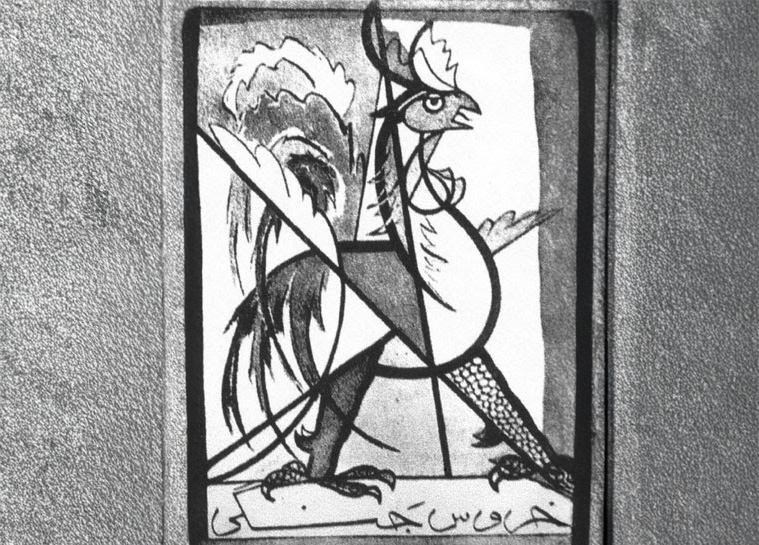
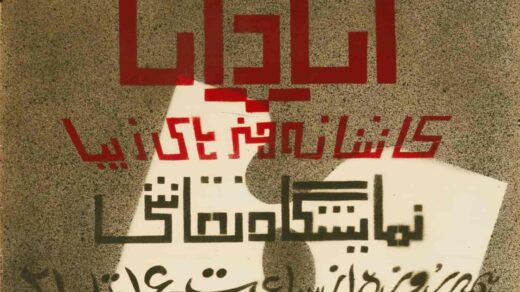
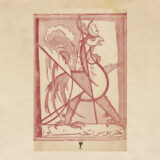
The emblem of the Fighting Cock Association, designed by Master Jalil Ziapour, 1948
This note is the reply of Manouchehr Foroutan (a painter and supporter of the “Fighting Cock” Association) to Manouchehr Sheibani’s criticism of Master Jalil Ziapour’s lecture on “Gharib and the Method of Writing in Iran”. Foroutan writes that Master Ziapour did not himself offer a precise literary critique but only a general opinion, and that this is the right of every artist and of every literate person. The text opens with an introduction by Master Ziapour himself about the roosters who supported the association.
It had become such that all supporters of the Fighting Cock (Khorus Jangi) Art Association (even fame-seeking opponents) would later call themselves Roosters (Fighting Cocks) and address each other as such, expressing warmth in their modern thinking and like-mindedness, and offering mutual assistance when necessary.
One of these supporter Roosters, who was also a talented painter, sent an article under the title of Critique of the Critique (concerning Ziapour’s Lecture) to the Iran newspaper, in response to the Rooster (Sheibani):
Respected Editor of the Iran newspaper, I request that you publish this article in refutation of Mr. Sheibani’s critique, which he wrote concerning Mr. Ziapour’s speech.
Mr. Sheibani had engaged in careless writing concerning Mr. Ziapour’s speech, speaking in a manner unbecoming of a critic, and in many respects it was clear that he was acting out of personal motives. Therefore, his writings can by no means be called a critique.
They say: Mr. Ziapour has no right to critique writing, and they have presented his statements as evidence with incorrect and erroneous conclusions (claiming that his critique is not deep and that he has overstepped his bounds).
This seems strange. For with the existence of sufficient evidence, the truth of Mr. Ziapour’s statements is fully confirmed. Our critic, due to a lack of attention, conflates the issues and makes correct speech appear incorrect through rhetoric and clamor! And in this way, he offers unjustified support for the “flower and nightingale” artists!
Readers are aware that Mr. Ziapour did not offer a precise literary critique, nor did he wish to do so, and, in his own words, considered it outside his specialized work and only offered a general and public opinion. With the reminder that he said: “What I recount is not something that requires the critique of a precise literary critic, and these flaws are so obvious that even any non-artist of taste who has only a general study of the course of evolution of world literature and artistic thinking can immediately discern along what lines our writers are treading.” Therefore, it is clear that if Mr. Ziapour does not allow opponents not versed in the Cubist style of painting to make a precise technical critique, and only considers them entitled to express a general opinion, he will undoubtedly not make a precise literary critique either (just as he did not, and left precise critique to the specialist of the craft), and he had also said before that an Impressionist cannot judge Cubism, just as a Realist writer does not understand how a Symbolist or a Cubist thinks. For if the Impressionist understood the Cubist and comprehended his logic, he would no longer be an Impressionist himself, and if the Realist writer also understood what Symbolism means, he would certainly be a Symbolist himself. Therefore, since he does not understand, his critique is a critique that holds true only within the limits of his own school, not higher. Consequently, he cannot manage a precise critique, but has the right to express a general opinion, let alone the artist, who must be informed of the course of other arts in general, and if he is not, he is not an informed artist.
If a countless number of people forbid general expression of opinion for others, this is not correct. Such statements are raw, devoid of critical method, and empty. On the other hand, it is quite clear from the writer’s critical grounds that he himself has not yet understood the correct concept of art, and after all those lessons that he received from the founders of the Fighting Cock Art Association regarding the correct way of artistic thinking, he still pursues ideas such as the thoughts of those who, under various pretexts, want art to serve society, political manifestations, and the leadership of the broad masses, saying: “Today’s writer must determine the course of society’s evolution.” Our critic does not know that the artist is not a teacher of morality, a leader of society, or a nanny to the broad masses, but the creator of the beauties of his era. The artist is only the cultivator of the people’s tastes, not the determiner of the course of society’s evolution. If our critic engages in tedious repetition and retells the statements of the artists of the Fighting Cock Association to themselves and others, let him know that perceptive and informed people pay no attention to such critiques, which he has parroted, and they recognize the superficiality of his critiques.
Readers will understand that because Mr. Sheibani was always disrupting this association and was inevitably expelled from it, he has now turned to spite and is engaging in demagoguery.
Mr. Ziapour has spoken sufficiently and comprehensively about the method of writing; there was no need for our critic to engage in tedious repetition and bring up Saadi and deep philosophies. As for those philosophical and stifled pains that our critic champions more fiercely than others, demanding a deeper meaning from them, and mentioning this word “deep” with the utmost pomp, let him not forget that he is quoting them parrot-like from the mouths of the artists of the Fighting Cock Art Association in his own name. Our critic assumes that no one will become aware of such craftiness and statements made without citation of the source, and that they will remain hidden! He considers brazier-side stories to be devoid of substance, whereas the spirit and life of a nation lie asleep in these very brazier-side stories, and they are a great document for presenting the views and desires of a nation.
Although Mr. Gharib has repeatedly analyzed such works in folk literature in an interesting manner, and all those discussions have served as a lesson and a means of illuminating our critic’s artistic thought, it is strange that he has ignored all those valuable statements and returns them all to Mr. Gharib from his own tongue and thoughts, and in his own illustrious name, saying: “The folk literature that Mr. Gharib champions seems to have a deeper meaning than this concept he has derived from it!” Our critic does not know that if an artist critiques the works of another artist in good faith, they do not intend to make the work appear worthless and trample their character out of personal motives or artistic displays, but rather the purpose is to show truths for the progress of art and to open ears and minds. This is clear and everyone knows that one’s artistic stature is not established by belittling artists. This point does not need to be pointed out. Surely, an association like the Fighting Cock Art Association, which stands up for the progress of Iran’s arts, understands and knows better that one’s artistic stature is not established by belittling artists.
Amidst all this fallacy and sophistry that the opponents have initiated, I hope that Messrs. Gharib, Ziapour, and Shirvani will not remain silent, and with the reasoning and clear expression that has always been their method of debate and critique, will illuminate the minds of the general Iranian public regarding art more than ever, so that the tongues of detractors and the uninformed are cut short, and the sublime purpose of this art association in the progress of Iranian art may be realized.