by
by This article was machine-translated from the original Persian and may contain inaccuracies.
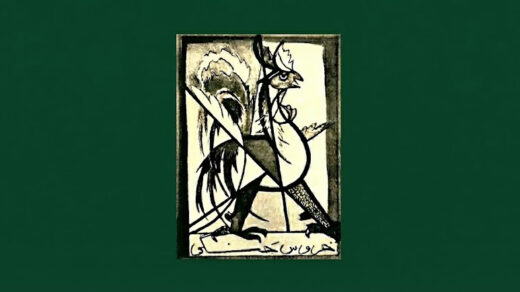
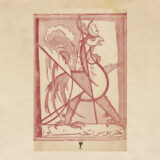
An article by Master Jalil Ziapour, titled “Painting,” published in The Fighting Cock (Khorus Jangi) magazine, Issue 5, pp. 31 to 41, year 1948.

Master Jalil Ziapour, cover design of Fighting Cock magazine (Issue 5)
Painting
According to the belief of Surrealism, Cubism not only from the standpoint of technique “except in some cases” contained all the conventions of the past schools, but in some of them “even far more than what was probable” it was bound to such a degree that without doubt the expression – falling from the frying pan into the fire – applied to it. With all this bondage, the novelties that Cubism brought into being were so much in accord with the time and expressive of the spirit of its artists that no other school besides it could express the spirit of its own time so well. It was said earlier that the period of Cubism was a period of struggle and of the consolidation of new ideas whose foundations had been gradually laid long before, and by knowing this point too, that along with every economic, political, and educational transformation there is always a new ideology, it is better understood that the existence of the grounds of transformation and the class struggles at the time of Cubism’s emergence also necessitated manifestations of movement-seeking and dissatisfaction with the environment, which in meaning encompassed a new ideology. Hence, artists who possessed the particular mode of thought of this dissatisfied class (though in their own profession), based on the unquestionable principle of need, and also the effect of inner searching “which brings about changes in the nature of human behavior and action,” involuntarily make their struggles public by means of artistic manifestations, and strive in the transformation of their specialized technique in such a way that their works are commensurate with a revolutionary mode of thought, and represent a spirit of movement-seeking: that is, decisive and cutting, and at the same time logical, dignified, and formidable. Classicism, Impressionism, Neo-Impressionism, Fauvism, and the other isms, none except Cubism were able to represent all this and so well, “from an ideological point of view,” the power of movement-seeking and the desire of the day. And it is for this very reason that most possessors of cultivated taste, and all those who possess precise and impartial eyes, look upon it with an eye of admiration. Of course, Cubism “that is, a particular method of painting” is not what has brought the Cubist into being; rather, the essential condition for the emergence of a Cubist is, certainly in the first stage, possessing a revolutionary spirit that has a desire for progress and wishes to emerge from under the burden of pressures, weaknesses, deprivations, and especially conventions “which have lain like revealed scripture upon the shoulders of former artists.” It is the existence of such kinds of spirits that causes the spiritual reflections of such artists, like all progressive and faithful artists “whose firmness of faith is evident from all their works,” to take the form of firm lines and planes, and colors in the form of heavy material pieces, solid and enduring: which is proof of the artist’s interest in and attention to his surroundings instead of the divine realm. And it is by this path that the Cubist comes into being. Therefore, the Cubist is not only not decadent and deviant, but is a struggling and progressive artist. But there are points of difference among Cubists. These points of difference lie in the difference of cultivation and the incomplete development of their mode of thought in the specific degrees of struggle. In no class can one find persons among whom, outside the principle of their common points “that is, in secondary matters”, there is no difference; except in very exceptional cases. This difference, in proportion to the ascending trajectory, begins from the first stage of the mode of thought of a struggling class, and ends at the extremity of the mode of thought of that same class. In the interval between this beginning and end, there exist three more distinct stages which one may call the periods of doubt, despair, and hope. In the first stage, the Cubist, due to lacking sufficient logic: which strengthens the sense of struggle “while the essence of struggle takes favorable ground within his nature,” is doubtful. And because he cannot analyze the cause and effect of factors in order to make a decision, it is that he is plunged into a hesitation and a state of what-am-I-to-do. He has the desire to understand and advance, to become precise and to find the truth, to rise against whatever is superstitions and conventions; but in order to advance better he never accepts anything cursorily, blindly, and out of blind obedience. And due to the lack of breadth of discernment and necessary clear-sightedness, he naturally enters into artistic movements with great caution. This period, in truth, is the period of his intellectual crisis, and it is in these stages that his brain may comprehend a great deal of the necessary knowledge. In this period, the Cubist brings forth works which are confused in terms of both technical and ideological manifestations. This confusion and hesitation in his works take the form of contradictory colors, sharp, illegible, chiaroscuro, sometimes opaque and at times transparent, and at the same time accompanied by nervousness and roughness, and is also expressive of a searching. The lines appear firm and nervous, dry and brittle, and due to having a spontaneous sense of opposition for comprehending matters “which exists in him consciously and unconsciously,” the movement of seeking truth and correctness awakens in him. His work is cubic: a cubic that has doubt in itself, and also the color of pessimism and optimism. This artist, if he is weaker than a qualified artist: whose mode of thought is commensurate with a first-stage Cubist, because he is situated at the beginning and head of a necessary movement, his work might come into being in the grounds of Fauvism: that is, weaker than what it ought to be. In the second stage, despair, that is, the stage of disgust and hopelessness and at the same time meaning the artist’s opposition against a usurping class, in this stage, the artist sees the surrounding conditions, comprehends the unfavorabilities, discerns the atrocities and sabotages “which are obstacles to his progress” one by one, but because he sees himself solitary and powerless, hence he complains of the state of the times and always recites verses of despair. This individual wants all these conditions to become otherwise, he wants a new world “which accords with his ideal in every respect” to be created, he wants life to become sweet, but because his inner wishes in facing correspondence with the external situation are very far from the stage of practice, and his hand of recourse is cut short from the hem of his ideal, hence he is despairing. This very despair leaves a reflection in him. It darkens his conscience and makes the grounds of his impressions opaque, and awakens a sense of malice and hatred in him. This very malice and hatred in the end bring him up “even though he may be grappling with despair” as an audacious and vindictive individual, and in general a struggler and with power: “a power which is created from vindictiveness and audacity; and an audacity which is created for him from the unfavorabilities of the environment.” The reflection of this kind of feeling and audacity is well evident in his works. In this manner that: the formerly solid and brittle lines, due to his stifled hatred and vindictiveness, assume a more wrathful power. The colors, thick and material, are especially dark and sorrowful. Frozen and suffocated verses of despair are evident from the features of the general coloring of his work. That is, the colors are mostly leaden and opaque, but at the same time steely and firm, and are often like metallic plates that have a greater and heavier display of materiality. In some cases, spirits are found in this stage that seem to have raised their heads from the depths of sludges and bottlenecks and hidden vindictivenesses “which is the result of successive, frustrated, and dormant hopelessness.” Here anymore, within the being of these vindictive and patient artists (whose hands are cut short from any hope “except freedom of action in specialized technique”), despair has made complete pessimism rule; except in a few, in whose works one rarely sees sparks of hope, and even then a cheerfulness and hope that is manifested by means of those same opaque colors “which have formed the totality of his compositions,” and is exactly like the frozen mornings of a sunless winter. For example, of the Fauvists one may count Vlaminck, “who, without considering his mode of thought and spirit,” has wrought havoc in his technique in the combinations of colors, especially gray, black, and brown. And of the Cubists, one may name some of the works of Picasso’s black-gray period, and also his and Braque’s brown-blue period. And also most Surrealists “especially the group of painters who are more concerned with negativity” can be counted among the complete pessimists. Including Félix Labisse in the piece “The Happiness of Being Loved” (Le Bonheur d’être aimée), in which one can well perceive the pessimism of the mentioned artist. (Labisse in this painting shows a naked woman sitting in a pained posture on a bed. The head of this woman is the head of a defeated lioness that is attached to a human body, and her hands, joined together, are placed on her head. The state that has been given to this head and body – the head of a predatory animal and the body of a woman full of lust – is indicative of a world of inclinations, inclinations that have mostly revolved around victories and possessions and suddenly or gradually all of them, like a grandiose palace that has been struck by a lightning bolt, have collapsed apart. Nothing seems more heart-rending and repulsive than the howl of an animal that has been struck by a calamity. This head that Labisse has chosen for such a woman well shows his belief regarding love, and his conclusion regarding women’s excessive desire to be loved. It shows how, if a woman does not reach her wishes, her inner nature which has always manifested in the form of “fair-seeming and foul-hearted,” reverts again to its primal state. And it shows how, when a woman does not attain love “at which Labisse himself sneers with allusion and metaphor,” her state, like a wounded lioness, is moving in the very midst of anger and ferocity). In the course of the intervals of the field of despair, near the completion of this period, there also exist artists who are not drowned in complete despair. And it happens that sometimes the expression – the end of the black night is white – has struck their ears, and from narrow crevices a ray of hope has illuminated the crypts of their despair. In this state, the artist, due to a slight attention to a correct mode of vision and thought, has attained clear-sightedness and hopefulness in the manner of a worldview, becoming the possessor of will and decisions. Hence, greater optimism is evident in his works, and cheerful and hopeful colors little by little find a majority in his works, and by this path he gradually enters into the circle of optimistic individuals and artists. If this matter is not inferred from him verbally, this gradual progress is certainly perceptible practically in his works. The final stage, “hope,” belongs to the Cubist who is a complete struggler, with a correct and logical mode of thought, in accordance with the latest theory of the social life of the day, in the method of a worldview. In this state, certainly a Cubist comes into being who is hopeful of a new life. Doubt and despair have no penetration amidst his worldview thoughts, and he knows that by means of struggle against parasites, and eliminating deprivations, he can finally create the necessary environment (even if it does not reach him) at least for posterity. Hence, in any case he is hopeful and optimistic toward the future. Such an artist naturally brings forth a kind of colors that represents his optimism and firm and certain faith in success. In his works, vivid, fresh, resonant, and brilliant colors exist. His combinations of lines are also very expressive and powerful. What has passed was a glimpse of the mode of work and thought of a Cubist in various stages, and the correspondence of his spirits with the general mode of thought “from the standpoint of ideology.” Of course, one must be aware that one cannot express an opinion about the works of a Cubist “which I have graded” with this very simplicity. And I distinguished these three distinct stages for the ease of the task, so that at least its general identification becomes easy; otherwise a doubtful, despairing, optimistic, or pessimistic Cubist, in addition to the three distinct stages, traverses numerous other stages “from the standpoint of intellectual analysis, synthesis, and deduction” in the period of his life, such that all these reports emerge one after another from his works spontaneously (not intentionally). And in these stages, thin threads exist that create a sensitive relation between two modes of thought, or two contradictory feelings; which may influence the artist only in a particular moment or moments. And because traversing in these stages is very interesting for inquisitive artists “and for this very reason they strive to skillfully show those precise and difficult moments by means of the factors they have in hand, and to bring them from the form of pure and weak feeling into the guise of possibility and reality,” it is that most of the time, those who are in search of obtaining the intellectual and spiritual grounds of such artists, often due to lacking the power of comprehension and strong insight in artistic fields, and due to the lack of necessary breadth of discernment (since they cannot discern the connection between a work that is taking ground in the house of the artist’s thought “to come into being” with the result of the work “which is material and has external existence”), hence encounter difficulties and errors in the analysis of psyches. Especially if a non-specialist wishes to perform this matter. This is why discerning the spirits of such artists or any other artist “whether they are pessimistic or optimistic, or from which group and class, with what mode of thought they are” is very difficult even for a precise psychologist, let alone for non-specialist and lay claimants, for whom it is entirely outside their level of discernment. From this standpoint it is that a viewer, if placed before the works of such artists, will certainly face two heavy, unfamiliar, and complex ambiguities: one is the ambiguity of the subject (for he does not know why they are not natural, and does not know that if the artist is bound to the subject, it is for him to show his intentions in the garb of the subject. And he also does not know that whenever the artist has a particular mode of thought and perception, he searches for a special type of subjects. And sometimes too these subjects, since they might not completely be in the form of the very mold he needs, hence with distortion and alteration, he changes its form to bring it into the form of a suitable mold worthy of his own inner secrets). And the other is the ambiguity of the artist’s mode of thought (where the shallow viewer does not know what he wants and what he says). By taking these reports into consideration, the result becomes as such: an optimistic Cubist with a correct mode of thought from the standpoint of ideology is the sole struggling artist who continues his work in the vanguard of his progressive society, and no artist from the past schools can ever show himself as the peer of a Cubist and place himself on the same level with him and consider himself comparable to him. For in their specialized practice (provided that we view their works free from the subject “since only in this case can one judge in specialized technique”) it by no means provides a complete example of the sense of combativeness and progress-seeking according to the demand of the day. And if past schools have also been revolutionary from the standpoint of specialized technique; “in which there is no doubt,” there is no objection, but whatever it is, they belonged to their own period and the mode of thought and necessary movement of their own era, not now, and if they more or less correspond with the present era, it is clear that it is not sufficient, and the Cubist too, due to this very lack of sufficiency and perfection in them, has rejected the past schools “since he has not found them in accord with his necessary combative and revolutionary spirit.” Therefore, knowing the above processes in addition to this matter that: since the correct and logical mode of thought of a class or an individual of society “who in the vanguard of others perceives the correct mode of thought like a worldview-holding thinker,” in the first alternative due to the law of mutual effects, and in the second alternative in the state of individual struggle, a qualified artist passes through the ascending hierarchy of the three stages until he brings himself to the circle of the optimistic Cubist; in this case let us see whether the existence of a particular mode of thought “without regarding its correctness or falsity,” or the existence of a correct and logical, or an incorrect and illogical mode of thought is what brings forth the artist and the artwork? Or does an artist exist outside of these talks? More importantly let us see who the artist is. Or among the Cubists of the three stages, who is more of an artist. Is it the one who is generally optimistic? Or the one who is skeptical or despairing? Of course, from the standpoint of that class which has a specific desire, the one who is more optimistic is an artist and more of an artist. Because this artist may guide a great multitude “from the standpoint of mental and intellectual cultivation” (Pédagogie mental) and may bestow abundant spiritual power upon them. Hence, from the standpoint of that same class, an artist is said to be someone whose works are social, represent the necessary and general issues of the human spirit, and speak of it. This view, however much it is completely apt and correct regarding class ideology, unfortunately does not apply in the case of art, never and by no means. From the standpoint of art and artistic cultivation (Pédagogie Artistique), all three of them are artists, and among them that person is more of an artist who has more correctly employed the artistic factors (which consist of drawing, coloring, and compositions: “which themselves, due to better conveying a kind of precise psychological states, might even lose their ordinary harmony”) in the manner that the advancements and trajectory of artistic evolution, in the latest and most logical style, permit, “even though he may personally be a pessimist from the standpoint of ideology.” So, by this view, an artist is someone who copes well with the artistic factors and deals with them more than anything else. It may well be that a subject which from the standpoint of ideology is related to the necessary and general issues of the human spirit, and is optimistic, is entrusted to an artist who is pessimistic, and he can accomplish it in the best way from the standpoint of technique; but an incompetent optimist could not accomplish that same matter artistically. And assuming he could, it still does not constitute a reason to consider only him an artist. Leonardo’s St. Anne (Ste. Anna) is not artistic for the reason that Da Vinci thought optimistically; or Picasso’s Guernica “which is a masterpiece of the art world” cannot be rejected for such reasons “that the painter is decadent, deviant, and pessimistic from the standpoint of class ideology.” No, both of them are artists and have shown the utmost skill and artistry in their work from the standpoint of specialization. The history of the evolution of art, and the intellectual society, always consider the artist, in whatever mode of thought, as an artist. But if a special class selects and requires specific artists for the advancement of their own purposes, and gives the name of artist only to them, this is another matter. Here it is a matter of class desire and expediency, not logic and correct artistic judgment. Here it is a matter of interests, not the understanding and perception of art in the correct sense. In my view, an avant-garde artist is that artist who, based on artistic advancement and evolution, is a vanguard and struggler solely in his own art, not in the work of preaching and propaganda “which belongs to another group other than artists.” And if the artist is to be a propagandist as well, he must be a propagandist in his own work for backward artists, not a propagandist of politics and class goal. Those who have an expectation of the artist other than artistry and creating artworks, do not fall outside a few cases; either they are entirely ignorant of the concept of art, or have incomplete information, or they are well-informed, but because the expediency of their work “for advancing their goal” necessitates it, hence they employ individuals who are no more than mercenaries under the name of artist. It must be known, when an artist strives through a correct and logical path to place himself in the current of the trajectory of artistic evolution and strives never to leave himself in stagnation, this artist is truly an avant-garde and struggler, and serves his progressive society in his work. That is, like all progressive guilds, he places himself at the disposal of the degrees of evolution. It is not necessary for the artist to absolutely enter into politics to become avant-garde and progressive. I do not say that politics, economics, and so forth have no effect on art. This is impossible. Everything is generally connected to each other, and it is this very connection that takes effect in the artist by means of mutual effects. It is this very connection that makes the artist more mature and deeper in the conflicts of life; and consequently, this depth and maturity spontaneously manifest in his works by means of “artistic factors.” I have said this many times. But before all, one must know the role of these “artistic factors.” One must know how each school presents a spirit. If individuals or a class do not know art or do not want to know it, and cannot discern the artist’s goal, or have an expectation other than what “specialized” art demands, it does not constitute a reason for that art to be deviant and decadent, or reactionary and charlatanry. One must know in what, for example, the artistry of a Cubist lies and how he is a struggler and progressive in his work. Or, one must understand whether in painting it is solely form and subject that represent artistry? Or whether, apart from form and subject, other means exist that are directly related to artistry? One must understand whether form and subject, because they are feigned as natural, that is clear “and in the words of the intended class, real,” it is for this reason that a work becomes artistic? Or because it is mute and ambiguous, it constitutes a reason for being artistic? Knowing these points is important and very interesting, and the truth is this: artistry is neither in this nor in that. That is, it is neither solely in form and subject, nor in muteness and ambiguity. “For to profound artists ambiguity has no meaning and existence, and everything is manifest.” [Even though, without exception, all schools, even the latest modern school which has come forward with the most logical weapon, have not completely entered into their specialized technique until now, and have not removed their shoulders from under the burden of parasites, and have constantly been in the constraint of form and subject or their precedence and succession relative to each other. With this description, the existence of form and subject or the cause of their succession and precedence to each other is for creating a suitable mold for inner secrets. Otherwise, painting, in the correct sense of painting, that is, where it must approach its goal, is entirely separate and far removed from such stages (namely playing with the formal factors of nature “in the form of form and subject”); why it is far removed, will be discussed in detail in its own place]. But for the time being let us know this, that the firm guarantee and complete representative of the artist’s mode of thought “as to whether he is generally pessimistic or optimistic, or is clear in his intellectual method, or has not yet adopted an explicit path” – this matter: knowing that from the standpoint of specialized technique it has no relation to the world of art and his artistry – can be well perceived in his coloring and their composition, and his lines together. And especially in this matter one must enter closely and view the works in order to judge them. Without prior information and study one cannot measure them relative to one another, and also against the mode of thought of a progressive society; except by means of sufficient information “for only through this path does discovering the mode of thought of any artist become easy, and his works become analyzable.” It is possible that that special class may consider an artist, in the comprehensive sense of artist, to be someone who combines optimistic subjects with – technical skill – and say this is the complete and comprehensive artist: whose existence our modern world needs! We will ask, which technical skill? The technical skill that the commoner understands, or that which the history of art and the trajectory of its guild evolution shows? If it is that which the commoner understands and accepts, it is not artistry, and if it is, it is certainly an ordinary art and there is no doubt about it for sufficient reasons. And if profound art is that which the understanding of the commoners is certainly incapable of comprehending “and double-sided art too, which is pleasing to both the elite and the common, since not only is it banal from the standpoint of reality, being lower than the stages of depth and pertaining to the borderline stages between ordinary and extraordinary, but it is also of the kind of reasoning, deduction, and pretext of fanatical and talkative critics which they always brandish like a weapon for demagoguery and showing off their knowledge, and is never worthy of attention,” then it is only the elite who comprehend profound art. Therefore, the hand of attainment of the commoners “as long as they lack the cultivation of artistic understanding” is cut short from the hem of the pleasures of profound art. So the judgment of profound art rests with the elite, and the elite too are naturally limited. And these limited elite too recognize Cubism from every standpoint “that is, from the standpoint of class ideology, as well as technically, and logically, and the power of struggle, and everything else” as one of the most complete and necessary schools in the world. Result? – The result is this: A- Cubism is the most complete, most necessary, and most logical of the schools of painting in the present era, and from every respect it also agrees and corresponds with the mode of thought of the most progressive avant-garde peoples in the world. B- In correct painting “that is, existing painting, in accordance with the latest theory of the trajectory of artistic evolution,” the subject never takes precedence over the artistic principle and must not do so “for the subject is a means and excuse for coloring and compositions, and besides, a painter is someone who fundamentally deals with colors and compositions, not with a story.” C- The artist in any kind of mode of thought “pessimistic, or optimistic, or other types of modes of thought” is still an artist, and never by possessing a specific mode of thought can one be called an artist or non-artist, because artistry and the bringing into being of artworks “according to the previous reasoning” is entirely separate from class ideology, and therefore if someone could recognize an artist from the standpoint of class ideology, it still does not constitute a reason for recognizing his works. For the former is related to sociology, and the latter is related to the understanding of art, and for the understanding of art a special cultivation of a complete and comprehensive artistic understanding is certainly necessary. And judgment from the standpoint of sociology alone in it not only does not suffice; rather it must be said that from the standpoint of art it is completely useless. Besides, the existence of pessimists is also very necessary. Because they create wondrous colors that are very valuable in the world of art.
By Ziapour