by
by Fouad Faroughi’s interview with Jalil Ziapour, titled “Innovation and Modernism”, published in “Rastakhiz”, No. 739, Saturday, 17 December 1977

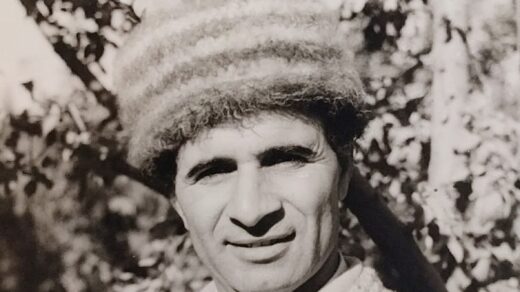
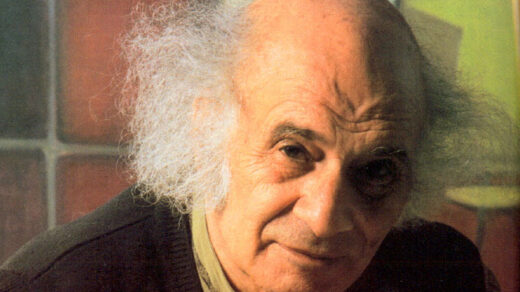
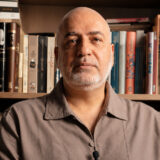
Master Jalil Ziapour, the Father of Modern Iranian Painting
“Rastakhiz” wrote under the title “Introductory Note”: “Today, innovation and modernism in art do not face a wave of opposition and reproach. Art no longer has specific boundaries, and artists are experimenting with new styles in broader dimensions. But twenty-five to thirty years ago, innovators and those who wanted to create changes in their artistic works were ruthlessly criticized. Their breaking of tradition in art was not acceptable to the people. Jalil Ziapour is one of the few artists who for years have willingly endured the sting of the pen and the wounding words of many individuals (who define specific boundaries for art). Ziapour is the first person who has experimented with modern styles of painting, including Cubism. Interestingly, after the passage of years, this modernist painter has put his art at the service of Ferdowsi’s Shahnameh, and has begun research in the field of official attire, painting, and sculpture in various contexts of the stories.”
Conversation with Jalil Ziapour about painting and the issues of the Shahnameh:
Q- Why did Cubism face a wave of opposition in Iran?
A- Any kind of experimentation in the world of art is a movement toward the progress of the art world; the spirit of modernism and curiosity must be strengthened in the youth.
Q- In these few years that you have accepted the responsibility of illustrating the Shahnameh stories, the impression has arisen for some that you have not achieved the desired success in modern painting! To what extent is this impression confirmed by you?
A- Usually, if such impressions are rooted in malice, they can in no way be confirmed. Anyone who is active in various artistic fields must brace themselves for opposition, and I have not been an exception to this rule either. From the beginning of my activities, I have had opponents, and the reason is also clear. I wanted to express my way of thinking and perception, and I wanted to create a dynamism in Iranian painting, and this was hard for many to bear.
Q- What was the result of these innovations, and to what extent did society accept them or oppose them?
A- Before answering this question, it is better to dissect a reality. If I had not brought forward Cubism in this land, undoubtedly after a while, by the compulsion of the times, someone else would have done it out of research and curiosity. I did not wait for someone else to start this work. But as for what results my innovations in painting have yielded, I must say that just seeing that currently the youth and the painters who became acquainted with the brush and paint after me pay attention to new styles of painting, I have obtained the best result, because I created a dynamism in them to search for a new path, and I must also say that any kind of innovation and new experience is a movement toward the progress of art.
Q- Those who have engaged in painting after you have also used other things besides the brush, paint, and other painting tools.
A- For example?
Q- For instance, one must mention a painter who would paint his body and then press it to the canvas.
A- I understand who you are talking about; I am not opposed to this style of painting. Of course, he has done something that has been done in Europe for years. Painting the body and pressing it to the canvas, and the image that is haphazardly obtained in this way, seem simple and at the same time ridiculous to many, and they are right. But this kind of painting is not that simple either. In essence, after obtaining the image, the painter must put their brain to work, find a meaning for the patterns, and by completing the obtained patterns, give life to their thought in the painting and express their intent. In any case, because a brain has been put to work, I approve of it.
Q- In your words, you spoke of malicious opponents; who were or are these opponents?
A- When I introduced Cubism and other styles of modern painting, the classical painters, one and all, rose in opposition, but gradually my work gained approval. On the whole, it can be said that my opponents were all ignorant of art and my supporters were the media (although those who wrote in opposition were still confrontational). The very people who once accused me of destroying the authentic taste of painting, they are the ones who today criticize me for turning to illustration and research about the Shahnameh and its legends. This group must say something after all, because they fear that if they remain silent, no one will notice their presence!
Q- Your attention to the myths of the Shahnameh apparently evokes the work of modernist poets who, to refute the accusation of inability to compose poems in prosodic forms, occasionally turn to writing ghazals and qasidas.
A- In the first place, I must point out this mistaken perception: some imagine that those who do new work are completely at odds with their predecessors and their works, whereas this is not so. Today’s poets respect Hafez, Ferdowsi, and so on, and if they have accepted Nimaic meters, it has undoubtedly been the need of the times. You repeatedly see that poets have composed ghazals that are purer than the ghazals of poets who for years paid attention to prosodic meters and forms, or painters following modern styles have at times presented brilliant classical works; so modernism is not out of inability, but rather for the sake of traveling new paths. To achieve more and better results, besides painting, I also have education in other fields such as (history of civilization, sociology, history of art, stylistics, color and psychology, history of clothing and textile studies, archaeology, and philosophy). If today a responsibility has been entrusted to me for the illustration and relief designs of the Shahnameh stories, it is because of the education and experiences that I have; furthermore, I earn my living this way. (1) My studies in the fields I mentioned led me to oversee the staging of the Shahnameh designs, both in terms of painting and sculpture.
Q- What impact have the exhibitions you have held so far had?
A- Until a few years ago, numerous exhibitions of my works were organized. The most important effect that I can attribute to the exhibitions organized of my works is the creation of a spirit of artistic inquiry in the youth, a spirit which has caused many young people today to experiment with new styles, because I only wanted artistic dynamism (if possible, artistic dynamism and innovation). I wanted to be a lever, which I was, and I also got the result.
1- At this time, due to my opposition to the minister of the time (due to my lack of cooperation with the views of the establishment), for two years, with the removal of all financial privileges and through labeling and accusing me, I was confined to my home, and it was only then that, ostensibly by way of placation, they asked me to engage in research on the Shahnameh, which I accepted with reluctance (not their views).