by
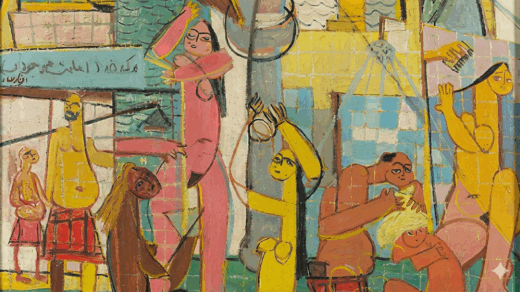
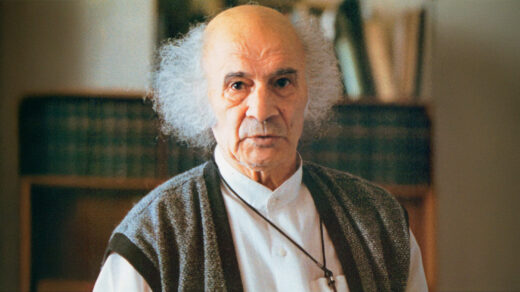
by Text of Master Jalil Ziapour’s lecture at the Giti Art Association; published in the weekly magazine “Shahsavar” (Issue 4), 16 October 1950

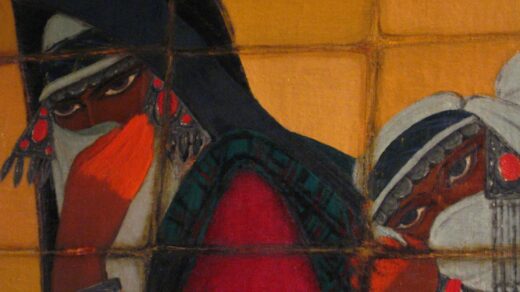
Master Jalil Ziapour; “Zeynab Khatun”; March 1961; oil; 120×95 cm
Last time, I explained what the artistic inclinations and manifestations of the different groups of our people are like. In the process, I of course clarified the goal of new art briefly and comprehensively. However, for whatever reason, these explanations were not sufficient for some, and they wanted more discussion to take place on this matter. Therefore, I shall proceed to repeat the explanation concerning new art in a simpler manner.
In new art, two matters must be taken into consideration: first, it must be known whether its goal is correct; and second, assuming it is correct, whether it can be shown with current technical means. Regarding the first case, that is, the correctness or incorrectness of the goal, the explanation is this: new art wishes to take an approach beyond the manifestations of past methods. That is, to display what past methods have been unable to accomplish. (It may be objected that in the arts and methods of the past there is no subject that has not been displayed, and to prove this point examples may be brought from artists and their works: that, for example, a certain artist neglected no point in expression, or that a certain musician, in rendering precise feelings, truly exerted the utmost power; or that the magical pen of a certain writer worked miracles, or, for instance, that a certain painter excelled extraordinarily in skill; and they may consider these very examples as sufficient proof and say that, in this case, new artists cannot add anything beyond their achievements, and the claim of creating new works of art is a futile claim).
Of course, all of these are groundless praises and cannot be assigned value. In praise, such exaggerations are permissible and, at the same time, are a means of encouraging faint-hearted artists. But from praise to reality there is a long road. Those who are people of sufficient knowledge and research do not readily submit to such praises, and their curiosity is not satisfied. A rational person believes that every era has subjects particular to itself, and these subjects possess characteristics which, however much they may have ties to the past, in any case have stronger and greater ties to their own age. Likewise, the people of the past may have said or displayed things that also encompass a part of today. But they cannot, as they ought, be representative of the spirits and conditions of today (especially). For this reason, on the principle of correct observation, one cannot accept that, for example, a certain artist has artistically expressed all subjects as fully as was fitting, has left nothing unsaid, and that those who come after have no choice but to repeat those very utterances and perform an operation akin to chewing the cud. Of course, it is not so.
There are many matters that have emerged from the minds of artists and people of the past like a spark and remained ambiguous, or were not justified and explained as they ought to have been. In that case, it is necessary for the artist of the following age to pursue that spark or prelude in a better and clearer manner. On the other hand, today differs from yesterday at least in this: today is today, and yesterday was a day that has passed. The characteristics of yesterday and today differ from one another, even if only to the extent of a yesterday and a today, let alone the characteristics of one period and another, which fundamentally and wholly can differ greatly.
The characteristics of a period, too, have their own particular form and mold, and with that same mold one cannot show a form for another period; that is, another time has another condition and therefore requires another mold. For example, the mold of a certain jug always yields that same shape of the jug (even if instead of potter’s clay we pour cast iron, bronze, gold, or iron into it). The details and the whole of the form will be exactly what the mold possesses. Such a mold, even if it wishes to be representative of another form, cannot be. Therefore, new thought in an old mold is the same old thought, limited to a past time.
Just as we believe that every life has its own modalities that accord with that life itself and are representative of that life and its properties, so too we must consider that new thought requires new companions and wants a new mold. When we foster the thought of speed, comfort, and obtaining results in the shortest possible time, without doubt we set about creating a fast automobile or a train in place of a cart and a howdah. Just as a cart has four wheels, an automobile has them too. If a cart has a puller, an automobile has one too. If one must sit cross-legged in a cart, an automobile also has a place to sit. But how much difference is there between a cart and a fast automobile? In the automobile, whose basis was built upon the cart or the early howdahs, we see these distinct differences. Even so, when a person looks at the cart, the howdah, and the automobile from the perspective of form and mold, they do not even see a close resemblance among them. That is, the mold of these two is completely different, whereas the source of the creation of both has been laid upon a single intellectual basis.
Perhaps this objection will be raised: that the condition of the cart and the automobile, and fundamentally everything else in life, has no relevance to art! But if we cannot measure these two against one another, this will be a flaw, and it arises from the fact that our grounds of inference, in general and as a whole, still cannot establish the connection among the modalities of life, which is among the most important aspects of logical thinking. If we have no objection regarding the transformation of the cart into the fast automobile, it is because, without thinking, we have in hand the necessary product and result of this means of transport and transfer. But art and the enjoyment of it (unlike the object used as an example) have this difference in relation to it from the standpoint of the manner of drawing conclusions and benefiting: that here, thought, sharp-sightedness, intense feeling, and an agile mind are necessary (and even relative to all other things that need these factors, art needs them more). That is, to comprehend works of art, one must possess broader thought, more intense feeling, and a more agile mind; otherwise, the work of art (especially new art) will not be comprehensible and pleasurable as it ought to be.
Now let us see whether the existing molds are molds that are representative of our life today. Based on what I have stated, without doubt, no. Because these molds came into being in the distant or recent past, and certainly those pasts required that these molds come into being. For this reason, they can only be representative of distant or recent pasts, and the result is that, in any event, they are not the mold of today. Then which is the mold of today? This is something that the artists of an enlightened society lay the foundation for (not the conservatives who pass themselves off under the name of progressives and take not a single step on the path of advancement, and always act like a brake).
But the discussion here was whether the goal of new art is correct or not. Of course it is correct. Because new art wants to provide a mold for the present time. A mold that is representative of the spirits of the more enlightened and more progressive people of this era. New art needs a newer mold to express its newer things to be said. Thus, naturally, it casts aside the old molds, however excellent they may be, and considers them suitable only for the past time. This is why the artist wants to express in such a way that his expressions are, in the best manner, representative of the spirits of the milieu of his own age. Is this goal not correct? Are these views and these measures and these kinds of manifestations not rational and pleasing? Without doubt, one cannot say no. For it is clear that the intention is lofty, and its goal is correct as well.
But let us see how far this goal and claim has advanced. Is it a claim, or is action also involved! We may not claim that all the measures of new art are correct. But we only say that new art wants to carry out the measures it has mentioned, and its intention, too, is a useful intention (perhaps this objection may arise: that if new art is in the process of taking action and has not yet obtained a result, the unresulted measures should not be introduced and imposed as a decisive act). This, too, in its own turn, can be an objection that is answerable in its proper place. But the intention is something else, and it is this: do we believe that, generally and fundamentally, the molds of the distant past and the recent past belong to their own time? Therefore, they were not for today and cannot be; and if the molds of the recent past can, to some extent, express the wishes and spirits of this period, in principle they cannot be counted as a mold for today. So the result is that keeping away from past methods is obligatory, and searching on a newer path is, in any case, even more obligatory than that (since we know that the molds of the past, based on the previous reasoning, cannot express the condition of life today, and they are those same jug molds of which I said they produce nothing but one definite shape).
Certainly this objection will arise: that if the molds of the past are inadequate for expressing the purposes of today, the in fact non-existent molds of new art are completely inadequate. Because at least the molds of the past can, to some extent, express the purpose! Whereas new art in principle has no mold so that it might express even within these limits. Thus we must see whether new art, by means of this very so-called non-existent mold of its own (which others ignore because they do not approve of it), can manifest its views or not?
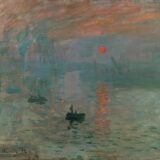
Among paintings, new art must be recognized from Cubism onwards, because pre-Cubism, with slight differences, entirely made sufficient use of the conventions of the past. That is, they are more attached to the past than to the era of Cubism and after it. In post-Cubist works, from the perspective of feeling and the transmission of effect, we can have greater inference than from the schools of the past (and this is practically proven) because if we place two paintings side by side, one Impressionist or Fauvist, Academic and Classical, especially Realism, or any one of these, and one Cubist painting, the effect of the coloring, drawing, scene-setting, and expression of the Cubist painting and what follows it, is more engaging (we take the word engaging in its true sense). The Cubist painting is more engaging because of clearer and more intense colorings, more legible and more eloquent drawings, and deeper and more important subjects, and yet it arouses curiosity and thought more. Whereas the other paintings, which are Classical and so on and so forth and Realism, never arouse curiosity and thought sufficiently for today’s world, and only sing the lullaby of the ordinary memories of the past into the ear of the mind.
Even though in such methods the themes may be new, still, due to the existence of old and ancient molds, a person sees himself traveling in the past. For it must not be forgotten that the aforementioned jug mold is always the aforementioned jug mold. If we pour gold into it instead of clay, we will still have the same jug, not a jug in another shape. For this reason, the artists of the new methods have fundamentally broken the molds of the jugs and have themselves brought another mold into being. (Contrary to the Realists, who demand new matters in an old mold and insist upon it out of ignorance).
Comprehending or feeling this reality is contingent upon the objectors coming into close contact with new works, knowing the various methods to some extent, and measuring them against conditions and needs, so that they may know whether new art, with its technical means, is truly capable of expressing precise intentions or not. We, who are in the flow of the work, have faith that yes, it is. It is only new art that can always express the conditions of its own era better than other methods, and progressive artists laid the foundation for the necessary mold long ago, and according to the law of need they may still change them. (Because fundamentally everything accepts change due to this very need, and nothing can ever remain stable in an absolute, eternal, unchangeable, and prolonged manner).
This change has not only passed through centuries from period to period, but has also gone beyond half-centuries, years, months, and weeks; it accepts transformation so rapidly, along with necessary needs, that it even reaches the stage of moment-by-moment. And this moment-by-moment, weekly, monthly, yearly, century-long, and period-by-period transformation is contingent upon the speed of advancement of the artists of a society. If a progressive artist wishes to consider the speed, advancement, and progress of his society, he is someone who, disregarding the difference in the level of the environment and the nitpicking and showmanship of the majority or minority of his society, charges forward as far as is possible for him, and tramples underfoot all laws, conventions, tastes, and expressions of opinion wherever necessary. In this case, it is evident that the claims, speechifying, and repeated showmanship of the self-sacrificing devotees of Realism will not in the slightest obstruct the path of such progressive artists; and these artists, who lay the foundation of logical new art upon correct bases and technical evolution, will never accept past-oriented artists as artists, and do not recognize them as artists of the time. For they know well these artists, who are mostly moral tutors and guides for the reproducing groups of society (and who have also bestowed the name of art connoisseur upon themselves), and they know that they have been nurtured by factions for the purpose of reaching certain goals and, under the name of great and global artists!, have been chosen out of expediency. The goal of this group may be lofty, but their artist-fabrication, since it is expedient and devoid of reality, is ridiculous. Therefore, neither the magnifying nor the diminishing of real artists by this group is of any value or concern to us (because we know that these very artist-makers and personality-fabricators yesterday called Picasso deviant and decadent, and today, the moment he drew a dove naturally and in accordance with their desire as a symbol of peace, they named him a progressive artist and a defender of so-called human beings!).
In the face of this great artistic movement, which has come into being based on need, through the efforts of the pioneers of new art, and which, sooner or later, will draw the taste of the people toward itself in order to resolve the related needs, the hollow propaganda of the self-sacrificing devotees of the opposing factions has no value. A new art that is accompanied only by technical evolution (and not by the backward whims and desires of society) has always been victorious, is, and will be.