by
by This article was machine-translated from the original Persian and may contain inaccuracies.

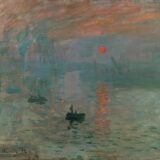
“Impression, Sunrise”; Claude Monet; 1872
An article by Jalil Ziapour, entitled “Impressionism,” published in Andisheh va Honar magazine, No. 2, May 1954
At the time when “Impressionism” Impressionnisme finally prevailed over Realism, it still could not be said that the world of Realism had in fact already disintegrated. For the voice of the likes of the Lebruns Lebrun had been ringing in heads like a bell for three hundred years, and drawing ruled as the sole artistic principle in painting; and his lecture (in January 1672) concerning the primacy of drawing, which he had delivered against the primacy of color, still had many supporters, and those possessing old theories, tastes, and knowledge were not about to abandon these assets of theirs (which they also strove to represent as authentic in the face of the knowledge of the day) anytime soon. How many other beliefs there were which, like divine revelation, had still taken root so deeply in minds that it was as though they had been engraved upon stone, and the passage of many epochs would be necessary for them to disappear!
The Davids and their followers had told them: “drawings must be correct, and when they stand before the model, they must completely and precisely penetrate its natural structure. They should select its good parts and cast away its bad parts; otherwise, they will be like sculptors who sit before a model for long years – when they see the model growing fat, they make their work fat, when they grow thin, they make them thin, and their work is constantly spent on making fat and thin, and finally, one day, they abandon both the work and the model with dissatisfaction.”
They had heard from David that he said: “In art, I love sincerity more than a passion and audacity in which there is no sincerity,” and also David had told them: “First reality, then beauty.” And Ingres, in confirming the theories of the predecessors, while he did not consider himself an innovative artist, did not consider himself an imitator of the minutiae of nature either; yet his claim (that he himself is the guardian of authentic principles) was a pleasing pretext for those who did not want to, or could not, detach themselves from the past.
One after another, they passed beliefs from mouth to mouth and breast to breast, casting their two eyes like two sucking creatures upon the body of nature, and in this way, in their own words, went in search of realities. Only in the midst of this did aware artists sometimes recount interesting points that had novelty, or attempt to put them into practice themselves.
Ingres had said: Nicolas Poussin was accustomed to say during artistic debates: “An artist can become a painter only by paying attention to nature, not by copying it. But to pay attention, two seeing eyes are necessary.” (While Ingres paid attention to this saying of Poussin, he himself also did not forget to say: “Having regard for drawing is to preserve honesty in art”; indeed, he had even gone so far in this belief that he said: “Drawing takes the place of everything in painting except color.”)
It was beliefs of this kind and the like that had constituted the capital of people’s artistic work from times long past, as well as at the beginning of the work of Impressionism, which Impressionism went to war against.
The rigid customs of the aristocratic period at that time favored stiff movements and, consequently, lifeless drawings and cold, classical colors in the mold of Realism and “Neo-Realism” Neo Realisme. To whatever extent the life of aristocracy endured, the beliefs concerning the “primacy of drawing” had life and gathered supporters for themselves.
It was all this limitation and intellectual rigidity that compelled first Delacroix and then other artists to rise up against the “supporters of the primacy of drawing” and, instead of paying attention to the expressionless and rigid drawings and cold colors of the academic period, to turn to warm coloring and necessary drawing. In fact, while they established “Romanticism,” they also prepared the ground for “Impressionism.”
The artists who were under the direct strike of the needs of their environment well understood this transformation, and from this time onward, the primacy of color went to war against the primacy of drawing.
The schools between Academicism and Impressionism (which consisted of Romanticism, Realism, and Neo-Realism) conservatively made use of both principles. But for how long could the necessary artistic expressions be uttered conservatively? This general restraint and inward gnawing in the art environment was lethal. That was why Impressionism came forward and opened up a broad foothold.
Until this time when Impressionism rose up, the reins of artistic affairs and the fate of the Impressionists were still in the hands of those who, in any condition, were all more or less guardians of past authenticities; and therefore, obstructionism and abuse directed at the innovators – or as the opponents called them, the “prattlers of nonsense” – was the last means of self-defense they deployed. The Cézannes Cezannes, the Manets, the Sisleys, the Pissarros, the Degas, and the Gauguins had no path at all into their sanctuary. The guardians of authenticities formed an artistic judicial council. They rejected works they themselves did not approve of, deeming them unfit for exhibition, and finally these very obstructions caused the Impressionists to form an association named the Free Artists in order to remain protected from the hypocrites and to ensure that no further delay would occur in their progress.
The Impressionist would say: The “Realist” (and at its core, the “Neo-Realist”) who searches for absolute reality does a futile thing. For according to the knowledge of the day, no absolute reality exists; rather, reality is always in alteration and change along with the conditions of time and place. Moreover, showing reality does not consist in taking the appearances of nature exactly as they are and striving so that the drawings do not deviate by a hair’s breadth, or that the colors remain just as they are. Working in this manner does not leave the necessary impressions in the viewer’s mind, and there is no expressive power in such manifestations. Every landscape, due to its constant changes in terms of light, sunshine, and variable chiaroscuros (or in human beings, in terms of psychological changes), has a particular impression on the viewer. These impressions cannot be created by appearances that are bound by conventions. Inevitably, some factors must be dispensed with. Sometimes the drawing must disappear, or the colors must become more intense so that a particular state may be shown. Moreover, how can the “Realist” claim to display reality? Whereas such a thing is not possible with his existing method of work, and he can only show something of the transient state of landscapes and beings. In creating the state and face of a person, a “Realist” can never employ realism of vision, because the model is at all times in constant change in terms of thought, appearance, and chiaroscuro; and if the painter brings varying truths onto the canvas during variable moments, this is no longer that absolute reality of which he speaks and which he guards, but rather an Impressionist representation with an inadequate method. For the Impressionist, too, does nothing other than this. That is, he only combines the necessary sum of the effects of transient moments to create a representation of a transient whole in the viewer’s mind, and this is the reality that must be pursued. In fact, the Impressionists are the genuine realists who are conscious of their work, not the Realists who merely make claims.
It is obvious that the Impressionists, in order to put their claim into practice, became unconstrained towards drawing and attached importance to coloring, and made use of the science of physics which had made significant progress at this time, decomposing colors and introducing an expansion in identifying them; and their effort became to pursue as much as possible the impression of nature, not the external shape of nature itself (and for this purpose, it was required that the artist change his method of work and, in order to show the impressions, combine colors with one another in such a way that perhaps the representation of a specific impression might become possible).
Since much time in the work of the Realists and those before them was wasted on displaying rigid appearances with their minutiae, working in that manner inevitably disappeared in Impressionism (because the goal had changed).
From here, a foundation was laid for inwardness (so to speak), and attention was directed away from pure superficiality, measurement, and detailing with mesghal weights and scales, toward a fundamental artistic vision (of course, this was not a simple matter). Feeling the effect of nature and seeing its transient realms required precision, delicacy of feeling, and speed of action; therefore, an Impressionist had to possess both technical skill and be sharp-sighted and familiar with the transient aspects of nature (which in itself is a very difficult task). Yet along the path of this work and together with the first group, two other groups emerged. One group was associated with those same obstructionists, opponents, and guardians of authentic principles who, it must be said, were uninformed individuals devoid of any sense of the needs of the age and the temporal conditions, who under various pretexts subjected the Impressionists to accusations and represented their work as childish and facile. The other was a group of supporters who accompanied the Impressionists in the name of innovation and, by expressing their inadequate and raw opinions, engaged in promoting Impressionism in any case (these people, whose number is countless in every environment, were those who mistakenly imagined that Impressionism meant working quickly and mixing various colors together in the name of color variety). Consequently, instead of being affected by a specific impression in nature, they quickly and in a short time produced paintings (which were devoid of the impression and concept of Impressionism) and in this way caused a mental misconception for the viewers. So much so that they imagined, and still imagine, that Impressionism means rapid brushwork, working carelessly, and not spending time, precision, and patience! For this reason, the literate among them called this way of working Impressionism, and the illiterate among them called it free brushwork. Yet one must note that in this school, the essential goal is to pay attention to the impressions of the transient moments of nature, seeing them quickly and being affected by them (that is, feeling them), and bringing that feeling into action.
Of course, Impressionism was the only school that, through its approach, was able to find its way into the interior of memory and thereby expand the field of vision of this art; but let us not forget that its defect, namely the lack of attention to drawing, was corrected by its successor, “Fauvism.”