by
by The entry “Fighting Cock” (Khorus Jangi), written by Afsaneh Monfared, Encyclopaedia of the World of Islam, vol. 15 (Khaneh–Khal’at), pp. 437–439, 2011.

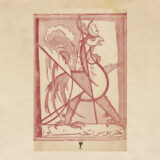
The emblem of the Fighting Cock Association, designed by Master Jalil Ziapour, 1948
The name of an art association and a magazine in Tehran in the late 1940s and early 1950s. The change in the political situation and the accompanying transformation of the cultural atmosphere (resulting from the entry of Allied forces into Iran, 1941) led artists to experiment with various styles, from surrealist fantasies to abstract configurations. The choice of this title by the members of the association also indicated the combativeness of this group against the old, prevailing style and manner in art and literature.
This association was first formed in 1948 by the gathering of a group of painters, musicians, poets, and literary figures in the painting studio of Jalil Ziapour, after his return from his first trip to France. In addition to Ziapour, the other founders of this association were: Manouchehr Sheibani, poet and painter; Gholamhossein Gharib, fiction writer and musician; and Hassan Shirvani, playwright. Gradually, by holding discussion sessions on new art, this association became a gathering center for modernist artists. The association also organized exhibitions of works by members or young artists.
Eventually, the association published a magazine named The Fighting Cock, the first issue of which began with Nima Yooshij‘s poem “From the City of Morning.” From the very beginning, a kind of division of labor in preparing the content, based on taste and area of activity, was observed among the members of the association, which continued more or less until the final issue; thus Ziapour prepared the articles on painting (for example, see The Fighting Cock, No. 1, pp. 12-15, No. 2, pp. 13-18, No. 3, pp. 3-18, No. 4, pp. 31-41), Gharib the materials related to fiction (for example, see The Fighting Cock, No. 1, pp. 16-30, No. 2, pp. 3-10, No. 3, pp. 36-63, No. 4, pp. 21-39), and Shirvani the plays and theater criticism (for example, see The Fighting Cock, No. 1, pp. 31-45, No. 2, pp. 30-35, No. 3, pp. 23-34, No. 4, pp. 6-17). Also, in each issue, poems by Nima (see The Fighting Cock, No. 3, pp. 1-2, No. 2, p. 1, No. 4, p. 30) and Sheibani (for example, see ibid., No. 4, pp. 1-5, No. 2, pp. 20-24, No. 3, p. 35) were published. Furthermore, an article by Morteza Hannaneh in the field of music (see ibid., No. 1, pp. 3-7) indicated the collaboration of artists other than the association members with the aforementioned publication. The first series of The Fighting Cock magazine, under the editorship of Jalil Ziapour, was published biweekly, and in total, five issues of it were published from 1949 to 1950. On the cover of all issues was the image of a crowing cock drawn by Ziapour. During this period, despite its innovation, the magazine had a relatively conservative tone, and its aim was “to raise the level of public knowledge.” Aydin Aghdashloo has mentioned other artists, such as Hossein Kazemi, Javad Hamidi, Mahmoud Javadipour, and Ahmad Esfandiari, alongside the members of the association, and has considered them not only as disseminators of modern painting, but also the initiators of the challenge of modernism, the popularizers of the new concept of painting, and the “buglers of the beginning of the battle” between the new and the old, who, through much effort, struggle, and suffering, at least established the term “modernism.” During these years, more radical modernists joined the association, the most prominent of whom were Hushang Irani, Nima Yooshij, Sohrab Sepehri, and Bahman Mohassess (painter and caricaturist). During these years, the publication of the second series of The Fighting Cock magazine began with the artistic and literary manifesto “The Slaughterer of the Nightingale” in thirteen clauses, which was chiefly written by Hushang Irani and expressed his views. In this manifesto, it is stated: “The art of The Fighting Cock is our living art. This cock will silence all the voices that lament over old art,” and in it, it is emphasized that new art, “with sincerity toward the inner self” and as “the gateway of creation” and “the breaking of conventions” and “the reliance of the artist’s thought on modern knowledge,” considers “a merciless battle against all past artistic traditions and rules” and “the destruction of all associations favoring old art” as its slogan. During this period, Jalil Ziapour withdrew from membership in the editorial board.
The second series was published in four issues, from 22 April to 6 June 1951, and with the cessation of its publication, the successors of the association founded the publication The Cock’s Claw (Panjeh-ye Khorus) in 1953, under the editorship of Bahman Mohassess, which was also short-lived.
The perspective and spirit of the founders of this association had a serious impact on the artistic atmosphere of that era, so much so that the phrase “purple scream,” from one of Hushang Irani’s poems titled “Blue” [Kaboud], was for a long time a figure of speech referring to new poetry and the works of modernist poets. In the visual arts as well, the association’s theories paved the way in the 1960s for what Aghdashloo has called Iranian modern art.
Source: Encyclopaedia of the World of Islam, vol. 15 (Khaneh–Khal’at), pp. 437–439.
Editor’s note: This entry states that the five issues of the first period of the Fighting Cock magazine were published “from 1949 to 1950”. A document available on this very site, Hassan Shirvani’s speech at the association’s annual celebration, printed in the newspaper Iran in May 1949, states explicitly that “five issues have been published so far”; that is, all five issues were published in 1948. The text of the entry has been left untouched; this note is only to clarify this discrepancy.