by
by Leila Derakhshani’s article entitled “A Report on the Commemoration of Jalil Ziapour at Barg Gallery – In Praise of the First Modernist”, Tehran Emruz Newspaper, Tuesday, 17 November 2009

“First of all, I would like to offer my condolences on the passing of Mehdi Sahabi. His death has coincided with the anniversary of Jalil Ziapour; what a coincidence!” Parviz Kalantari began his remarks with these words at the commemoration ceremony for Jalil Ziapour, which was organized by the Barg Gallery in collaboration with Tandis magazine. The ceremony was held on a relatively cold autumn afternoon in the open air of the gallery, but listening to Kalantari’s warm words kept the audience there until the end of the ceremony.

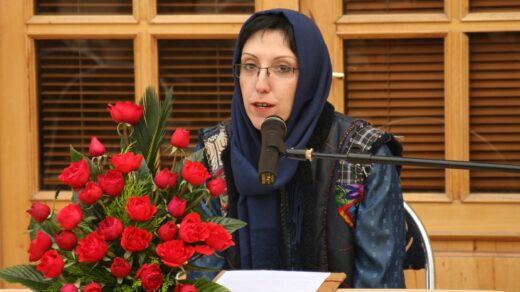
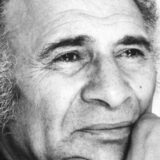
Parviz Kalantari, painter and writer
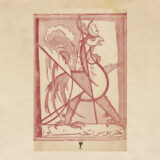
World War II had ended, Jalil Ziapour had just returned from Paris, and Parviz Kalantari was a high school student. In those years, there was certainly no opportunity more precious than for painting to be taught in high school under the supervision of a teacher like Ziapour, and this was an opportunity that Kalantari benefited from. Ziapour spoke of new things; he had founded the Fighting Cock (Khorus Jangi) Association, and Kalantari and his peers, following his lead, had become young fighting cocks who imagined they had to fight against whatever had the color of banality: “Jalil Ziapour is rightly considered the standard-bearer of modern Iranian painting. According to one account, contemporary Iranian painting begins with the era of Kamal-ol-Molk. When Kamal-ol-Molk returned from Europe, influenced by Renaissance art, he brought European painting to Iran, and this painting, in a country where there was no familiarity with this type of painting, was an event. According to one narrative, the school of Kamal-ol-Molk is considered the beginning of a kind of modernism in painting, but modern in the sense of twentieth-century art belongs to the period after World War II when Ziapour returned from Paris.” Ziapour published the Fighting Cock magazine with the participation of Gharib, Shirvani, and Hushang Irani. The atmosphere of that time did not accept the words of Fighting Cock. Hushang Irani, with his famous Dadaist poem – ‘the black cave runs, lets out a purple scream’ – had created a strange and bizarre atmosphere. The traditionalists could not tolerate the words of Fighting Cock and Ziapour, and often in exhibitions, matters came to blows.
Iran at that time was shedding its skin; it was rapidly transforming from a feudal system into a national capitalist system, and with the sale of oil and the boom in trade, everything took on the color of change: “I remember that during my adolescence, various Western factories like Singer sewing machines, Chevrolet cars, Chrysler cars, etc., established their representative offices in Iran. In parallel with this, the entry of Western cultural goods and modernity also had representative offices in Iran. The representative office of Cubism and Picasso was held by Jalil Ziapour. With his anti-traditionalism, he opened the way for subsequent generations, but it is very strange that he changes after that.” Like all great artists in history, Ziapour was faced with serious questions: Who am I, where do I stand, and how do I look at existence? To find the answers to these questions, Ziapour’s long and far-reaching journeys began, and in these wanderings in the wilderness, many things changed. It did not take long before he abandoned the representative office of Picasso and Cubism, and the product of his travels became the life of the nomads that appeared in his paintings. Kalantari says: “I remember that at that time, for the first time, an anthropological museum was established on Aramaneh Street, which was run by a Russian gentleman named Hannibal. It was the first time we saw such a place; people’s bathhouse utensils such as bowls, water pitchers, pumice stones, bath wraps, etc. were arranged there, introducing the people’s way of life. And on the doors and walls were Ziapour’s small sketches of the nomads, which left one bewildered. Now I was seeing another type of painting that showed the life of the nomads in a very free and expressive way.” Ziapour, who had spent a lifetime in battle with tradition, went to the Ebrahim Khan Bathhouse during one of his trips to Kerman – 1956 – and carefully painted a Qajar-era fresco – the battle of Rostam with the White Demon: “For me, there is always this question: was it not these very brickworks that shaped the structure of Ziapour’s paintings – squares that change with a slight color nuance?” Ziapour traversed the entire geography of Iran, and after that, in cooperation with the Department of Culture and Art, launched provincial exhibitions showcasing Gilani, Khorasani, Kurdish, and Baluchi women, etc., none of whom were left out. After this period, he turned his attention to history and mythology and began working at the Shahnameh Foundation: “But unfortunately, after the revolution, this work did not continue; otherwise, today we would possess a valuable collection of a painter’s interpretation of the Shahnameh.”

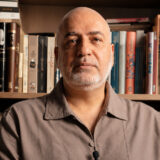
Touka Maleki
The weather is still cold. The front row seats are filled with artists such as Mahmoud Javadipour, Abbas Mashhadizadeh, Nahid Saliani, Iraj Eskandari, etc., and the family of Jalil Ziapour. The next speaker of the ceremony is Touka Maleki – a visual arts researcher – who reads her article focusing on the Fighting Cock Association to the audience: “Allameh Dehkhoda considers Fighting Cock grammatically a compound noun and defines its meaning as a rooster prepared for fighting, and there is a note in Dehkhoda’s handwriting that metaphorically considers Fighting Cock as someone who wishes to fight everyone without cause and is quarrelsome.” According to Maleki’s statements, later, after Ziapour’s return from France and the beginning of his struggle against traditionalists in art, and especially in painting, Fighting Cock became equivalent to Ziapour himself. In Maleki’s belief, despite the apparent meaning of Fighting Cock, “there is no fight or dispute, and if there is, it is on the part of the opponents of the modernists; and simply because in every era there are those who have a dispute with traditional culture and art and, in Ziapour’s own words, with regression, and who themselves bring about a new and modernist movement, the number of Fighting Cocks increases.” Maleki cites examples of Fighting Cocks in various literary and artistic fields; people like Mohammad-Ali Jamalzadeh, Sadegh Hedayat, Gholamhossein Gharib Gorgani, Nima Yooshij, Hushang Irani, and ultimately Ziapour himself in the field of painting, and after him, other examples such as Ebrahim Golestan, Farrokh Ghaffari, Abbas Nalbandian, and Alireza Mashayekhi are lined up, and then it is concluded: “This male bird continuously produces offspring. In our own time, in all fields, how many Fighting Cocks we have, who all, with or without reason, rightly or wrongly, have a fight to pick with others.”
Regarding the nature and details of the Fighting Cock movement, Maleki quotes Ziapour as saying: “We left no regression or traditionalism unanswered and, to the extent that our knowledge allowed, we decisively cast aside and exposed the factors of obstruction and opportunism. Fighting Cock is a struggle against a traditionalism that is detached from the realities of society.”
“Were the pioneers of modern poetry and painting – Nima and Ziapour – to whose account all the disputes between the new and the old were written, real and authentic Fighting Cocks?” This is the question raised in the article, and its answer is also given there: “No. Both Nima and Ziapour were more conservative than to be real Fighting Cocks, though of course this conservatism is not a negative thing, but rather very positive and logical. They disrupted minds addicted to a thousand-odd-year-old addiction, yet both Nima and Ziapour were the true continuation of ancient works.”
Further on, the ban on Fighting Cock magazine is mentioned, along with the interesting story of a misunderstanding in the comprehension of the word Cubism: “He was asked: Who commissioned him to propagate Cubism? After Ziapour’s explanation of Cubism, they apologized to him for banning the Fighting Cock magazine and told him, ‘We thought Cubism meant Communism!'”

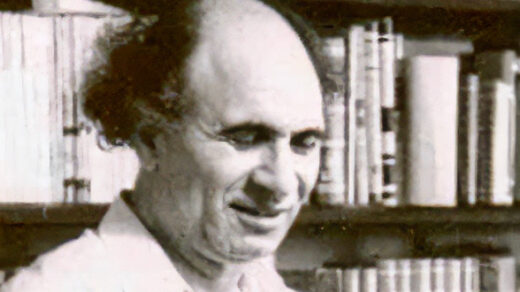
Members of the Fighting Cock Association from left to right: Gholamhossein Gharib, Jalil Ziapour, and Hassan Shirvani
The members of the Fighting Cock Association changed slightly in different periods: the first group, from 1949, consisted of Gholamhossein Gharib in the field of literature, Hassan Shirvani in the field of theater, Morteza Hannaneh in the field of music, and Jalil Ziapour in the field of painting. The association began publishing the magazine with the aim of enlightening minds regarding modern art, and at the very beginning, Hannaneh stepped aside due to a difference in taste, and in the year 1951, the poet Hushang Irani found his way into the association, while Ziapour distanced himself from it. Jalil Ziapour is quoted as saying: “With the entry of Hushang Irani into the association, his extremism caused me to withdraw from the circle of friends.” After Ziapour’s trial and it becoming clear that he had no connection to communism, it was decided that the banned magazine would be published under a new name; thus, from the end of the year 1949, another magazine named Kavir was published by Gharib, Ziapour, and Shirvani with the same objectives. In this low-circulation magazine, Ziapour printed the first painting in his own style, titled Public Bath, as well as an article titled “Painting,” which was in fact an explanation of the obvious regarding his Public Bath. Kavir was also banned; this time, The Cock’s Claw (Panjeh-ye Khorus) was published. Then The Cock’s Claw was also banned, and after this, Ziapour sought the help of the cultural and artistic pages of other publications to express his views.
According to Ziapour’s statements, there were three groups of actual opponents of Fighting Cock: “The first group were the members of the Tudeh Party, who, in Ziapour’s words, said that art must be understandable to everyone, such that even an orange seller would be satisfied with it. The second group were the miniaturists, who opposed modern art in general, and the third group were the followers of the school of Kamal-ol-Molk, whose art was considered the official art of that period.”
Source: Tehran Emruz Newspaper