by
by An article by Dariush Kiaras, titled “The Story of Jalil Ziapour and the Fighting Cock (Khorus Jangi) Association,” Tandis Biweekly, special issue for the Eighth Art Research Meeting, the Tenth Commemoration of Master Jalil Ziapour, Barg Gallery, 10 November 2009

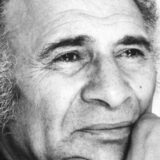
Master Jalil Ziapour, the Father of Modern Iranian Painting
From time to time, thoughts too fall unripe from the tree. (Wittgenstein)
The temptation to deviate, like a feminine soul, was constantly with him. He wished to depart from natural norms. To depart from nature was to become unnatural, at a time when all artists seemed to be taking on the same form.
Ziapour is among the most unnatural artists of our century. In Persian, few people have been “accused” of modernism and modernist ideas as he has been, and undoubtedly, by virtue of a paradigm-shifting role, he is considered one of the first pioneers of a new art whose initial tremors seemed to demolish the entire edifice of Iran’s old art of painting. He would look directly into the eyes of simple-sighted painters, whose ultimate model was nature and the seasons of the year, and with explicit candor he preferred “the pleasure resulting from perception” to facial beauty and “prettiness.” Before going to Paris, he had seen Kamal-ol-Molk’s painting and his students, and fundamentally Iranian painting, which was continuously constrained by the modesty of reason. And now in Paris he had become acquainted with a current called Cubism, whose partisans believed that “rational thoughts are incompatible with artistic feelings”; and he had returned to Iran, and in the capital the ultimate in Iranian painting was the works of Kamal-ol-Molk, and Kamal-ol-Molk strongly emphasized that feelings should not overcome reason and that the painter must draw on the canvas only and only whatever the eye sees. In contrast to Kamal-ol-Molk’s advice, who would tell his students: “From the collection of several trees that you see in the schoolyard, construct a garden plot on the canvas”; Ziapour would tell his students: “From the collection of several trees, bring an emotion into being.”1 And this was at a time when there was no emotion, or there was and it was only emotion and nothing else, and this was a blow to an obsolete mentality and to the question: Can “emotion” be drawn? And an even greater question: Can an “emotion” come into being on a canvas from a collection of several trees!? He wanted to erase the wrong old (Iranian) mentality and make it understood that emotion is not the very thing that it is; rather, “emotion” is in fact something that we make manifest with our “sense” and later become captivated by! Although this teaching did not help “emotion”, but rather killed emotion. But this is no more than an idea for an illusion that, when you are alone and the sole champion, calms you! And he had become the sole champion of the arena of new art, on a pitch where all its players and spectators were old; they came from the old and presumed the old to be new. He blew into the horn of modernist art in Iran at a time when all history and all art and literature, by means of a bullying king named Reza Khan, was reverting and wanted to revert to the pre-Islamic past. Consequently, contrary to the politics of the day and the Westernization of this country, statesmen preferred to drive the pen, the step, and the pen-wielding mind in history, literature, and art toward the past. Most artists who could do creative work, at the beginning of the first decade and in the 1940s, thrust their heads into the well of manuscripts and sheathed their instruments, pens, and creative thought so that as correctors, researchers, and annotators they could not apply a modern thought; for this thought naturally repelled backwardness, and repelling backwardness meant democracy, and democracy was the poison and venom of dictatorship! For this very reason, all art schools were either miniature academies or carpet-weaving schools, and all painting was this: that in an art competition it be determined who could draw the face of the illiterate bullying king more naturally and exactly like the living version on canvas, so as to become worthy of a medal of honor in Iranian art! Ziapour’s adolescence passed in this artistic turmoil, until two decades later when the presence of a painter bride from the Diba family completely expunged the old consciousness of art from the Pahlavi family and embedded modern Western thought in their confused minds.
Jalil Ziapour was born in 1920 in the city of Anzali, in the thick tumult of politics and amidst the fires of the decline and establishment of two governments (Qajar and Pahlavi). His adolescence in most Iranian cities was a time of famine, but in his youth the eruption of the southern oil wells was already connecting Iran by pipeline to the important arteries and crossroads of the world.
He is eighteen years old when, intending to pursue musical studies, he comes to the capital for the first time in 1938. His interest in composition remains abandoned halfway due to the shortage of music schools. In this year, art schools are proliferating in Tehran. Most youths who possess artistic taste, now that a university has not yet been established in Iran, turn toward the School of Fine Crafts. In 1939, he enters the School of Ancient Fine Crafts, which Hossein Taherzadeh Behzad administered, and for one year he learns everything they taught in this school. As a result, Ziapour was not yet twenty years old when he became proficient in carpet painting, tile design painting, illumination, and miniature.2
The presence of Hadi Khan Tajvidi alongside other teachers such as Zaviyeh, Bagheri, and Karimi in this school, apart from teaching trade and technique, also acquainted the student with color and the colorful realms of painting, even though the pinnacle of painting for these individuals was the painters of the Marvi Mosque and the students of Kamal-ol-Molk. It is not long before expediency dictates that, like any civilized place in the world, Iran too should be equipped with a “university”. With the conversion of the School of Fine Crafts into the art branch of the university, Ziapour becomes a student at the University of Tehran. In the university, it is no longer only the students and nurtured disciples of Kamal-ol-Molk who are masters and teachers. Subjects are dispersed, and each master teaches within their specialized domain. Master Heydarian and Master Sedighi are still caught up in the Kamal-ol-Molk mentality in art, but the presence of Dr. Keyhani (who taught anatomy) and the passionate presence of Mohsen Moghaddam, who was a dissident thinker; and most importantly the vanguardism and progressiveness of Madame Ashoub and Aftandilian, taught the pupil and student something of the modern world besides the old teachings. The presence of Europeans in the education system, and particularly the cultural connection between Iran and France, created conditions in which, in 1946, the French government placed a scholarship at Iran’s disposal to invite art-studying students to the temple of new art (namely the Beaux-Arts in Paris). With Ziapour’s emigration to Paris, all his learnings in Iran seemed to become worthless, and the entirety of “value” in his mind becomes the new identity that he learns in Paris. In truth, Ziapour is the first painter who, after Kamal-ol-Molk’s trip to Europe, returned to Iran from Europe with a mentality entirely opposed to that of Kamal-ol-Molk, and this was under circumstances where Kamal-ol-Molk’s students in the media, press, university, and artistic circles of Tehran considered the dominant face of art to be that very Kamal-ol-Molk tradition!
The year Ziapour left Iran for Paris, despite the French teachings of Madame Ashoub and the modern architectural vision of Aftandilian, a glimmer of “nature-making” was still the dominant feature in the university; meaning the university was seemingly that same School of Fine Crafts, but with the difference that here modernism was now perceived as a kind of Impressionism. He returned to Tehran two years later; and this was the year 1948, and in Tehran a commotion had been started by a few fresh-breathed youths who seemed to want to treat the background of Iran’s history, art, and literature as a ruin, using harsh language and a sharp gaze, so that the Iranian mind would go down a path that for years the common people had been calling Turkestan! For the first time, around these very years, sentences from Nietzsche are being exchanged among the young artists of Tehran. This philosopher’s most important statement for them was: “Art must be understood in terms of the artist”! And this sentence in truth taught that every artist individually has their own particular moral characteristics. And this was a blow that descended upon the group of Kamal-ol-Molk’s students; because Kamal-ol-Molk’s disciple-nurturing mentality had learned and taught: all painters must have a single moral characteristic, and that is the very moral characteristics of the master. And these characteristics had no connection to painting whatsoever; because it was a collection of: honor, respect, reputation, modesty, generosity, chivalry, and manliness!

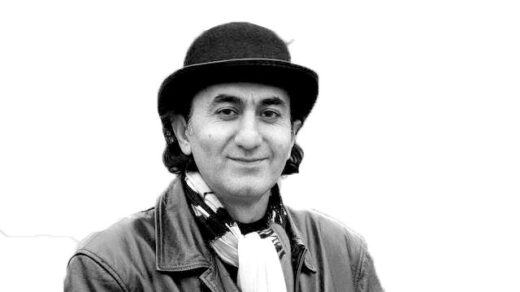
Members of the Fighting Cock Association from left to right: Gholamhossein Gharib, Jalil Ziapour, and Hassan Shirvani
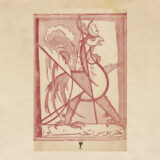
Ziapour considered these characteristics suitable for a champion wrestler [pahlavan]. And he viewed the painter differently. Precisely in opposition to this Iranian mentality, he conceived of the painter as a being made up of a collection of canvas, brush, color, atelier, and the album of works by other painters. This attitude caused him, at the outset, to establish an atelier to present his different works and thoughts. Nowhere – if there was anywhere at all – followed his new ideas. Painting was still state-controlled and had not become private. On returning from his first trip (1948), together with two like-minded youths who had suitable propositions for advancing modern art, he founded the “Fighting Cock Association” – in the atelier he had established. Given that the press was not a place for publishing avant-garde ideas – of the kind he thought – he, in collaboration with a few but like-minded friends, published a magazine named “Fighting Cock,” which to this day is considered one of the most important periodical magazines in the avant-garde position. This magazine, which was published in a book format (Vaziri size) (the magazine’s format later changes), created an earthquake in the Tehran press. Gholamhossein Gharib in fiction, Shirvani in theater, Hannaneh in music, and Ziapour in painting; all laid claim to modernism, and even more interestingly, right from the first issue, the most avant-garde poet of those days, who was the object of curses and damnation by traditionalist poets, namely Nima Yooshij, was also somehow recognized within the circle of the association’s members, and works of his were published alongside the works of these few individuals. Careful attention to the first issue of this magazine and an exploration of its contents reveal a new condition in the semantic sphere and the epistemological sphere of Iranian art and literature. Even though the magazine is bound in forty-five pages, it disrupts the historical condition of Persian magazines. Although shortly thereafter it is prevented from publication under the baseless accusation of being affiliated with the Tudeh party, “Fighting Cock” is in fact the first non-Tudeh magazine and the first non-profit magazine in Iran. As soon as one opens the cover (which shows a cubist fighting cock purely in black color, without any writing), we are confronted with a poem by Nima Yooshij which is, in truth, the manifesto for all the periods of this magazine: Cock-a-doodle-doo. The rooster crows/ from within the hidden seclusion of the heart,/ from the descent of a path that like a dry vein,/ runs blood into the bodies of the dead,/ it weaves upon the cold wall of dawn;/ it exudes toward every side of the plain.3
In this poem, Nima says: This rooster brings “glad tidings” and in this “ruined abode” will guide the way toward the “flourishing”. Also, in another stanza, he recounts all the moral characteristics of the association’s members: softly it comes/ warmly it crows/ it beats its wings/ it flutters its feathers… In nine stanzas, Nima masterfully recounts the entire essence of the magazine through the allegory of the rooster. And what is more interesting is that, even though the year 1946 is inscribed in the poem’s footnote, it is the first time that this poem is published in “Fighting Cock”. Did Nima compose this poem specifically for the magazine? Then why does the date beneath the poem relate to four years earlier? Did Nima, as always, still fear the regime, the government, and the Tudeh party members, and deliberately date the poem older?! Following the inclusion of Nima’s poem across two pages, on the third page a short article by Morteza Hannaneh acquaints the reader with “symphonic music”, with a Fighting Cock-esque beginning that generates a question mark in the mind: “As a result of backwardness from the civilization of the world, and the severe and misplaced prejudices that had appeared in our society against listening to music and rejecting it, naturally a great blow has been dealt to the morals and spirits of us Iranians, such that…”4 But after four pages of news related to modern music, Ziapour’s important and controversial article titled “Painting” is printed, in which he practically attacks Hossein Behzad and Kamal-ol-Molk, makes references to the issue of Cubism, and in it writes with irony to the people of the School of Fine Crafts: “After the thought reached the brains of artists that they must show their own perceptions, not be the slaves of the tastes and preferences of others, various schools emerged, among all of which there were only two schools that reached the summit of their progress and yielded the result of their long years of explorations; one was Impressionism, which created a revolution in the realm of coloring and gave a different meaning to watercolor painting. And that other one, which is the newest of all, and in my view is directly affiliated with the art of painting, not with poetry, poetics, and storytelling, is the school of Cubism.”5 Ziapour in this piece also makes references to the individuality of the artist, while at the same time emphasizing at the end: despite his statements about Cubism, Iranian art (including tile and carpet painting) is worthy of reflection in this matter! Gholamhossein Gharib’s story, titled “Excavation,” also announces another voice in modern prose. And also a play by Shirvani named “God’s Lover,” and most importantly the poem “Rebellion” by Manouchehr Sheibani, a distinctive poet and painter who dealt the first blows with his poem to the body of the quatrain-composing poetry of the 1950s; a distinct poem with strange language and a new meter that, alongside Nima’s poem, in truth demonstrates a duet; a poem that, except for Hushang Irani and for a short period Sohrab Sepehri (in his youth), was never again experienced in the mind of any poet! And this is the entirety of one issue of a magazine that created a turmoil in the darkness of a generation.
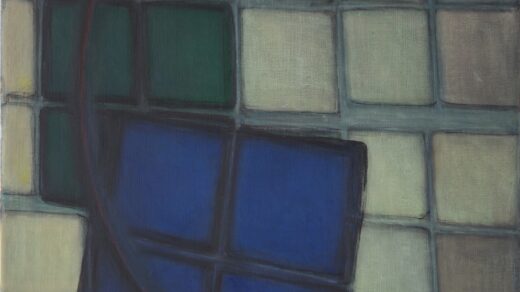
The “Fighting Cock Association”, in that very first issue of the magazine, had turned into a new artistic and literary collective. The sharp articles and heated lectures, which were equipped with a fresh vision, fueled the tension between modernists and traditionalists. He enjoyed making an ironic dig at classical painting, which was the dominant feature of the time, in every speech. For this reason, conditions were prepared for the two mentalities, new and old, in painting to turn into a battlefield. Of course, the right in this matter lay with Ziapour. He had realized that Kamal-ol-Molk’s students had mostly confined and restricted themselves within the framework of stale and worthless visual rules, such that no path other than retrogression could be seen within the limits of their vision. And genuinely, up until the year Ziapour came from Paris to Tehran, all the old and new history of Iranian painting was a form of decorative painting. Ziapour stripped decoration from Iranian painting, made micro-painting appear unimportant, and managed to substitute creativity for “skill” in painting. He constantly referred to the school of “Cubism”; and of course, the Cubism he spoke of was entirely different from the Western school of Cubism. Through his writings, notes, and speeches, it becomes apparent that the school of Cubism, in the first period that it was introduced by him into Tehran’s painting, dictated that natural shapes be broken down with small geometric shapes; and this was not even the same Cubism that was taught at the Beaux-Arts school in Paris! Over time, of course, he defined new pointers that distanced the painting of a decade later from nature-making. In a piece titled “The Matter of Painting” (in one of the issues of “Fighting Cock” in the year 1949) he makes fresh remarks about the school of Cubism. In this piece, which is the transcription of a lecture at the association, he refers to the concept of passage (relationships) in Cubist painting and says: “Passage explicitly in the school of Cubism (a need which had awakened in the works of novice Cubists) eliminates the paradox of placing two contrasting colors side by side without a mediator. Passage in painting causes the eye, with its presence, to move gently across all points of a canvas; and in this way it became possible for the eye to have a distinct soft traversal from one color to another, and from one surface to another, from one corner to another corner of the canvas.” He also refers to deformation (alteration of form) in painting in this piece; and it is in this very lecture that he makes reference to statements by André Lhote. And he states the most important key point of his own works from Lhote’s remark in his final sentence, that: “To exaggerate, to reduce, and to omit are three absolutely mandatory tasks that an artist must engage in”! He himself strove for a long time to construct an Iranian Cubism from the collection of teachings of André Lhote and the Cubists. In the painting “Turkmen Girl”, he has brought out the cheeks of the image in the subject’s face through linear foundation, without creating shading. In the paintings “Public Bath” and “Sepahsalar Mosque” too, by creating lines and angles, he has deformed the entirety of the painting to show the domain of the painting’s power rather than the concept; meaning he attempted in his works to somehow conceal formal surfaces in favor of other characteristics. These behaviors altogether, in contrast to classical painting and nature-making, which recommended a kind of simple-seeing, formed a sort of sadistic mentality. In truth, Ziapour rejected nature painting entirely and was a staunch opponent of nature-making, even though in his speeches he referred to Iranian culture. The “Fighting Cock” group was fundamentally opposed to looking backwards and the old situation, and they endeavored to bring about a kind of modern vision in a new framing from the heart of their own culture. The entire effort of the “Fighting Cock” members became aimed at somehow attaining the “articulation of theory” so they could introduce their works to the post-experimental Iranian society. It is from this very group that the debate of “art for art’s sake” versus the topic of “art for the people” emerges for the first time. In his debates and speeches, he brings the efforts of Kamal-ol-Molk’s students and of himself into question and interrogates their Tudeh-aligned thought with a blame-seeking mentality. In a lecture at the “Fighting Cock Association”, he practically deems Kamal-ol-Molk’s students illiterate, and standing before a painting drawn by Ashtiani, he says ironically: “One of the characteristics of some of our painters is that they paint based on the poems of poets like Hafez, Khayyam, and Nezami; they select a topic and so to speak visualize a scene: ‘It is no wonder in the sky if, as Hafez says/ the song of Venus brings the Messiah to dance’… and they paint His Holiness Jesus dancing in the sky. Concerning this group of painters, it is not permissible to discuss any further.”6 He says these kinds of painters are only a liaison from the art of miniature-making to nature-making, and they themselves are neither of that category nor of this one; he presumes that they do not even observe color psychology in their canvases and are ignorant of artistic rules!
Ziapour in truth tried in any way possible, by gathering allies and arranging modernist material and in opposition to customary literature and art, to achieve a kind of new current-creation that he did not see in the press and art venues around him. For this very reason, the magazine “Fighting Cock”, with its limited print run and simple printing, was a nail driven into the beautiful eyes of the colorful press of its time. And the reality is that today it is by measuring against the standard of the magazine “Fighting Cock” that we realize the difference between realism and modernism in contemporary art and literature. Just as Scott Lash also says: “Modernism, above all else, had a debilitating effect on bourgeois identity. The reason for this is, to some extent, that modernist ‘texts’, compared to realist texts, are less comprehensible for the middle class. Therefore, they cannot have a similar pervasive role in the formation of their identity.” Consequently, all the noise and propositions of the “Fighting Cock” members were seemingly stifled in the embryo right there in the atelier. Why were the members accused of elitism, meaning that they paid no attention to the poor class? Of course, this was a governmental conspiracy; meaning, in painting and literature and, in general, the culture of the time, a discourse had arisen that was a conspiracy of the Tudeh party, which was that the wealth of the upper classes must be divided between the middle and poor classes! And the poor class was entirely the audience for its painting, for the canvases “Lettuce and Sekanjabin”, “The Beggar Old Man”, “The Shoemaker Child”, and “The Poultry Sellers”! Canvases whose living and breathing subjects could be seen in the alleys – in every street. Scott Lash, continuing his theory which posits that modernist texts are less comprehensible for the middle class, writes: “This matter is partly intentional; meaning the disorganizing and reorganizing of time and space has frequently and clearly been with the intention of shocking the bourgeoisie. Hence, modernism [from the beginning] was exclusive to an elite audience.”7 And exactly all the members of the “Fighting Cock” magazine were also in pursuit of a kind of elitism. Sometimes in their speeches this issue was even emphasized.
The magazine “Fighting Cock” was published for two periods with this same title, and later continued its work halfway under titles such as “Kavir” and “The Cock’s Claw (Panjeh-ye Khorus)”. The first period was published from the year 1949 to the year 1950 in five issues, which mostly revolved around Ziapour’s lectures and articles on painting. From the end of the year 1950, Hushang Irani returns to Iran from his trip to Spain and socializes with the members. In May 1951 the new period of the magazine is published with a sharp and fierce artistic manifesto named “The Slaughterer of the Nightingale”. Fire seems to rain down from Hushang Irani’s tone and speech. I call this second period of the magazine the true presence of modernity in Iranian art and literature. It is necessary to recall and note that this manifesto has little to do with Ziapour. By joining a government job, he seems to make decisions in favor of the government so as to deviate from that rooster-like language. He himself, years later, after silencing the rooster’s voice, says in an interview with Naser Hariri: “In the year 1951, with the arrival of Hushang Irani from Europe and his finding his way into the association, his offensive extremisms caused me to withdraw myself from the circle of friends. Thus, the second period publication of ‘Fighting Cock’ was published on 6 May of this same year, in square format, with repulsive promotional content (without my involvement).” And this confession was a peephole for understanding the reasons for the “Iranian Cubism” school ending up without consequence.
Evidence reveals that Ziapour’s case of “Iranian Cubism” was pushed back with the arrival of painters trained abroad, and another form of painterly expression, based on modern painting in the world, became the model for Iranian modernist artists. In the 1960s Gharib became a third-rate writer, Hannaneh reverted to dillydallying, Shirvani disappeared, Hushang Irani, through travel to different parts of the world, distanced himself from the Iranian public eye and later died in exile, and Ziapour entered the government’s educational system. That non-profit group on the threshold of the 1950s; how well it disrupted the crowd and disheveled the hair, only to itself later go bald.
The last “Fighting Cock,” having grown old but still clear-sighted, laid his crown upon the ground on 21 December 1999. He actually died at the hands of all these hens.
Footnotes
1- “I told a student to bring an emotion into being from a collection of several trees,” quoted from: On Art and Literature, compiled by Naser Hariri, Avishan Publications, 1999, p. 61.
2- The most important subjects of the school were these very “four arts”, which of course were more “craft” than art!
3- Fighting Cock, first issue, a subset of Qiyam-e Iran monthly, undated, p. 1 (It is interesting to note that in the first issue, the magazine does not bear a name on itself, and only on the back cover it says: Under the supervision of the Fighting Cock Art Association).
4- Ibid., p. 3.
5- Ibid., p. 14.
6- Later this lecture was printed in Azarpad weekly, issues 5 and 6, May 1950.
7- Sociology of Postmodernism, Scott Lash; translated by Shapour Behyan, Qoqnoos, 2004.