by
by The full text of Master Jalil Ziapour’s historic lecture at the Fighting Cock (Khorus Jangi) Association; 14 February 1950

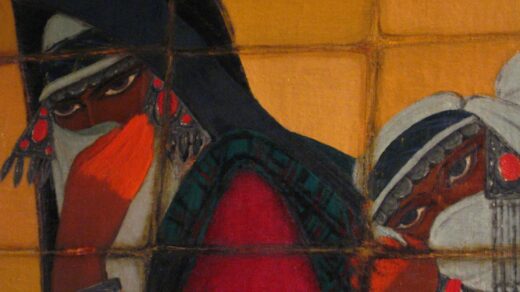
Master Jalil Ziapour; “Public Bath”; 1949; oil; 120×80 cm
The artist, through his works, is always ahead, and critics, art connoisseurs, and interpreters of artistic origins and principles run after him. The rest of the reports and interpretations in these matters are futile and fruitless. These critics, too, are of two groups: one group always looks at works from the perspective of the manner of thinking, and the other group pays attention to the manner of expression, “bearing in mind that artist-critics are exempt from these two groups and, since they are constantly in the course of practice on the path of progress, they will willy-nilly gradually turn their attention from the manner of thinking to the manner of expression.” Those who pay attention to the manner of thinking are entirely removed from the necessary aspects of criticism, their eyes and senses traveling toward only one aim; “in fact, they resemble horses whose eyes have been fitted with guiding blinders so that they pay attention only to what is in front of them, meaning the direction their owners have in mind.” And the group that pays attention to the manner of expression, compared to the first group, is more knowledgeable and precise in art, and their criticism regarding artworks is more correct and more artistic, and their attention is closer to pleasantness or beauty.
Human life and desire are founded upon the natural law of need. If, in the face of this natural law, there are also cases that must be heeded, and, for example, one must not always trust the reactions of needs “which might be deviant,” very well, this is among the necessities, but we know that attention to this act arises only in the manner of thinking, not in the manner of expression; and there is no problem with them changing the manner of thinking and teaching society the correct way to think, so that in the meantime, for example, artists too, while manifesting themes, might show logical and necessary ideas in their works and bring things into being that correspond with the reality of human life; but this work has absolutely nothing to do with artistry and artistic display. That is to say, how to think is separate from how to show a thought. I said, how to think is separate from how to show a thought. What people have in mind regarding art is simply their taking pleasure from artworks without any effort! And in the view of the critics of the people as well – “critics who look only at the manner of thinking” – it is how the artist thinks. That is, generally speaking, people too demand the people’s manner of thinking from artists! This demand is entirely apart from the demand the artist has and thinks about, and from this perspective, a great distance exists between the artist and society.
During this time that I have encountered people who are more or less knowledgeable, I have found them all seeking their personal thought and desires, and in the world of art and the understanding of those realms, I have seen them entirely astray. And these individuals, merely on the grounds that they possess general knowledge, and since they are such and such in sciences and crafts, therefore their understanding is certainly capable of grasping art, expect their opinions in analyzing artworks to be deemed sound, and the expression of their beliefs to be recognized as the correct criterion for art criticism! I have encountered few people who confess to understanding artworks only more or less, and who, in comprehending them, present themselves with a truly insufficient foundation. If moderately educated people, and even the elite, sometimes make great mistakes and their beliefs and expressions of opinion are rejected by us, it is because all of them inwardly keep their eyes on the manner of thinking and its direct and untouched reflection, or outwardly on its more or less touched-up form. I must always cry out in the artistic milieu with legible and measured sentences and continuously repeat that (how to think is separate from how to show a thought), because how to think belongs to thinkers and how to show a thought belongs to artists. It is not improbable for an artist to be a thinker as well, but in any case, artworks are valuable to us from the perspective of artistic display, not from the perspective of thought; that is, what I think about such and such a thing, or what he thinks, or what the people think is not important. What is important from the perspective of art is showing a kind of thought (whatever it may be, “in the necessary technical and masterful method”); here I emphasize and once again affirm the core of the matter: (in the realm of artistry and artistic display, “how to think is separate from how to show a thought”).
An artist is someone who is capable and skilled in defining and interpreting states through specialized technique, and an artwork is that work which is valuable solely from the perspective of perfection in displaying technical factors, not from the perspective of choosing a specific manner of thinking. If today a number of people, due to the necessity of general conditions and the existence of a kind of supposedly necessary thoughts, are compelled under various titles of progressivism, intellectualism, and being a progressive society to think of the society they call deprived, as I have repeated many times, one can never for this same reason bind artists to the obligation of producing such and such a kind of work. The philanthropists who engage in unrestrained pen-pushing and who, to satisfy them, or for the sake of the faith they themselves hold in this matter, with a few words of feigned sympathy, suppose they can or must bind artists, are mistaken; because knowledgeable artists, regarding progressive art, are more aware than those who, outside the artistic milieu, pant and, foaming at the mouth and full of complexes, due to ignorance and lack of intellectual breadth in artistic conditions, hurl their fists at the foreheads and brains of progressive artists and tear their works apart. In such a society, it is obvious that everyone must present themselves as a leader, a critic, and a meddler in every matter.
The artist never concerns himself with whether this or that person, so-and-so or such-and-such, derives pleasure from that artwork or not, understands it or not, or whether his thoughts and intentions are inscribed therein or not. There is no doubt that the artist is the mirror of his environment and the representative of the spiritual states of the people among whom he himself was raised. But it is not the case that, under the aforementioned conditions, the artist must specifically be the reflector of general spiritual states and opinions and ignore his own spiritual states; rather, on the contrary, whatever he displays must specifically be his own opinions and spiritual states. In displaying personal spiritual states and opinions, the artist also carries general and social characteristics through forced contact and mutual influence, and these characteristics penetrate his works through whatever path or aperture possible. Here, certainly, from the perspective of sociology, the opinions, spiritual states, and manner of thinking of a society can be subjected to study and criticism in artworks, but from the perspective of the manner of display, artworks can never be placed under the scrutiny of sociological critics. The criticism of artworks from the perspective of the manner of display can only relate to the critics of the manner of expression of artworks.
In the arena of art, the manner of expression is the foundation of artistry and artistic display. A new manner of expression is the foundation for creating a new pleasantness. It is possible that the thoughts favored by the public, in the hands of an artist who is not progressive, will turn into a conventional work with a conventional manner of expression. Certainly, this ordinary and conventional work is pleasing to the minds of the majority of people and is also pleasant for the critics of the people; but these limited critics and philanthropists “who have limited the people themselves as well,” as I said, resemble horses whose eyes have been fitted with guiding blinders. They possess no artistic breadth of vision and never know art, and they pay attention only to the manner of thinking. The manner of expression holds no meaning for these individuals. But progressive artists are never anxious about this matter and continue on as before, because if a new manner of expression is pleasant, it is because it expresses new things to say within a newer mold. The repetition of repetitions by means of ready-made molds, in whatever form it may be, is unpleasant and, for progressive people and artists, repulsive. The cries and lamentations of a handful of uninformed people will not have a bad effect on the progress of progressive people and artists: “even if they are in the ultimate minority.” Place a sublime subject at the disposal of an incompetent painter; from a technical perspective, he certainly will not skillfully manage to expound upon it, but that same subject, a skilled and knowledgeable artist will show more sublimely than he. Place a simple social subject at the disposal of an incompetent philanthropist painter “who is not knowledgeable in the technical manner of expression”; from a technical perspective, he can never manage the necessary interpretation and exposition, but that same subject, a skilled painter “who, let us suppose, in the words of the commoners or demagogues, is not a philanthropist and social painter,” will express in the best way. Here, my purpose from every angle is showing thought and the manner of introducing thought. A good artist is one who, in the best way, as technical perfection requires, introduces a thought, “whatever it may be.” This thought may be from the specific thoughts of the painter, or it may be from others who have imposed it on him. In both cases, the value of the painter does not lie in the thought and the exigency of pristine themes; rather, his value lies solely and entirely in how he shows the thought.
So, by mentioning these grounds, we arrive at the core of the matter, which is that they do not know thinking from the principle of artistry; for this reason, the works of new art appear mute and incomprehensible to them. It is here that the critics of the people, with their baseless displays, roaring on behalf of the people, demand that the artist create a subject that introduces their ordinary and comprehensible daily realities. That he bring into being a subject that is pleasing to their minds! That he construct a theme that is a guide for the people! That he embody ideas that show a goal on the path to the elevation of life and civilization! Or at least bring an artwork into being that the critics of the people understand! Yes, understand? They must certainly understand the theme, and that too, a theme that has been manifested by means of ordinary forms. Strange! They also consider the deformation of beings as resulting from decline and intellectual deviation, and they believe it has come into being pessimistically! They cry out that we need optimistic thoughts and an optimistic society, and they roar that these melancholic people who deform our sacred nature, these regressive degenerates who pay no heed to the tastes of society, these misguided extremist possessors of crooked taste; these reactionary Surrealists and Existentialists, these Dadaists and disruptors of peace and intellectual order, divert humanity from happiness and optimism; these people look at society with eyes of contempt, these people, out of the arrogance they possess, imagine themselves above all of society. This group of people are not artists; they are the outcasts of society, yes, outcasts.
It is not strange that these heralds of the saviors of humanity! call progressive artists outcasts of society by these titles, and, panting and sweating, incite the flood of the ignorant masses against them, but with the utmost peace of mind and complete certainty, I must repeat as always that: how to think is distinct from how to show a thought. The first relates to thinkers and the second relates to artists; these opportunistic, rabble-rousing demagogues, with all this uproar and clamor, have no intention other than attracting the commoners. It is clear to any ignorant person that the level of understanding of society varies, and in this same regard, their level of research, inquiry, discernment, and taking pleasure is also different. A beginner never understands from Saadi what he should, and never takes the pleasure from Hafez that he should. An ignorant objector never derives the benefit he should from an excellent artwork, and an unknowledgeable scholar understands nothing better of art. The stage of an unknowledgeable scholar in art and his taking pleasure from art has the same proportion as an ignorant person understanding nothing of art. To understand and take pleasure from art, both must be in the course of it. I will always cry out that without learning and effort, pleasure and benefit are impossible. Do not imagine that because you possess higher education, you can therefore always take pleasure from art. No, you must also gradually acquire art literacy parallel to other necessities, and you must always be in the course of it. You have never taken pleasure from art through the correct artistic path. You have only sought your own desires in it, and in any work where you have found your own personal intentions, you have imagined it a masterpiece of the art world. You have imagined it a masterpiece, while perhaps you have never possessed the competence for such an opinion from the perspective of art.
The competence for criticism and expressing opinions in art does not belong to people who do not distinguish how to think from how to show that thought. Excellent art cannot be for people who lack the necessary cultivation. Those who feign philanthropy and under such pretexts want art for the people, and by force and coercion in the art market broker artworks for the commoners and expect progressive artists to walk in the footsteps of the commoners’ tastes are oblivious that out of ignorance they are damaging the culture of a nation. The progressive artist must never bring a populist art into being. These loudspeakers of art for society, who expect that one day art will be used for peace, at another time for war, and at yet another time for the propaganda of the regime and ideologies, are mistaken. Progressive artists are not people who are at their disposal and that of the critics of the commoners, to create works however they wish. A progressive artist is not someone whom such and such an uninformed pseudo-critic would want to guide, and progressive art from now on can never be the representative of the ordinary intentions of the people.
Art today is far beyond such words and such critics. Art today never recounts the tale of ordinary deprivations, nor does it ever consider itself obliged to even express extraordinary deprivations, nor is it ever required to put joys on display from the perspective of being optimistic about life and giving the people tidings of a bright future as propaganda and encouragement. Artistry is not a nanny to recite the poem (“He took my hand and led me step by step until I learned the manner of walking”) into the ears of the people. Nor is art today a newspaper and magazine, or the tale of Hasan Kord and Hossein Kord, to be pleasing to the minds of a handful of uncultivated commoners. Art always deals with intelligence, speed of mental transition, and sensitivity. Art today can only penetrate the thought, work, and emotions of the most precise individuals. Art today puts the necessary inner realities on display, and in this work, the shapes and forms are not those same ordinary forms with which ordinary people have an old familiarity. In this kind of art, a new expression exists, and concepts are manifested with new forms and molds. These new forms and molds are not such that they are entirely alien to the people and lacking concept; rather, they are alien to those who have not been in the course of it at all, and they become difficult to understand for those who lack sufficient gradual knowledge in art.
A true artist, like a genuine thinker, strives to display his thoughts and opinions in the best way, as technical perfection requires, and his precise works are never utilized by the people of his era as they should be; moreover, an artwork must direct listeners, readers, and viewers toward truths that are never in their view, and must remove this group from the ordinary world and usher them into a newer world. There is no argument that the individual lives within society, and society is formed from individuals, and art has emerged from society, but when an artist brings an artwork into being that is specifically indicative of his own inner and spiritual life, in this case, even though they may assume his work is an individual and personal work, it must still be known that his work is not an individual work and is one hundred percent social, and in any case, it is also the representative and introducer of the spiritual states and characteristics of his society. However, an artwork is always called an individual work from this perspective, that personal thoughts are considered more than other thoughts; apart from this case, an excellent artwork can never come into being. Beyond all these points, a progressive artist is a knowledgeable artist who is aware of all the spiritual facets of a society among whom he lives. He keeps the world, with its past and present, under his gaze. He has examined the past and is also the master of the present time. The progressive artist always has his back to the past and his face toward the world of new art. The artistic past and present are repulsive to him; therefore, he never regresses to them, and the artworks of today are always specifically the introducer of the manner of expressing the theme, not the direct introducer of the theme itself, and it is in this manner of expression that beauty (meaning pleasantness) comes into being.