by
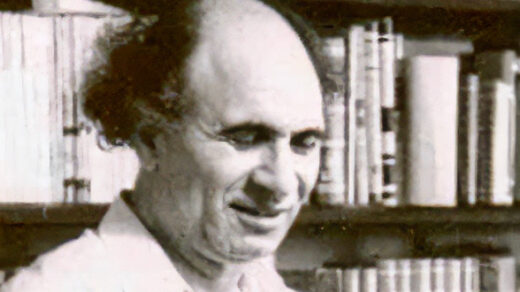
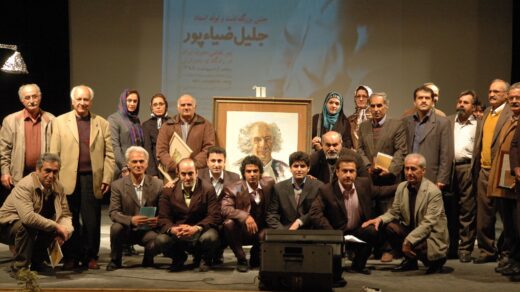
by An article by Mehdi Hosseini on the occasion of the commemoration of the sixth anniversary of the passing of Master Jalil Ziapour, entitled “He Whose Heart Was Made Alive by Love Shall Never Die,” Tandis biweekly

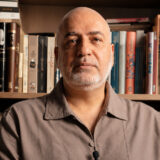
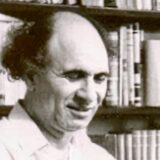
Master Mehdi Hosseini, painter.
Now, as I review the evolution of modern painting in my mind for the writing of this text on the occasion of commemorating the sixth anniversary of the passing [2005] of the elder of contemporary Iranian painting, Master Jalil Ziapour, I recall that a period of
nearly fifty years has passed since my first acquaintance with the paintings of Master Jalil Ziapour.
This first acquaintance was in May 1958, on the occasion of the holding of the first Tehran Painting Biennial, at the Abyaz Palace. For an adolescent who, in a space deprived of the world of images (a world that I later realized had held such a lofty and exceptional place in our past culture), was studying in the high schools of Tehran of those days, and was neither interested in nor able to continue his studies in scientific and technical fields, and wandered bewildered through the streets of Tehran, the experience of an exhibition of modern painting seemed an event beyond the realm of imagination. In this exhibition, which had been mounted through the efforts of the General Department of Fine Arts of the country and under the secretaryship of Marcos Grigorian, I first became acquainted with the names of many artists who later became peerless friends and colleagues to me, and from whom I learned a great deal. Not only learning drawing and color, but more importantly, self-confidence, humility, and freedom. In the catalog of this exhibition (which I have preserved and still have with me to this day), an introduction by Dr. Ehsan Yarshater had been printed, and a foreword by Marcos Grigorian, the biennial’s secretary.
In a part of Dr. Ehsan Yarshater’s introduction it is stated:
“What gives promise to art lovers is that many young painters are traversing the path to their goal with confidence and strength of heart, and doubt and shame do not weaken their hands. In the shelter of this confidence they have realized that the home-grown beloved is beautiful, and that the new style that has arrived from the West, however pleasing it may be, is nothing but a garment upon the body of the painter’s true imagination and feeling. They have realized that beneath Iran’s blue sky and brilliant sun, and in the age-old art and culture of this land, there are thousands of novel motifs that can occupy the painter’s mind and give his brush the enthusiasm of life…”
Marcos Grigorian also writes in a part of his foreword:
“Modernism in our country has unfortunately not grown along the right path, and as a result this newly emerged creature has not been able to appear beautiful in the eyes of the people; and the absence of critics and guides who can acquaint the people with visual art in its proper meaning has given scope to the present dispersion.”
It was in this same exhibition that I first became acquainted with the name and the famous work of Jalil Ziapour, “Zeynab Khatun.” Naturally, at that age and level of maturity, I was not able to properly arrive at a true understanding of this exhibition and Master Ziapour’s impactful canvas. Perhaps rather than being able to grasp the authenticity of the work, I was only able to do so through the folk poem that had been made the subject of the painting, with this content:

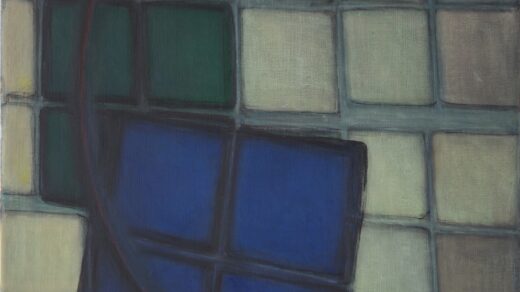
Master Jalil Ziapour; “Zeynab Khatun”; March 1961; oil; 120×95 cm
Jomjomak, autumn leaf
My mother, Zeynab Khatun
Has hair as long as a bow
A little longer than a bow
A little blacker than jet
She wants a thirty-day bath
She wants a turquoise comb
The canvas “Zeynab Khatun” is in the collection of the Tehran Museum of Contemporary Visual Arts. In this work, using one of the lines of the poem, “She wants a turquoise comb,” Master Ziapour has depicted Zeynab Khatun while she holds a turquoise-colored comb in her hand and is occupied with combing her hair. The hennaed hands of “Zeynab Khatun,” in orange, settle with a slight softness around the yellow tiles of the background and on the surface of another of the tiles, and then, on the pretext of the henna on the soles of “Zeynab Khatun’s” feet, settle with that same initial force upon the soles of her feet. The fusion of the words with the coloring of the canvas has been designed and arranged in such a way that the eye has a harmonious movement throughout the image, and removes every kind of stasis and stillness from the viewer’s mind and memory. The composition of the canvas, like most of Master Ziapour’s works, has a mosaic arrangement, and this decomposition is for the sake of inducing dynamism throughout the work.
This arrangement is entirely conscious and in accordance with the artist’s intention, and it is repeated in all of Master Ziapour’s works. When Master Ziapour expresses the question of “time” in the image, he explicitly states that: “Every kind of decomposition in the realm of art is a movement toward the advancement of dynamism.”

Master Jalil Ziapour; “Quchani Kurdish Woman”; 1960; oil; 200×83 cm
The first Tehran Biennial, too, like any other exhibition, came to an end, and in the year 1960 the second Tehran Biennial opened in May. In the second Tehran Biennial as well, Master Ziapour was present with the canvas “Quchani Kurdish Woman.”
This time, too, the figure of the Quchani Kurdish woman, while carrying her child on her back, found a new composition within the latticed and geometric arrangement of the canvas. The geometric structure of the canvas “Quchani Kurdish Woman” this time as well, within the framework of active and subordinate space, the analysis of the form of the body of a goat moving alongside the Quchani Kurdish woman, the use of indigenous motifs to connect the pictorial components, and also the warm colors beside cool planes, all presented a novel definition of two-dimensional space that held a freshness for the Tehran viewer of that day (and even now) and guided them into a space outside the conventional space of the image.
Dr. Akbar Tajvidi, who played a constructive role in the formation of the first Tehran biennials, wrote in issue six of the periodical Akhbar-e Honar va Honarmandan in January 1960: “Those who are acquainted with the new arts will try, with a higher vision than what is usually necessary for observing an ordinary, simple, and easy work, to look and to perceive the depths of the artist’s soul and particular world. Although until now the people of our country have been less accustomed to seeing new and contemporary works, fortunately, since the reality of Iranian art, that is, what we have thus far dealt with in our daily life, and upon which we have perhaps not even insisted on placing the name of art, has possessed the essence and substance of new art, with a little effort we shall be able to grasp the nature of modern art. In the words of Master Ziapour, the esteemed artist to whose precious guidance many of our gifted young people today are indebted in choosing their artistic path, what difference is there, from the standpoint of the principles of distribution and composition of colors, between an Iranian carpet with a Turkmen pattern and an abstract painting? It is a matter of great pleasure that this young, gifted, and active artist has presented new and noteworthy works for the forthcoming exhibition.”
This prediction of Dr. Akbar Tajvidi proved correct, and one year later, in issue eight of April 1960 and May 1960, concurrent with the holding of the second Tehran Biennial, this periodical carried the headline: Jalil Ziapour, Winner of the Gold Medal Prize. The same periodical continued: “Ziapour has thus far written abundant material on the various schools of painting, which, in the view of experts, is of great importance in introducing modern art to the people.” And it goes on to write: “The works of this artist, because they possess authentic Iranian subjects and a particular style of painting, are well known among art lovers.”
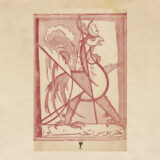
In truth, the canvas “Zeynab Khatun” is considered the objective manifesto of Master Ziapour’s treatises and theories from 1948 onward, especially in the periodical Fighting Cock (Khorus Jangi), and the canvas “Quchani Kurdish Woman” was the practical outcome of his anthropological research and studies in connection with the various ethnic groups of this country. It goes without saying that the publication of Master Ziapour’s articles in the periodical Fighting Cock, at that time, was by no means simple, and this periodical was banned repeatedly, each time being published under another name. The first time, after its banning, it was published under the name Kavir, and the last time under the title The Cock’s Claw (Panjeh-ye Khorus).
Master Ziapour’s research and publishing activity was not limited to the publication of periodicals. Among his written works in the field of the art and clothing of the people of Iran, the following may be mentioned:
– Ancient Clothing of Iran from the Earliest Times to the End of the Sasanians / 1964
– Achaemenid and Median Clothing at Persepolis / 1971
– The Clothing of Iranian Women from the Earliest Times to the Beginning of the Pahlavi Dynasty / 1968
– Ornamental Clothing in Iran from the Earliest Times to the Median Period / 1974
– The Clothing of Iran’s Tribes, Nomads, and Villagers / 1967
In the field of sociology:
– Woman from the Beginning to the Present Day / 1965
In the field of art:
– The Art of Painting and Sculpture in the Land of Iran / 1964
– General History of the Art of the East and the Middle East (in brief)
Among the late Ziapour’s other highly important and controversial articles is an article entitled: “What Did the Painters of Old Iran Do among Books, and What Are Their Survivors Doing?” which was delivered in the year 1949 at the “Fighting Cock” art association. While enumerating the characteristics of Iranian painting, Ziapour writes in a part of it:
“If our artists were interested in nature, it was only from this standpoint: that nature placed means and models at their disposal so they could express their intentions, and for this reason, they were never subject to and bound by nature and did not imitate it.” Ziapour then addresses the characteristics of Iranian miniature painting, and at the end, regarding those who claim to preserve and safeguard the heritage of Iranian painting, writes with the particular irony that was his own, as follows:
“What is stranger is that they claim that by copying from old works, or by moving slightly nearer to or farther from them, and by training several pupils like themselves (which is itself a calamity), they have come to the aid of miniature painting and have saved this so-called national art; otherwise, by now it would have worn out seven shrouds (unaware that not only have they not caused its salvation, but in this way they themselves have caused its death and even the wearing out of seven shrouds).
These gentlemen are unaware that they have undertaken a useless task and that for some time they have needlessly spent their precious hours with His Excellency the Cat’s brush, and with it, from above or below, they begin the thin design and gradually end with the thick design. They fashion the face of an old man whose turban has fallen from his head, and who has fixed his eyes on the face of his beloved, who has placed a half-crown and turban and so on and so forth upon her head, has disheveled locks, and offers wine.”
Although the nature of such works is now clear to everyone, it is necessary to note that this text was written more than fifty years ago, and to compose it at that point in time, a great deal of knowledge, courage, and self-confidence was required.
Another subject that must be mentioned is the matter of the late Ziapour’s teaching in the years after the Revolution. Although the duration of this educational period was short, and the opportunism and rigid-mindedness of some prevented its continuation, this very short period of his teaching at the University Complex of Art (the present University of Art) trained a generation of young artists, many of whom today are active figures in Iran’s contemporary art movement and have found their own particular place in the continuation of the country’s modern movement.
One of the good fortunes of the writer of these lines was being alongside the late Ziapour in judging the first Tehran Contemporary Painting Biennial, in the year 1990, at the Tehran Museum of Contemporary Art. Among the prizes of that year’s biennial was a two-week trip for the biennial’s winners, together with the judges, to China. After the preparations for the journey had been made and we had set out for China, when in the hotel lobby it was decided that every two people would be settled in one room, to my utmost happiness, Master Ziapour chose this humble writer as his roommate. This happy coincidence and choice afforded me a felicity that caused me to be directly roomed for some ten days with my spiritual father, and to enjoy every moment of it and to learn points from every thought and utterance of his.
At a time not so distant, when the Isfahan Faculty of Art was considered a part of the University of Art in Tehran (and has now become independent and continues its activity under the title University of Art of Isfahan), I was asked by the department head to invite the Master, and for us to spend a few days together at the Isfahan Faculty of Art, among the students and in the painting studio. Since the Master had by this time suffered two heart attacks, and it was possible that this trip would not be suitable for him, I turned this request over in my mind for several days. For I considered it probable that this trip and his presence among the eager students of Isfahan would cause him fatigue and indisposition. Finally I gathered my courage and raised the matter with the late Ziapour. To my utmost surprise, the Master welcomed the invitation. But my concern was over the time of the flight, which had been set for six in the morning (or thereabouts), and we were supposed to be at the airport one hour before the flight. I continually reproached myself that this trip and this time would cause the Master indisposition. In any case, the day of the journey arrived, and although I considered myself an early-rising person, to my complete surprise, as soon as I entered the airport hall, I found Master Ziapour cheerful and in good spirits, waiting for me and for the trip to Isfahan. Two very active days were spent in Isfahan, and all this energy and expenditure of time on the part of such a pioneering personality at this age was astonishing to me.
He whose heart was made alive by love shall never die
Our permanence is recorded in the register of the world