by
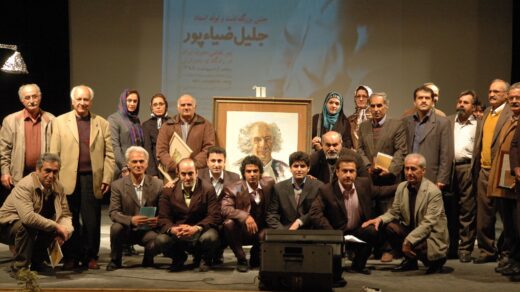
by An article by Parviz Kalantari, titled “Ziapour, the Standard-Bearer of Modern Iranian Painting,” the biweekly “Tandis,” special issue for the eighth art research session, the tenth commemoration of Master Jalil Ziapour, Barg Gallery, 10 November 2009

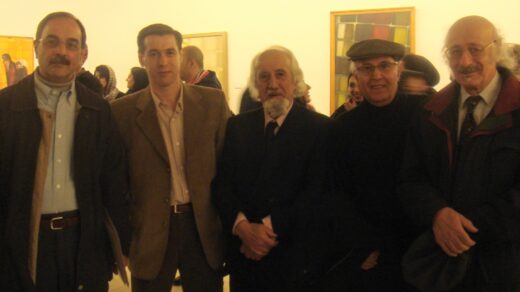
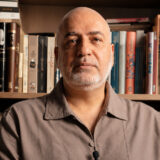
Master Parviz Kalantari, painter and writer
Modernity and anti-modernity in Iran have a thousand-year history; from the seventh century and Mowlana’s words: “Mostaf’alun, mostaf’alun, mostaf’alun killed me…” to the arrival of Nima in the arena of poetry and Jalil Ziapour in the arena of visual arts. Here, the discussion is about Jalil Ziapour, his contribution to the contemporary painting movement, and his struggle with traditionalists. Modern painting in Iran began after the Second World War, and Jalil Ziapour was its standard-bearer. The modern begins where it rejects tradition. After returning from Europe, under the influence of the modern painting movement of that time in Iran, Ziapour first went to war against the traditionalists by establishing the “Fighting Cock” (Khorus Jangi) Association, in collaboration with Gharib, Hassan Shirvani, and Hushang Irani.
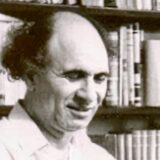
At that time, I was a student at “Sharaf” High School when he became our painting teacher. He, who had newly arrived from Paris, like Jean Cocteau – in images I later saw of him – had curly hair and pince-nez glasses, and like him, he would turn up the collar of his jacket and smoke a pipe. Iranian society at that time, in its historical transition from tradition to modernity, was shedding its skin. In the economic arena, Iran was passing from the feudal stage to national capitalism; with the boom of trade and the arrival of new goods, representative offices for Singer sewing machines, Chevrolet and Chrysler cars, and offices of trading houses for refrigerators, gas stoves, washing machines,… were opening one after another. Along with the arrival of these goods, seemingly new styles of modern life were also entering, and artists too represented such modern artistic styles in Iran. Agencies for the surrealism of Salvador Dalí and Chagall, the magical realism of Marquez’s literature, and so on.
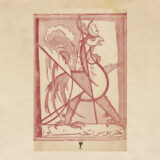
The first representative office of Cubist art in the style of Picasso in Iran was run by Jalil Ziapour, which at that time had severely caught the traditionalists off guard and left them agitated. For instance, this very painting of the fighting cock on the cover of “Fighting Cock” magazine demonstrates his mastery in the skillful imitation of the Cubist style in the manner of Picasso. But Jalil Ziapour, continuing on his path and in search of his own artistic identity, like all the great artists of the world, was seeking answers to fundamental questions: Who am I? Where do I stand? How do I view existence?… Although in the war against the traditionalists he paved the way for innovative artists, he withdrew from representing Picasso’s Cubism.
In search of answers to his questions: “Who am I? Where do I stand?”, he first embarked on long journeys and desert wanderings to discover the vast geography of Iran; and the fruit of these travels became his valuable paintings of tent-dwellers, nomads,… And he also turned his attention to the lifestyle and culture of Iranians, then to the historical background, and finally to Iranian masters.
At that time, through the efforts of Mr. Hannibal (the Russian Iranologist), an anthropology museum was established for the first time on Aramaneh Street.
In the display of the ways and customs of Iranians’ life, and among objects, for example, from the bathhouse (bowl, dolcheh, pumice stone, and bath wrap, or kilim and giveh,…), very beautiful and striking small sketches and paintings of the ways and customs of the life of Iran’s tent-dwellers and nomads had also been mounted on the walls. These works were by Jalil Ziapour and were the fruit of his journeys. I would go there every day and spend hours absorbed in watching them. The painters of that era painted in imitation of the Kamal-ol-Molk school. I was becoming acquainted with a new kind of painting, one that was highly scholarly and at the same time in a free and expressive manner.
Ziapour, in the continuation of his travels in 1956, and apart from the ways and customs of Picasso’s Cubism, noticed a piece of “tile-brick” on the entrance of the Ebrahim Khan Bathhouse in Kerman. For a long time he sat and, with precision and correct proportions, measured and painted it. The subject of the painting is Rostam’s battle with the White Demon. But what was it in this work that caught his attention? Was it not under the influence of these very tiles that the modern structure of his works came to bear the mark of this same structure of colored bricks?
In his search for identity, he reached Iranian history and mythology and made the sculpture of Anahita (the goddess of water). I remember well that for a year or two he was intensely involved in making this sculpture; unfortunately, it is not known where this work is now.
Ziapour, after the passage of years and traversing new paths, was working at the “Shahnameh Foundation” towards the end of his life, and Behrouz Golzari accompanied him.
After a series of journeys around Iran, Ziapour, in collaboration with the Department of Culture and Art, organized a series of provincial exhibitions, from which beautiful, enduring works of the women of Gilan, the people of Khorasan, and other ethnic groups, Kurd, Baluch,… have remained as his legacy. One of his most important works, “Zeynab Khanom,” shows his attention to folkloric culture.
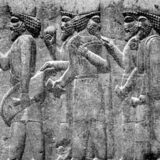
Later, as a researcher, Ziapour studied the clothing of ancient Iranians, especially (the Achaemenids and the Medes), which has been published in the form of a book. The result of his work was that it smoothed the path for illustrators who, like me, became involved in history textbooks (in painting Achaemenid soldiers, we had to have a correct understanding of the tailoring of their clothes and attire).
In short, Jalil Ziapour was in fact an intellectual and a revolutionary artist. An intellectual, meaning someone who was always in search of answers to his questions and who lived with his questions. A revolutionary artist, meaning someone who, in a new mode of artistic expression, and by rejecting past traditions, brought about a revolution in the path of modernity and modern aesthetics in his country.