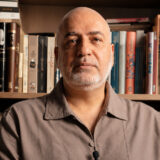
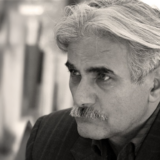
Master Ziapour, after his first return to Iran – in the year 1949 – as a pioneering painter and informed theorist, became the standard-bearer of the new movement of painting and proceeded to establish the Fighting Cock Association, which was a progressive assembly in the field of presenting the arenas of new art, especially literature, theater, music, and painting.
The members of the Association can be examined in two periods:
The year 1949 – the first group: Messrs. “Gholamhossein Gharib” in the field of literature, “Hassan Shirvani” in the field of theater, “Morteza Hannaneh” in the field of music, and “Jalil Ziapour” in the field of painting, who was also in charge of managing the association. The association, with the goal of enlightening minds regarding new art, began publishing a magazine of the same name. At the very beginning, Hannaneh stepped aside due to a difference in taste, but later wrote scholarly articles on Western music.
The year 1951 – the second group: Houshang Irani (poet) found his way into the association, and Ziapour distanced himself from it. He says: “With the entry of Houshang Irani into the association, his offensive extremism caused me to withdraw from the circle of friends.” Therefore, the association consisted of “Gholamhossein Gharib”, “Hassan Shirvani”, and “Houshang Irani”.
The Fighting Cock magazine was also published in two periods:
Publication of the first period (1949-1950) – In this period, 5 issues of the magazine were published under the supervision of Ziapour, Shirvani, and Gharib, and on the back cover of its issues, this writing appeared: “Under the supervision of the Fighting Cock Art Association. Our goal is to raise the level of public knowledge.”
Publication of the second period (1951) – This period of the Fighting Cock magazine was published in 4 issues, and its first issue was published on 5 June of the same year. In this period, Ziapour had stepped aside of his own accord, and in his place came Houshang Irani. The size of the magazine was enlarged, and on its back cover page, there was a manifesto signed by the Fighting Cock Art Association – Gharib, Shirvani, and Irani – of which apparently most lines reflected the beliefs of Houshang Irani and were written by him. This manifesto, under the title “Slaughterer of the Nightingale”, consisted of 13 clauses.
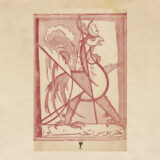
The logo of the association, which is the design on the cover of the Fighting Cock magazine, was chosen by Jalil Ziapour, and its name at the suggestion of Gholamhossein Gharib. Concerning the reason for choosing the name “Fighting Cock”, Ziapour says:
“In terms of bodily form, the cock is a robust and aggressive creature, and in terms of coloration, striking; in terms of identity (in our literature), it is the representative of the angel Bahman, and as a vanguard, its duty has been the awakening of the people; and since the beautiful and colorful stature of the cock is close to painting and it is itself a symbol of war and struggle, it was considered a suitable emblem for the goals of the association.”
In the year 1949, by hosting individuals such as Nima Yooshij, Manouchehr Sheybani, Mostafa Kamal Pourtorab, and others in the fields of new art, the association began a new wave on the path of art. It is worth mentioning that Nima Yooshij, as a sign of cooperation with the Fighting Cock magazine, started with the poem “City of Morning”, which was printed in the first issue of that magazine:
From the City of Morning
Cock-a-doodle-doo. The cock crows.
From within the hidden seclusion of the village,
From the descent of a path which, like a dry vein,
Sends blood running through the bodies of the dead,
It weaves upon the cold wall of dawn;
It seeps to every side of the plain.
…
The premises of the association were located in Ziapour’s studio – former Takht-e Jamshid Street, on the western section of the wall of the Oil Company Palace – where every Friday afternoon a lecture was delivered in one of the artistic fields, and at the end of the session, the attendees engaged in questions and answers; no exhibition was held at this location, and it was solely dedicated to lectures, and Ziapour, through weekly lectures at this association and other centers and writing theoretical articles and technical critiques on new painting, endeavored to promote the perspectives of new art.
Ziapour says the following regarding the motives of movement and activity of the Fighting Cock:
“Based on our slogan:
The tale of Alexander became a legend and grew old / Bring new speech, for the new has another sweetness.
(Farrokhi Sistani)
We left no regression or backwardness unanswered, and as far as our knowledge permitted, we decisively cast aside and exposed the factors of deterrence and opportunism. In fact, the Fighting Cock waged a struggle against the worship of the old and traditionalism detached from the realities of the times.”
The impact that this movement left on the course of contemporary Iranian painting is hidden from no one, just as in the year 1976 the English-language publication of the High Council of Culture and Art wrote: “Contemporary Iranian painting in the year 1949-1950 entered a new stage in the arena of dispute between old and new art, through the paintings and writings of Jalil Ziapour.”
From the year 1948, discussion in the field of modern painting escalated, the center of these cultural and artistic disputes being the Fighting Cock Association and magazine. Ziapour, at this very time, published twelve lectures on modern painting and a number of hard-hitting and enlightening articles against classical painters and Western promoters who were moving together in the same direction against new painting.
At this time, three groups were specifically considered his main enemies and opponents: the first group was the Tudeh members, who said that painting must be understandable to everyone, so that even the orange seller would surely understand it; the second group was the miniaturists, who generally opposed new art; and the third category was the realists, who were under the patronage of the aristocracy and said that realist works must be painted. These three groups colluded with each other against the Master. The disputes and hostilities dragged the matter to the parliament of the time, to the point that the parliament interpellated the Minister of the Interior as to why he had allowed the Fighting Cock booklet to be published at the level of art schools, high schools, and colleges, and to propagate the ideas of the Tudeh members. For this reason, the magazine was banned, and Ziapour (the author of the articles on Cubism) was summoned to the administrative offenses court. During his interrogation, he was asked who had commissioned him to propagate Cubism, and why he spoke of Cubism. After Ziapour’s scientific and artistic explanations regarding Cubism, they apologized to him for the banning of the Fighting Cock magazine, and he was told: “We thought Cubism meant Communism!”

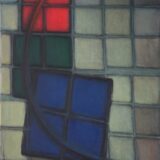
After Ziapour’s administrative trial and the officials’ realization that he did not propagate Tudeh ideas or publish a political magazine, it was decided that the Fighting Cock magazine, which had been banned, would be published under another name; therefore, in late 1949, “Kavir Magazine” was published by Ziapour, Gharib, and Shirvani, with the same previous goals in two issues, and the cocks that had appeared as a single form under the banner of the armored Fighting Cock, this time showed their faces in “Kavir Magazine”. In this low-circulation and important magazine, Ziapour reproduced his first abstract cubist painting named “Public Bath” as an Iranian artist and published an article named “Painting,” which was in fact an explication of the obvious points of his “Public Bath,” and more importantly, this very article is the first theory of modern art in Iran.

After Kavir magazine was banned in late 1950, the “The Cock’s Claw” magazine took its place, and Ziapour proceeded to reflect his thoughts in that publication. Among the younger painters who collaborated with this magazine, Sohrab Sepehri and Bahman Mohassess can be named.
Ziapour exhibited a number of his paintings at the Apadana Gallery, the Anatole France Society, the Giti Art Society, and the Mehregan Club, and also delivered lectures on new art, modernism, and backwardness. After much clamor had been raised in the radio, magazines, and the parliament against Ziapour and new art, he initiated a kind of reconciliation between traditional art and the new wave of Cubism. By using geometric shapes and decorative art derived from the tilework of mosques, and the divisions seen in his Cubist paintings, he brought forth a new design in modern Iranian art for the first time.