by
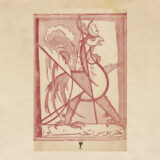
by The text of the lecture by Master Jalil Ziapour at the Fighting Cock (Khorus Jangi) Art Association; published in the weekly magazine “Azarpad” (No. 8), 13 May 1949

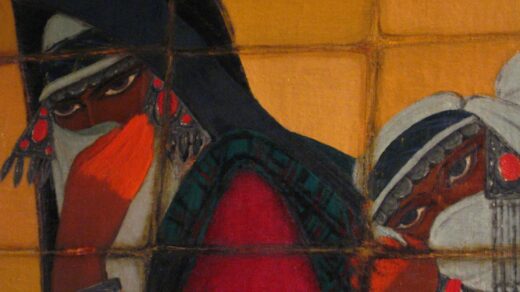
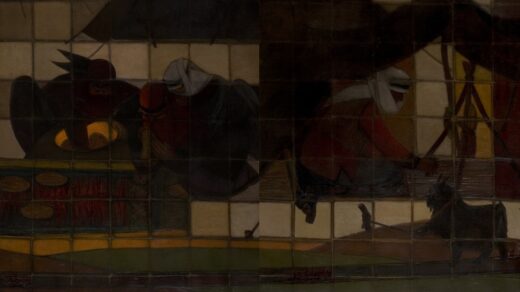
Master Jalil Ziapour; “Public Bath”; 1949; oil; 120×80 cm
I have always said that to recognize modern art and distinguish its position, one must pay attention to artistic time. Because modern art, with every newer step, is always associated with the latest stages of evolution. Laggard and decrepit demands must not be sought among fresh factors. Within every society, due to the existence of more or less differing tastes and opinions, various demands exist, and everyone expects artistic works to reflect their own intentions. The one who has a modicum of understanding and literacy, the one who is a newspaper reader, that other one, and others, all expect to see their own opinions manifested in the works of every artist! It is a strange thing. In our environment, everyone introduces themselves as an expert and knowledgeable in art based on these very qualities. It is just like everything else in our country, where people want to have wealth without having worked or suffered, want to be scholars without having read, want to be artists without having made an effort, and want to be art critics without having cultivated their taste! This is where an uproar is raised, and everyone speaks of recognition, exhausting a person with baseless and haphazard opinions, and making one detest all people of taste.
A while ago at Apadana, amidst a dense crowd, a gentleman with one hand on his hip and the other on his back was sizing up my paintings, moving the corners of his lips and mouth as a sign of contempt and wonder. It was obvious that he had a prior notion about this kind of painting and certainly did not like it, and now that he had heard that the crooked and misshapen paintings of Cubism had been exhibited at Apadana, he had paid a visit to Apadana for this reason; and now that he was standing in front of the paintings, he was not averse to asking the creator of these paintings some questions, and perhaps, in truth, continuing to mock him.
It was in the midst of this that we were introduced to each other: He is Dr. …, a professor at the Faculty of Engineering, and he specializes in the field of dyeing. Very well, I am glad. Sir, what are these? What does this rope composition mean? What are these unnatural and incomprehensible lines? These are not understandable to the people. This kind of painting that the majority of society does not understand? I don’t say the people, no, to hell with the people! At least we, who are the so-called intellectual type, should understand something of this nonsense? I, who have a good knowledge of colors (if painting is only about color), then why do I understand nothing? At this point I interrupted his speech and began several questions. I saw that he evaded answering my questions, as if our professor of dyeing was not at all willing to answer the other party’s questions. He is not willing to hear anything or any opinion from others. Our professor has a severe social objection to this kind of painting, and because he has debated this matter extensively, like all followers of art for the masses, the opinions of others have already been resolved for him and are not to be debated! And for this reason, he gives no one the chance to speak. He has accumulated in his mind a certain amount of material related to these very debates in his own favor, and he wants to say them and protest. I motioned to one of my friends to engage the professor, and having cut my own words short, I withdrew.
I said to myself: Fortunate are we with such professors and intellectuals! The gentleman is a dyer, and for this reason he gives himself the right to express a definitive opinion about modern painting! (Of course, there is no harm in a dyer also understanding painting very well. But solely on this basis – ‘because he is a dyer, therefore he must certainly understand the color of painting too’ – this claim is ignorant.
I wiped my sweat. I stepped slightly outside the Apadana premises to breathe a sigh of relief. I was thinking: this ancient nation, which for a full six thousand years has dealt with geometric painting, these professors who, by their own account, ought to be more versed and informed, how is it that they have so many ignorant objections and, based on having a quantity of raw and haphazard information about art, consider themselves authorized to make sharp and severe judgments! Is it not that this disordered environment of ours has stripped people of self-restraint, and is it not that individuals, in order to show themselves off and make reckless displays of learning, make themselves a meddler in every matter! Now, what harm is there if a professor of dyeing too (whose work is not far removed from a bit of coloring) should put one hand on his hip and one hand on his back, position his legs fore and aft, and with tilted shoulders, head, and neck, scrutinize the Cubist paintings and wrangle with their maker!
I was thinking how poor we are in terms of substance, and how we have relied solely on our predecessors (and that too because foreigners praise them). How indifferent we have remained toward the works of our own artists, and today we are unaware that if our ancient works were not one hundred percent (geometric), they were at least ninety percent geometric, and this has continued to this day. Who has left the people so oblivious? Is it not the fault of the artists and people of taste? Should artists not have prepared the grounds for the people’s artistic understanding? Should the people of taste not have cooperated in this regard, prepared books, and placed them at the people’s disposal? Should they not have put the paintings on public display? Should they not have established associations and held discussions around art, and put questions and answers forward, so that the people too would become aware of such matters, and our intellectuals too, like our professors! would not remain uninformed about art?
Why? It is due to the lack of these very associations, and these very exhibitions and institutions, and these very artistic discussions in our environment today that, contrary to expectation, a professor, backed by his familiarity with the chemical compositions of colors, claims understanding and recognition of artworks amidst a gathering, and is so bound to his haphazard findings that he expresses opinions at an expert level. If they had reviewed the past, if knowledgeable individuals had explained the arts of Iran for these people (who are in fact people of taste, only they have uncultivated taste), and had reflected their ardent spirit in the path of the art of painting and the value of their work in the uncultivated mind of society, would our intellectuals and professors today be suffering from this muteness and bewilderment in art?
A nation that for several thousand years has been at the head of the artists of the world, has been the guide of people of taste, has offered splendid works of art to the world, how is it that now, before works of art and the feeling and perception of them, it remains mute and bewildered and weaves nonsense?! Certainly the level of artistic understanding in this land is low. Certainly it does not have the necessary artistic activity. The saboteurs and ignorant people of this land deceive those in authority under various titles, and by this means prevent the progress and artistic activities in this country.
A while ago, in one of the interrogations that had been arranged for me at the Ministry of Culture, they were asking me: by what legal authorization do you propagate the method of Cubism in Iran? How many students have you trained? Who are the supporters of your method? Did the government give you the order to learn and propagate Cubist painting, or did you yourself, of your own inclination, choose and learn this technique? (Other questions of the same kind, very worth hearing and laughable, all of which are evidence of narrow-mindedness and unawareness.) As a result, it became clear that they had not differentiated the word Cubism from Communism and had grown suspicious! For such a country, which used to nurture the foremost artists of the world, it is utterly disgraceful today from the standpoint of general literacy (and that at the level of not differentiating the meaning of Cubism from Communism). The people are not much to blame, because people of taste and artists too should have made an effort, which they did not.
In the magazine Jahan-e Now, they had written this title in large and legible script: What sort of thing is Cubism? And they had also passed off an extensive account as a preface and afterword, or better to say as seasoning and mockeries for the content of the article ‘What Sort of Thing Is It’. The brief account of the preface was that our friend Mr. Kasmaei, having not seen Apadana, had been regretful, and with only one distant visitation had imagined that Ziapour had spoken there about Cubism. Later it becomes clear that no, Ziapour had spoken only about Iranian paintings from the Parthian period to the school of Reza Abbasi, and the critic of the magazine “Jahan-e Now”, who out of lack of information had found fault with Ziapour’s lecture, had plunged blindly into the water and had needlessly plied his pen. It had been requested that Ziapour take up the pen to explain the Cubist method and fulfill the request, and immediately say what sort of thing Cubism is! But they themselves, through the tongue of Tawfiq al-Hakim the Egyptian, for the time being hold Cubism up to mockery.
I see no objection if someone who does not like Cubism protests and finds fault. People are free to express their opinions in whatever way they desire, but from persons who consider themselves writers and people of taste! it is surprising that they should spend their time on clowning and fill the columns of newspapers, instead of instructive material, with nonsense to make people laugh. Today, people are eager and curious to know right from wrong. It is necessary that our people of taste strive as much as possible in explaining and describing the artistic conditions of their own country and the conditions of world art, and display it exactly as it is, and that our critics and artists discuss it seriously and explain it, so that they may have taken a step toward raising the level of the people’s acquaintance with art.
At clowning, all the people will laugh. Yes, they laugh, but as long as the situation is in this manner, it is obvious that our professors and intellectuals and people of taste too, with one hand on the hip and one hand on the back and legs fore and aft, one shoulder up and lips and mouth drooping, will sometimes mock and sometimes taunt, and mostly become mute and bewildered (only feigning comprehension of the matter and self-righteousness), and will take their own path and go off, and murmur to themselves like the majority of the uninformed: “Literature has become a hodgepodge!” In this case, the artists too, without paying attention to this kind of clowning (as always), will continue their work.
To clarify the story of Tawfiq al-Hakim (for this Hakim himself, too, in clowning is no less than our own clowns), I will explain the core matter that was hidden within the article: Tawfiq asks a painter named Otto (an unknown painter with an imaginary or real name) some questions about Cubism in a restaurant. He asks, what is Cubism? He answers that whatever Cubism is, it is this: it is based on reality and is a technique that is independent and reliant on itself. It does not employ the means and techniques of the past, nor does it rely on the subject matter of storytelling. Because subject matter belongs to the art of the story. When he asks about the connection between music and painting, he says: “The painter must hear music with the eye and manifest melody with color. The true painter is one who has no ear. The painter must not tell stories for the people and fabricate subjects; these acts are the work of story writers. The true painter is one who arouses only one sense in people, and that is the sense of sight. Painting is the poetry of the eye, and its sole means and aim is color.”
With this explanation, I separated the serious from the jest, and in confirmation and interpretation of the words of Otto I add that Cubism is the representative of the reality of the machine life of this era. Cubism is all eyes. The Cubist displays the hidden poetry of objects by means of color. The Cubist is the most progressive painter of the time. Because the Cubist strives to introduce the public manifestations and the result of the totality of the qualities of machine life, which is itself a reality. The Cubist, unlike the painters of the past, does not construct ordinary forms and does not show the images of objects, inanimate things, animals, and humans in the very ordinary forms that they are, and does not suffice with appearances. The Cubist is never a follower of the people’s tastes. The people are compelled, in every time and place, to follow the tastes of progressive artists. The Cubist is independent. Because he does not make a profession of the story-making of story writers. He does not describe the battlefields, collisions, and ordinary scenes of story writers. Cubism has a specific poetry for itself, and it composes this poetry by means of specific colors and lines. In this method, subject matter is never prior to form. Here it is form that contains the subject matter within itself. However, these forms are not ordinary, and non-ordinary forms also have non-ordinary and fresh subject matters, and because fresh subject matters are non-ordinary, they are therefore outside the bounds of the common people’s comprehension. Thus, for them Cubism appears to be without subject matter. Whereas Cubism, at the core of the matter, has abundant and visible subject matters. But where is that eye that would see? Where is that sense that would grasp, and where are those favorable grounds that would aid the viewers’ understanding and perception?
Cubism is an Iranian painting. This method has been prevalent in this land for a long time, but in Europe it has been active for sixty years. How and in what way? This is a matter that I must explain to you later.