by
by An article by Master Jalil Ziapour, titled “A Report on the Manner and Particulars of Clothing Decoration in the Time of the Medes,” published in Honar va Mardom magazine, Nos. 67 and 68, pp. 35 to 43, May and June 1968.
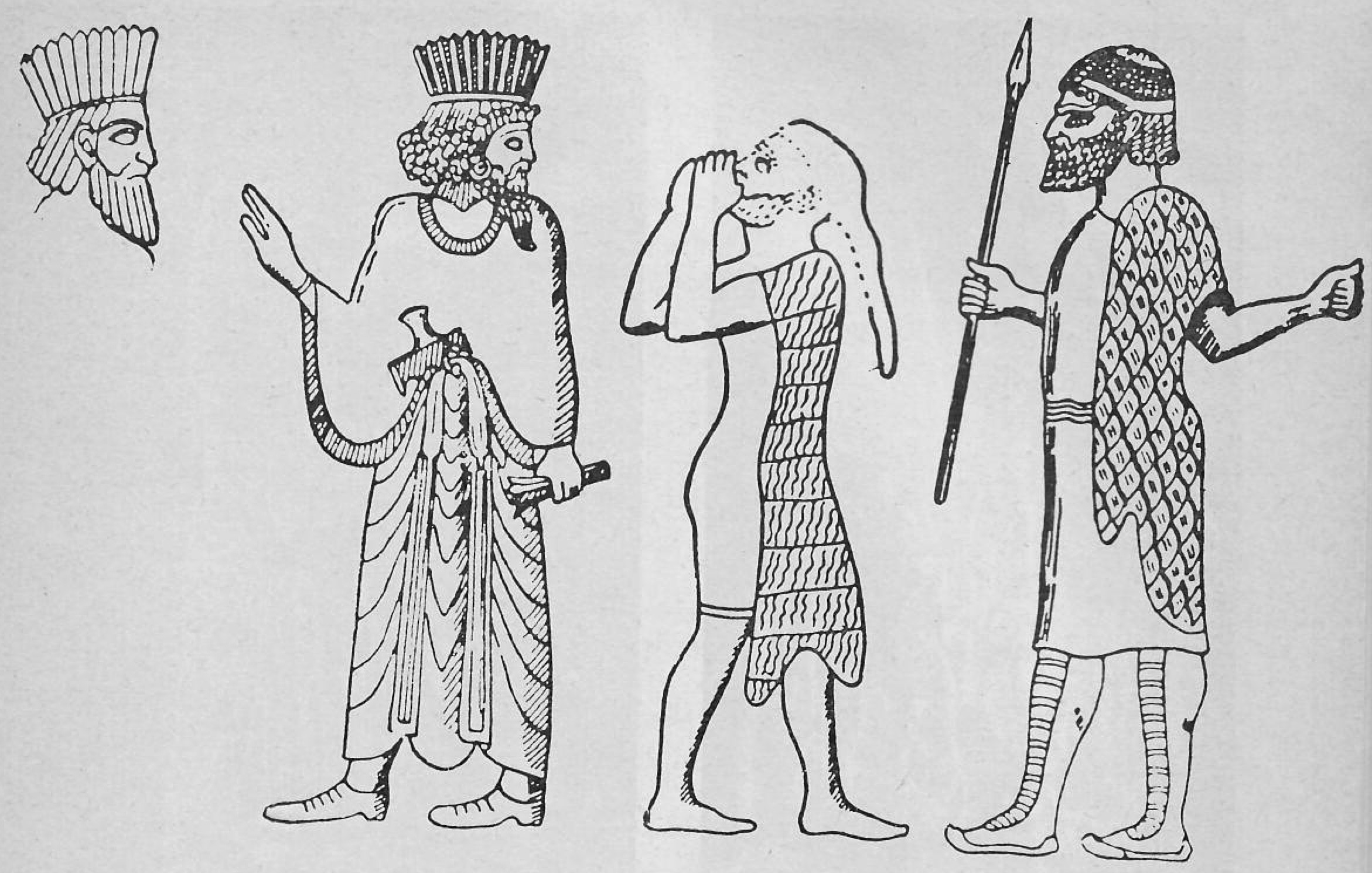
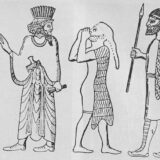
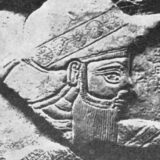
First figure on the left: drawing of a Median man on the relief of Anubanini at Sar-e Pol-e Zahab; second: Persian; third: Mannaean; fourth: a Mede in an Assyrian relief
Did the pleated garment known as Persian (which is depicted on the bodies of the Achaemenids at Persepolis) belong to the Medes or to the Elamites?
Most researchers (who have passed on reports quoting ancient historians “and have also expressed opinions of their own”) have at times made errors out of inattention, errors that inevitably compel the mind to pause and inquire.
Certainly, this inattention arises from the fact that secondary commentators and researchers (and also some of the primary historians) were not closely acquainted with the conditions and circumstances of the Iranians, and most of the reports (as some accounts show) come from those who were in contact with the Iranians on the battlefield (and naturally their descriptions could only have concerned the clothing they saw on the battlefield on various combatants, “subjects or people of the center”), while those who had close contact with the Iranians have spoken of more particulars; and therefore, since they reported accounts by quoting one another, they have given mixed indications. And this is evident from comparing their statements and the interpretation of their reports. It is therefore incumbent upon us, in accepting their writings and reports about ourselves, to pause and examine (as far as possible), and also, regarding matters in which a lack of realism is felt, to look for causes and investigate…
. . . . . . . . . . . . . . .
A Report on the Manner of Clothing Decoration in the Time of the Medes
Sir Percy Sykes has written about the love of luxury and the splendor of the Median court: The details recounted of the Median court, the elaborate ceremonial and thousands of attendants, the scarlet and purple garments of the courtiers, and their gold chains and necklaces and abundant luxuries make it known that they had decorations in imitation of the Assyrian court (“A History of Persia”).
Xenophon has written that the Medes were accustomed to wearing purple clothing, putting on a long robe, and hanging numerous necklaces around the neck and ornamented bracelets on the wrists…
In the book “Hegmataneh” we read that in numerous Achaemenid inscriptions which (were inscribed on the clay tablets of Persepolis and the large clay tablet of the palace of Darius at Susa), the Achaemenid emperors constantly spoke of the goldwork of the Medes and of the golden decorations that were carried out by the Median nation in the court of the Achaemenid emperors.
It is therefore no wonder that Hamadan (the center of the Median state) should have been, in the era of the Achaemenid emperors, the greatest center of goldsmithing crafts and golden ornaments, and that gold tablets and exquisite golden decorations… are generally found in Hamadan.
. . . . . . . . . . . . . . .
In the Old Testament (the Book of Judges) we read that Gideon (God’s chosen one for Israel) fought with the Midianites and the Amalekites and all the children of the east… and Israel gathered together out of Naphtali, and Asher, and all Manasseh, and pursued after the Midianites… and they took two princes of the Midianites (Oreb and Zeeb)… and they spread garments, and did cast therein every man the earrings of his prey, and the weight of the golden earrings that were given to Gideon was a thousand and seven hundred mithqals of gold, beside the crescent ornaments, and earrings, and purple raiment that was on the kings of the Midianites… and the chains that were about their camels’ necks.
. . . . . . . . . . . . . . .
Even if we are unwilling to accept this legend-like account of the Old Testament (because of doubts about the names of the persons, and the weights in mithqals “which belong to a time close to our own,” and the mixing of writings “in its historical aspect,” as well as the situations and places and their conquests and victories) (although we now have no evidence to refute the occurrence of this event or legend), at any rate, regarding the decorations and ornaments of the Medes, we cannot entirely take the path of denial, for other evidence confirms it and bears witness to it.
. . . . . . . . . . . . . . .
Besides the Median neck rings, bracelets and earrings (examples of which are depicted at Persepolis, but, as we know, are not conspicuous), one of the most interesting ornaments of this period is the decorative bells, which no living evidence shows (such as a relief or a seal showing their use, or a text mentioning them), but which have themselves been found in excavations.
. . . . . . . . . . . . . . .
In the book “Marlik” (which gives a brief description, without comment, of a bell found at Cheragh Ali Tepe in Rudbar, Gilan), it is stated that bronze bells, generally in the shape of a pomegranate, have been discovered in most of the tombs, and that these bells are similar to bells that have also been found in the cemeteries of Tepe Sialk in Kashan; likewise, other forms of these bells (which are simply made) are comparable with the bells discovered at Tepe Gilan in Hamadan (near Nahavand).
. . . . . . . . . . . . . . .
In the book “Hegmataneh,” the excavations carried out in Hamadan and the artifacts recovered from the goldwork of the Medes are described in detail. Among other things, it gives a comprehensive account of the decorative bells, and their use has also been plausibly conjectured:
The 33 small gold bells were apparently sewn on the inside and lower part of the skirt of the garment, or near the edge of the trousers, or in other places on women’s clothing, and when walking, their soft sound added to the luxury and adornment of the wearer. Only one of the 33 bells has a clapper, and when the bell is moved, a faint and pleasant sound is heard, and two of them also have, at the top, the small ring for sewing the bell to the garment. The clappers and rings of the rest of the bells have been lost. The length of these bells varies (shorter and longer); the length of the one that has a clapper is 12 millimeters, and the average width of the lower part of the bells is 7 millimeters. (Figure 1).
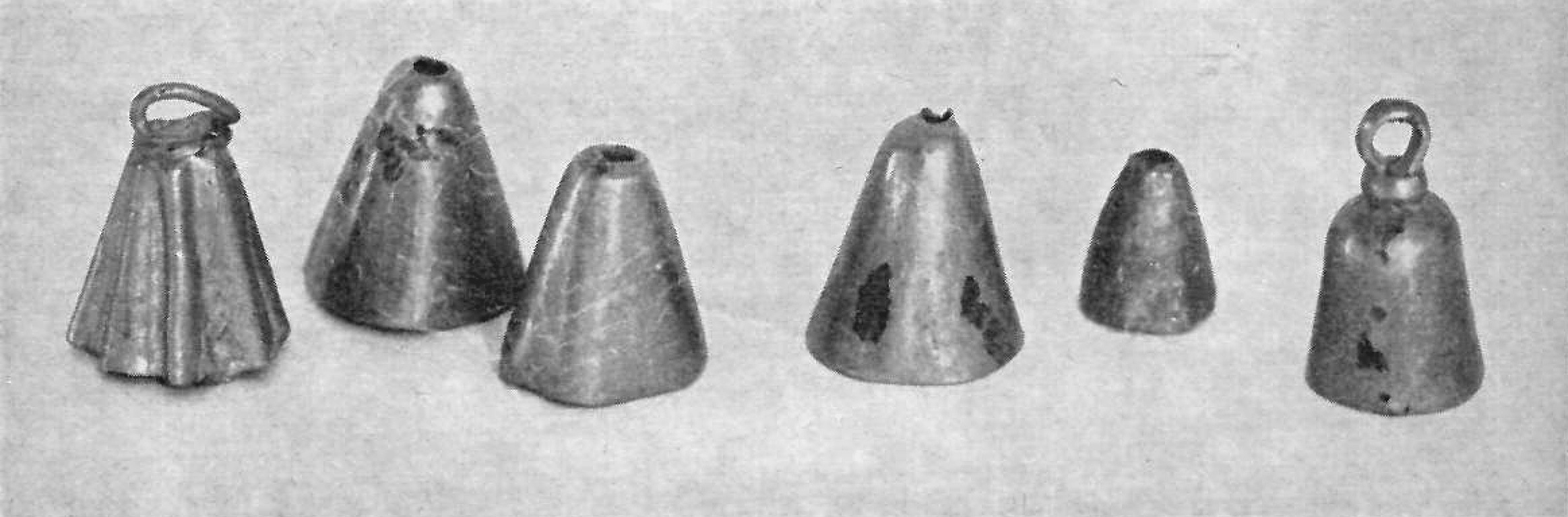
1. Examples of decorative bells found in Hamadan
The opinion expressed about these decorative bells is interesting, for other grounds lead the mind to the correctness of this view; and we should know that this type of bell was also used for purposes (which in every case had a decorative aspect) among other peoples (as one type of it exists in the form of a plaque with pomegranate-shaped bells from the Cimmerians) (Figure 2)
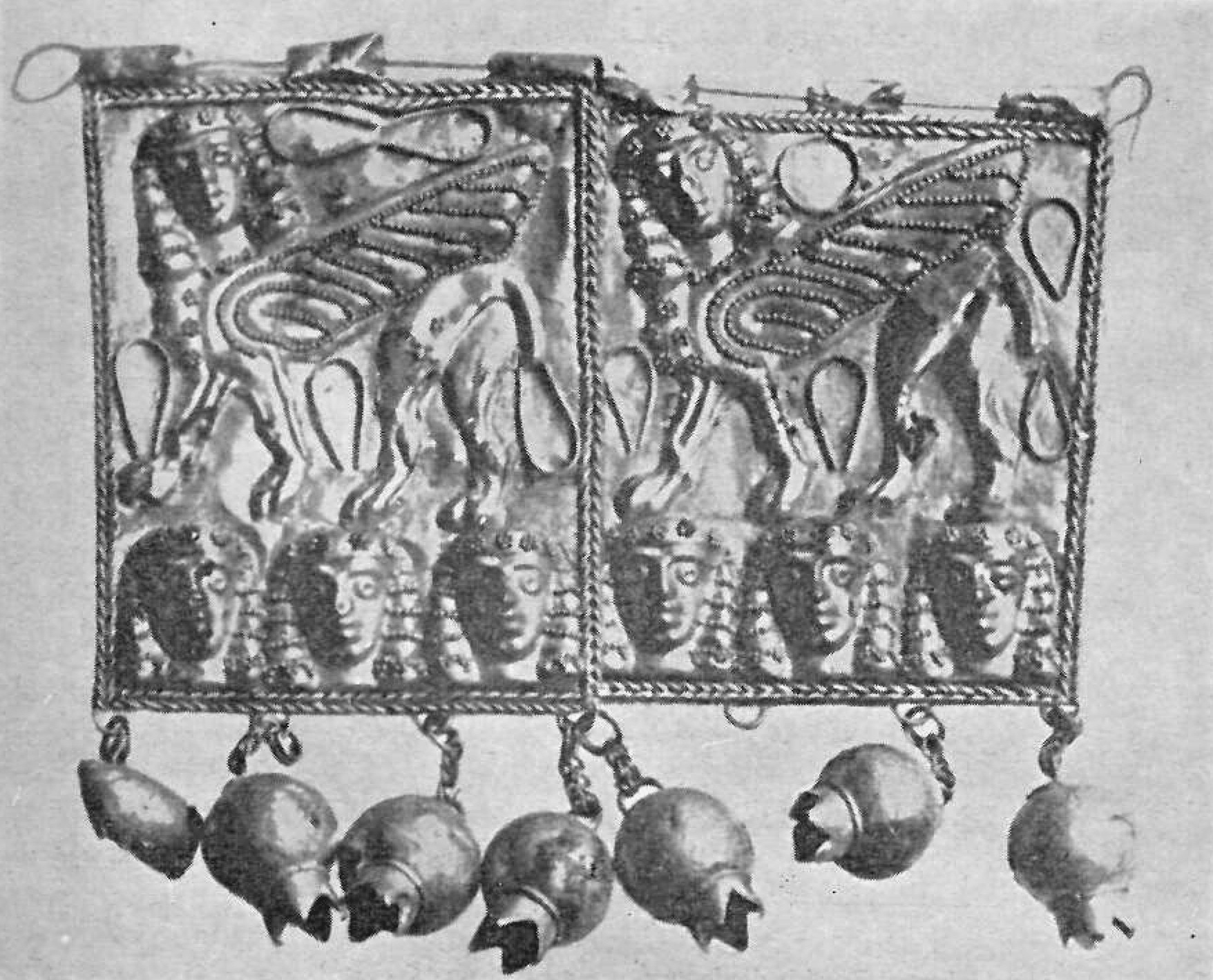
2. A plaque of the Cimmerian people, from the seventh century BC; taken from the “Encyclopedia of World Art”, volume six
And furthermore, the Old Testament also contains an account of the use of bells (which, in terms of the manner of use, cannot serve as a criterion of acceptance for our people), but in any case, by way of analogy and the contexts we recall, it can guide our thinking and draw our attention to how bells were used.
. . . . . . . . . . . . . . .
In the Book of Exodus (chapter nine) it is stated:
(1) … and they made cloths of service, to do service in the holy place, of blue, and purple, and scarlet, and made the holy garments for Aaron, as the LORD had commanded Moses.
(22) … and he also made the robe of the ephod(1) of woven work, all of blue.
(24) … and they made upon the hem of the robe pomegranates of blue, and purple, and scarlet, and twined linen.
(25) … and they also made bells of pure gold, and put the bells between the pomegranates upon the hem of the robe, round about between the pomegranates.
(26) … and round about the hem of the robe a bell and a pomegranate, and a bell and a pomegranate, to minister in, as the LORD had commanded Moses.
. . . . . . . . . . . . . . .
Did the pleated garment known as Persian (which is depicted on the bodies of the Achaemenids at Persepolis) belong to the Medes or to the Elamites?
. . . . . . . . . . . . . . .
From the many reports of researchers, it has not yet truly become clear what they mean by Median clothing and what by Persian.
One of them is of the opinion that the pleated garment of Persepolis formerly belonged to the Medes.
Another is of the opinion that the Elamites had this garment and that the Persians took it from them (who were natives of the plateau).
Herodotus has written (that they, “meaning the Persians,” adopted the Median dress, which they had judged better than their own).
Which does he mean by Median clothing (the pleated garment “which they believe formerly belonged to the Medes,” or the dress composed of trousers, shirt and cloak “which was worn by the Medes, and on which most researchers agree”)?
As has briefly been shown, the information based on the writings of ancient historians and modern researchers is confused, and in this situation it is not possible to distinguish their clothing from one another correctly; hence a second review becomes necessary.
. . . . . . . . . . . . . . .
Xenophon has written: Cyrus adopted the Median dress and induced those close to him to wear this dress. The merit of this dress is that it conceals defects and makes people look larger and more handsome. Cyrus had a pointed tiara encircled by a diadem, and his dress was half purple and half white (which was reserved for the king), and he wore half-trousers (of a vivid color) and a purple cloak.
. . . . . . . . . . . . . . .
This account by Xenophon (in view of the confusion of the clothing he reports) is such that one cannot rely on it without the necessary care.
From historical records we have learned that the pointed hat wrapped with a diadem is a type of Median (and originally Scythian) hat, and whatever its material may have been (felt, leather or bronze), in shape it recalls the ribboned pointed hat of the Median horseman (who is hunting a lion with a spear).
The half-purple and half-white dress is of the pleated type of garment, a counterpart of which the Immortal soldiers of Susa have worn.
The purple cloak is of the type that the figures called Medes wear on their shoulders in the reliefs of Persepolis (and wearing it over a pleated upper garment is not fitting).
Therefore, the picture of a jumbled dress of the two types, the one known as Median and the pleated one known as Persian, is a misplaced and disordered mixture that has been put forward; and furthermore, Cyrus’s half-trousers are something of which we have no example or evidence, and the idea of such trousers (without the clothing of the lower part of the body being specified “as to whether he had high-topped footwear into which the cuff of these half-trousers could be tucked, so that the leg was covered in this way”) is also difficult, for, given the belief which (it is said the Persians held about covering the parts of their body, considering it impolite to leave any of them bare), how would this bareness of the other half of the leg have squared with that belief?
. . . . . . . . . . . . . . .
Will Durant, in “Our Oriental Heritage” (quoting Rawlinson and other sources – from the time of Darius I), has written that most of them wore clothing like that of the people of Media, and later also adorned themselves with Median jewelry, and, except for the two hands, considered it contrary to good manners to leave any part of the body uncovered, and for this reason they were covered from head to foot, from headband or hat to shoes.
(They wore three-piece trousers, a linen shirt and two outer garments whose sleeves covered the hands, and they tied a belt around their waists).
The reason for dressing in this way was to remain safe from the harm of the intense heat of summer and the bitter cold of winter. The distinction of the king was that he wore embroidered trousers with red patterns, and the buttons of his shoes were saffron in color.
. . . . . . . . . . . . . . .
In this sentence of Will Durant’s: (that most of them wore clothing like that of Media) the word “most” is a sign that the Persians, besides the Median dress, also had another dress (and that must be of the type of Xenophon’s half-purple and half-white dress, “which recalls the dress of Susa, and is the very one depicted on the bodies of the Achaemenid kings at Persepolis”) (Figure 3).
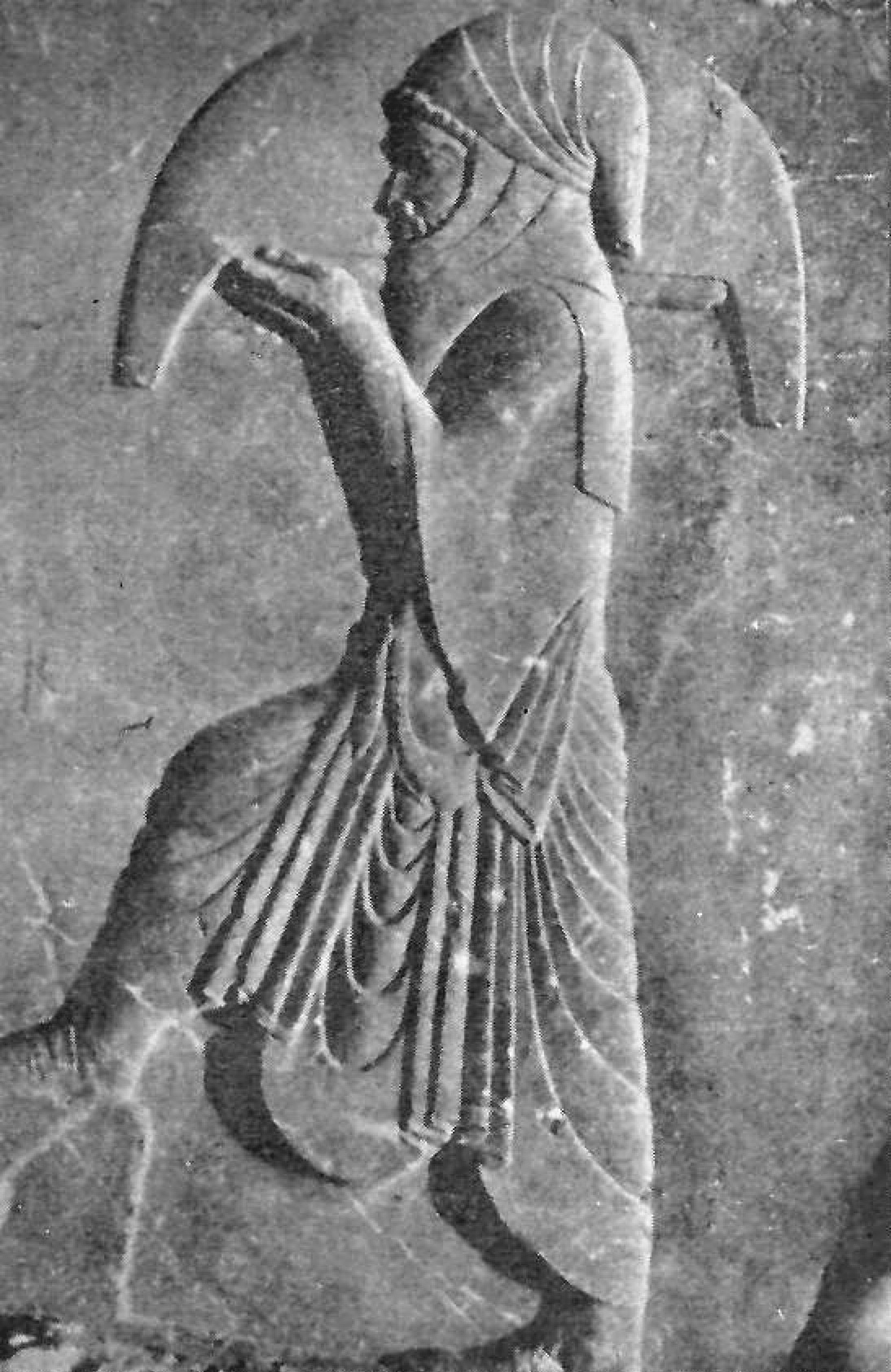
3. The pleated garment known as Persian
Olmsted, in the book “History of the Persian Empire,” has written: The Medes are distinguished by wearing the more original Iranian dress. Their dress consisted of a close-fitting, sleeved muslin (shirt) that reached to the knee, long trousers, and a robe.
. . . . . . . . . . . . . . .
The phrase (the more original Iranian dress) leads the mind to the idea that the other clothing (the upper garment and the wide pleated skirt known as Persian) must not have belonged to the Iranians (the Aryans of the Iranian plateau).
. . . . . . . . . . . . . . .
The matter of leaving or not leaving the body bare (in terms of customs and manners) and its observance, with regard to the climate of each region, is a subject that plays a part in shaping the clothing of every people.
If the ancient Iranians held the belief that leaving the body bare, except for the two hands, was far from good manners, it was necessary for them to have clothing befitting their custom (with sufficient covering capacity), and in that case it is the clothing composed of shirt, trousers, robe and headband that seems to have suited them; yet at Persepolis we see that, contrary to the stated custom and belief, figures fighting animals have been depicted with bare bodies.
. . . . . . . . . . . . . . .
Richard Frye writes: Perhaps the consolidation of Cyrus’s empire was achieved by applying the very methods to which he had devoted himself in uniting the tribes and people of Pars (whether Aryan or native).
This mixture of cultural elements can be seen in the garments of the figures carved at Persepolis.
Here the dress of the Iranians is mostly like that of the Elamites, whereas the Iranians (the Medes being among them) wore trousers and footwear.
. . . . . . . . . . . . . . .
… And again, Richard Frye, quoting Strabo, writes that the Persians especially followed the Medes in dress (except those who were in the south)? and in dress imitated the defeated people of Elam (“The Heritage of Persia”).
. . . . . . . . . . . . . . .
*
So, as has been reported: Olmsted doubts that the pleated garment belonged to the Aryans, and Richard Frye attributes it to the Elamites (natives of the Iranian plateau), but Diakonoff attributes this pleated garment to the Medes and presents evidence on this matter.
To find out how sound the researchers’ views are, it is fitting to pay some attention to the sources of their ideas.
. . . . . . . . . . . . . . .
Diakonoff writes: In the Assyrian images, the tall felt hat or crown (which in Latin was called the tiara and was particular to the inhabitants of Media) is not seen.
But since the said hat was in use from the second half of the third millennium BC and also in the Achaemenid era, it was undoubtedly customary in the period in question as well.
And then, referring to the relief of Naram-Sin (which was found at Susa), he writes:
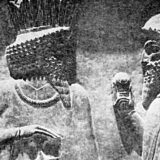
The Lullubi wear a light garment or a skirt and have thrown a spotted skin over one shoulder, and this itself, in the millennium BC, was the dress of the people of Mannea, western Media and the Caspians (according to Herodotus). (Figure 4).
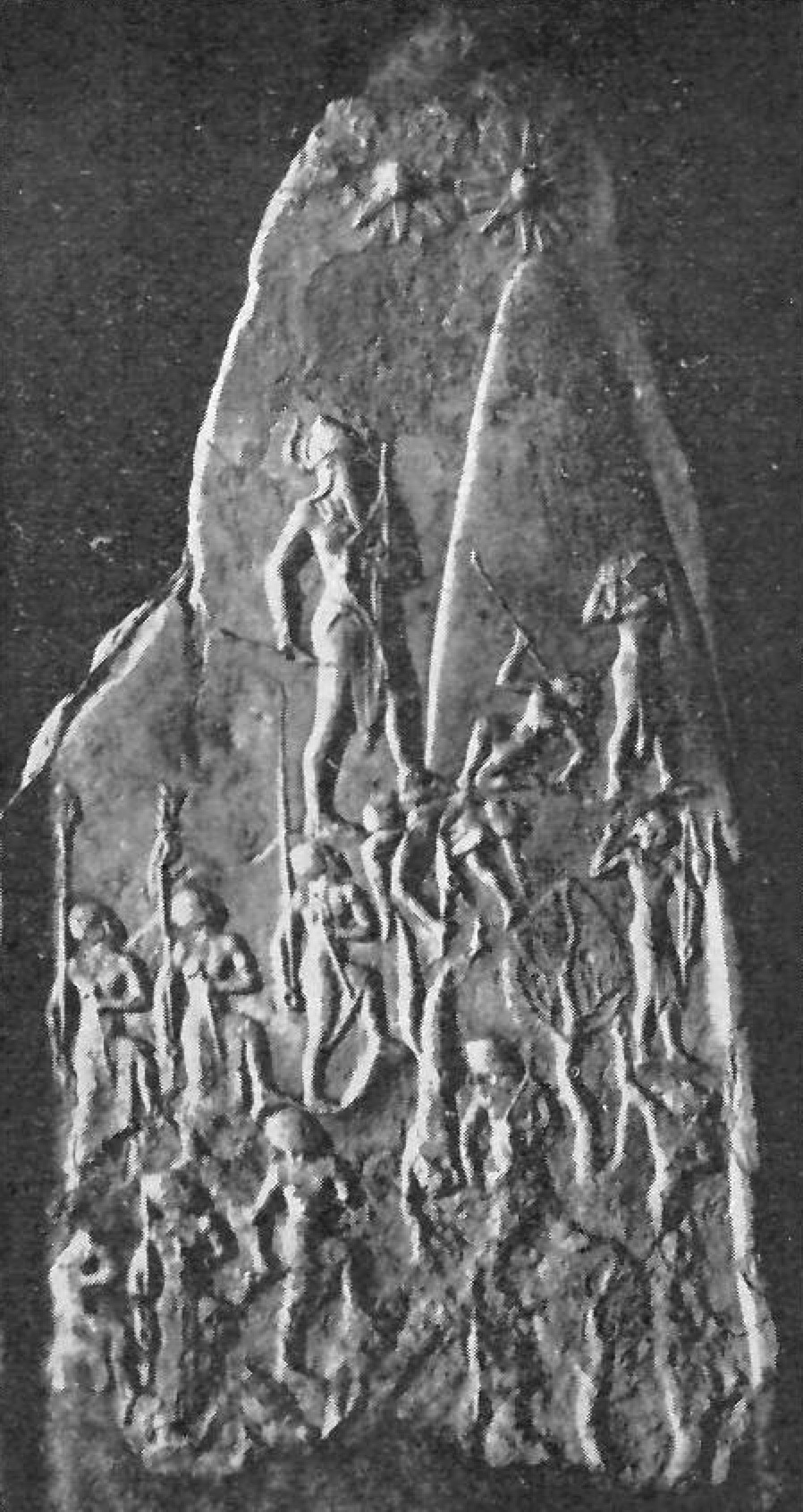
4. Victory stele of Naram-Sin, the Akkadian king (found at Susa), from the second half of the third millennium BC
In the relief of Anubanini as well, of the 9 figures, eight have Sumerian and Akkadian hats, and the ninth (the one who leads the others in the lower row) wears a hat or crown (which in the first millennium BC was particular to the eastern Medes, and which the Persians later adopted from them). (Figure 5).
5. First figure on the left: drawing of a Median man on the relief of Anubanini at Sar-e Pol-e Zahab; second: Persian; third: Mannaean; fourth: a Mede in an Assyrian relief
The Greeks had no knowledge of this Median dress and considered it particular to the Caspians alone, and they call another dress (which differs from the dress in the Assyrian images) Median dress, which consists of:
(A loose shirt, the “sarapis,” with long sleeves, and wide pleated trousers “which were in fact a long skirt gathered between the two legs,” and a short cloak of many-colored fabrics or of worked wool).
This type of dress was completed by a bashlyk that they pulled over the head. Apparently the Arizanti horsemen had this dress, and the western and central inhabitants did not use it in the first half of the first millennium BC, but in the east of the country it had been customary since ancient times, and this is evident from an ancient Median seal found in Necropolis B of Tepe Sialk, on which a rider in Median trousers is depicted on horseback.
. . . . . . . . . . . . . . .
And then Diakonoff refers to a figure that shows two riders. (Figure 6).
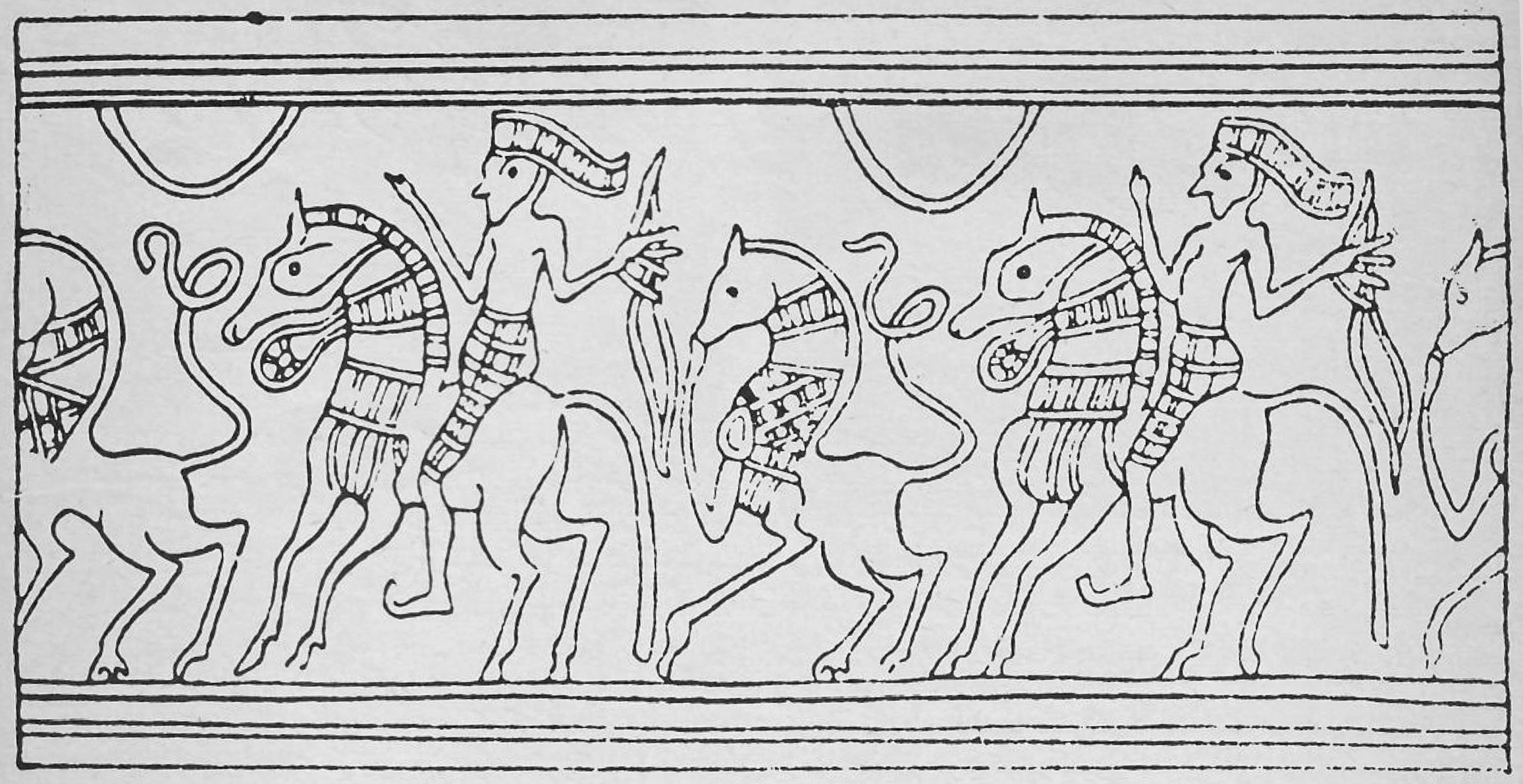
6. Drawing of the seal from Tepe Sialk, Kashan, and Diakonoff’s evidence for the pleated garment known as Persian
In this seal, the upturned toe tips of the riders do not show any outline of footwear, but this upturned tip recalls footwear of the very same Median type depicted on the Assyrian rock reliefs, “which is high-topped.”
The design of the trousers is such that it does not bring to mind wide trousers or a long pleated skirt (which Diakonoff described, and as evidence of which he presented this figure); rather, it is more reminiscent of the type of trousers worn by the Assyrians, the Scythians and the Medes of the Assyrian reliefs.
The upper bodies of the riders are also bare and show no upper garment that might suggest being pleated or unpleated (or of some other type), and the rider’s tailed hat (which has a broad, heavy tail) is not such as to resemble a turban or a hat, except that it bears a distant resemblance to the hat of a man in the relief of the tomb of Qizqapan(2).
Jalil Ziapour, Director of the Museum of Anthropology
1. Ephod: to put on, to wear; embroidery on the garment of the high priest (on the shoulder of which the names of the twelve tribes of the Jews were inscribed), from the dictionary: Universal English dictionary.
2. The relief of the tomb of Qizqapan (as Diakonoff indicates) is located in the Shahrizor valley (beside the village of Surdash, near Sulaymaniyah).