by
by An article by Master Jalil Ziapour, titled “Some Notes on Two Borderless Neighbors (Elam and Sumer),” published in Honar va Mardom magazine, Nos. 74 and 75, pp. 13 to 19, December 1968 and January 1969.
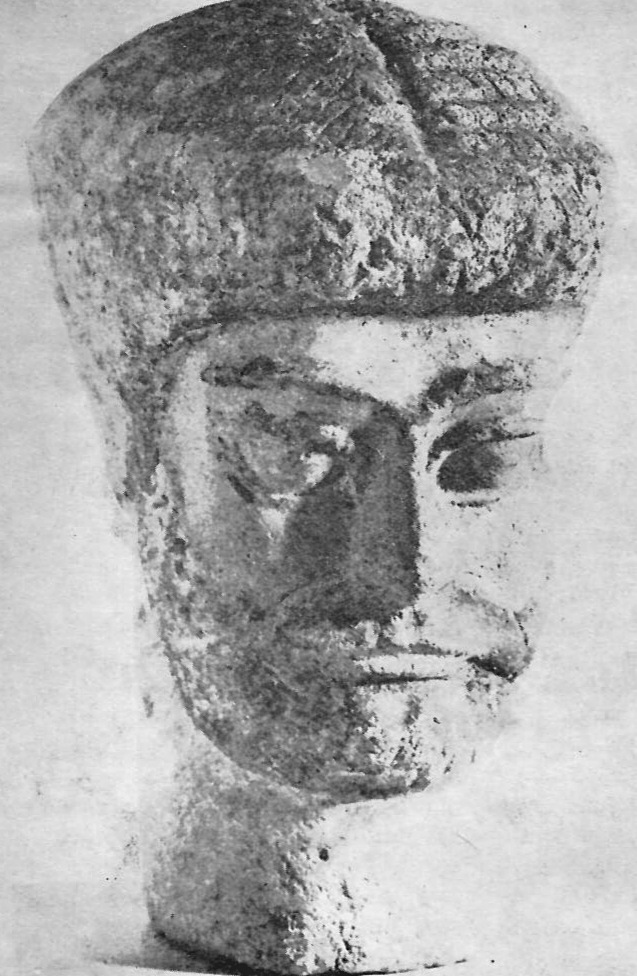
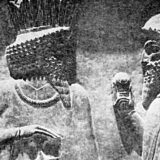
1. Head of an Elamite man in baked clay; found at Susa; belonging to the late second millennium BC; the Louvre Museum
Most scholars and archaeologists consider the civilization of Elam to be connected with the civilization of the people of Sumer, who lived in southern Mesopotamia.
To what extent this connection exists, it is archaeology that determines it. What now prompts our attention to this region of southwestern Iran or the lowest southeastern part of Mesopotamia is several connections that provide suitable grounds and traces for increasing our knowledge, and confirm our knowledge or examine it regarding the necessity of revision, and in this way, may well provide the grounds for sound thinking.
. . . . . . . . . . . . . . .
We must know: Elam (which is adjacent to the land of Sumer) itself had a very distinguished civilization, and as abundant documents and artifacts show, their specific clothing in one period was of the very same wide and pleated attire that later the Achaemenids used, and relying on abundant evidence, one must accept that the pleated clothing depicted at Persepolis was adopted from the native people of Elam and their surroundings, and as documented artifacts show, the land of Pars, before the arrival of the Persians, was under the influence of the Elamites, and this clothing had penetrated there, while the Persians themselves in ancient times had clothing of the Median type.
The attention of the Achaemenid monarchs to retaining conquered peoples through adopting their characteristics led to the use of this kind of native clothing. In particular, retaining the Elamites (a nation with such a civilization and historical background) was necessary only through providing gratifications (which would create a balance in local prejudices) so that their willing acceptance could become possible, and if we recall the statement of Xenophon: (that Cyrus believed that to win the favor of subject peoples, one must make use of their suitable characteristics, and for this reason obliged his close associates to wear Median clothing), we can observe that in the case of the Elamites as well, they took such a measure.
At Pasargadae, too, in the relief we see the winged man who has an Egyptian headdress on his head and wears clothing similar to the inhabitants of the western border of the plateau. Or another depicted figure at Pasargadae wears a fish skin, which is a sign of respect and regard for the beliefs of subjects or winning the goodwill of neighbors (which provided the basis for peace among the various subject peoples).
In any case, attention to the relationship between Elam and Sumer (which were borderless neighbors) creates a path toward their connection (especially since most scholars believe that the Sumerians came from the east of the plateau to the region known as Sumer). This matter itself connects many things of these people to the ancient people of the plateau and illuminates the origin of their civilization for us.
Who were the Elamites, and what position did the Sumerians hold in relation to them?
Behind the Zagros mountain range (in the southwestern part of the plateau), the vast plain of Susa (Khuzestan), as has been said: presents us with the most important civilization of the ancient world.
Richard N. Frye writes: This plain, which was once under the rule of the Elamites, was a center of political civilization due to the heavy traffic of the people of the plateau to this region.
Edward Chiera writes in the book “They Wrote on Clay”: Elam is the name of an ancient and historic people and civilization that existed in the location of present-day Khuzestan in 4000 BC, and he adds: The village of Masandan (located in Pusht-e Kuh of Lorestan), which had been known as Hoseynabad (and where the burial place of the Abbasid caliph al-Hadi is also located), was erroneously named Elam in 1932.
. . . . . . . . . . . . . . .
Sir P. Sykes writes: The plain of Elam in ancient times (whose history goes back to around 4000 BC) was nearly 120 miles north of today’s coastline, and under these conditions, it is evident what the extent of this country was.
And where he speaks of the Karun River, he writes: this river entered the Gulf at a point near Ahvaz around 4000 BC, and at that point there was an island in the ancient Gulf that now remains as a high rocky mountain.
. . . . . . . . . . . . . . .
Perhaps the ancient natural condition of Elam (which Sykes described in his book “A History of Persia” under the title ‘Geography of Elam and Babylonia’) was such. But this plain of Khuzestan, although it was small in those times and gradually grew larger with the recession of the waters of the Gulf, has a great history due to its regional characteristics.
The gist of it can be stated as follows with the help of Christy Wilson (who utilized the views of archaeologists, especially de Morgan):
The remains of the lowest stratum of Susa show that the people of this period (5000 to 4000 BC) practiced agriculture, produced grain and fibers, and wove cloth from fibers, and hunting was among their vital occupations.
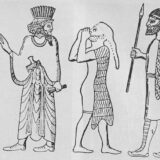
They used bows and arrows and flint spearheads, and employed clubs with stone heads. They had eyed needles, copper mirrors, and chisels, and had undoubtedly succeeded in domesticating certain animals. Three examples of the Elamites, numbered (1 – 2 and 3), are provided for further information.
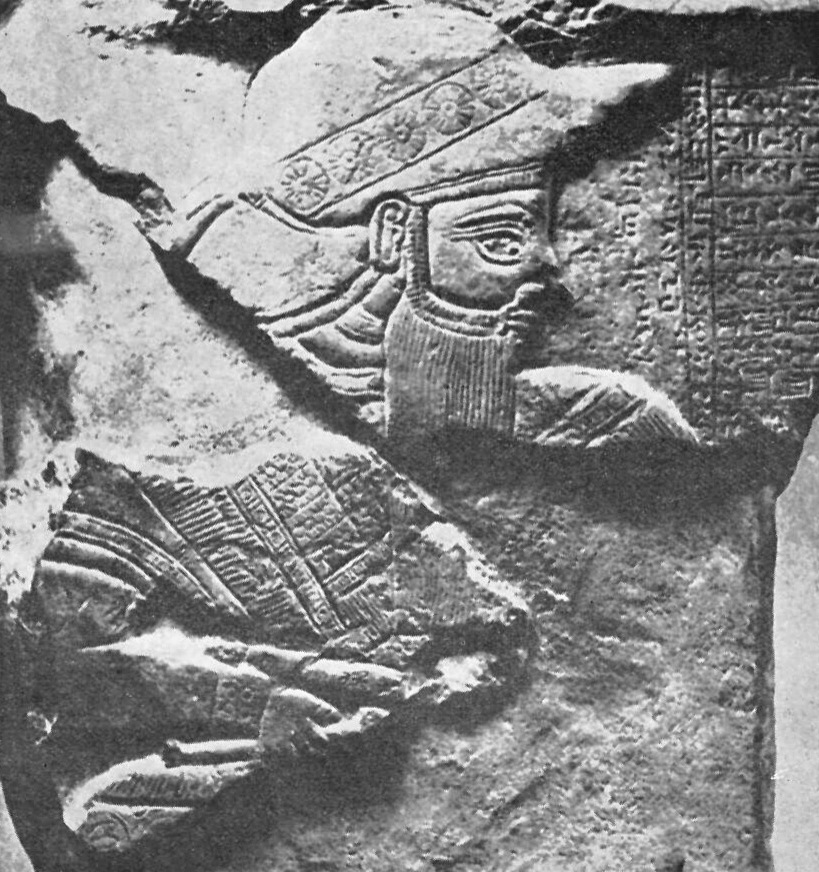
2. Relief of the Elamite Adda Hamiti Inshushinak; taken from Vanden Berghe’s book “Archaeology of Ancient Iran”
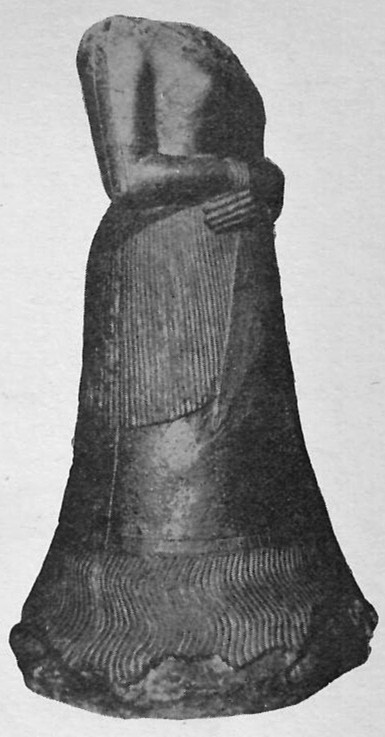
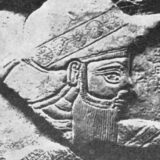
3. Bronze statue of the Elamite queen (Napir Azu); from the excavations at Susa; taken from the book “Mémoires de la Délégation en Perse”, volume eight
Now, given this concise introduction to the conditions of the people of Elam, we turn to their borderless neighbor (the Sumerians).
Concerning the known dwelling place of the Sumerians (located in the lowest part of Mesopotamia), it is stated in the book “History of the Ancient Peoples of Western Asia” that the date of the formation of its lands is relatively recent, and it was not inhabited until 5000 BC, and only in the third millennium were the Sumerians and Akkadians able to settle there, and before the end of this millennium the history of their rule and power also came to an end; and the Sumerians engaged in agriculture in these newly dried lands of Mesopotamia and produced cloth from goat and sheep wool, using it instead of animal skins, which (previously had been used as clothing).
. . . . . . . . . . . . . . .
Detailed research has been carried out concerning the original home of the Sumerians, because Sumerologists, by obtaining specimens and artifacts, have come to believe that their original home (having valuable evidence in hand) cannot be newly dried southern Mesopotamia. Their evidence and artifacts testify to a more advanced civilization, and their writings speak of a time and place that cannot encompass this region known as Sumer.
Edward Chiera writes: This view (that the Sumerians were originally foreigners and invaded this land from the outside) has for several years been gradually gaining strength and acceptance, because several points of connection have made the acceptance of such an idea inevitable.
Sykes writes: Through the discovery recently made in the Indus Valley, many civilizational remains (similar to Sumerian remains) have been unearthed.
The extraordinary similarity of the buildings, statues, seals, and figures made of clay all indicates that these two civilizations arose from a single root or common origin, and testifies that the original homeland of the Sumerians is in certain mountainous areas of eastern Iran, Afghanistan, or Baluchestan.
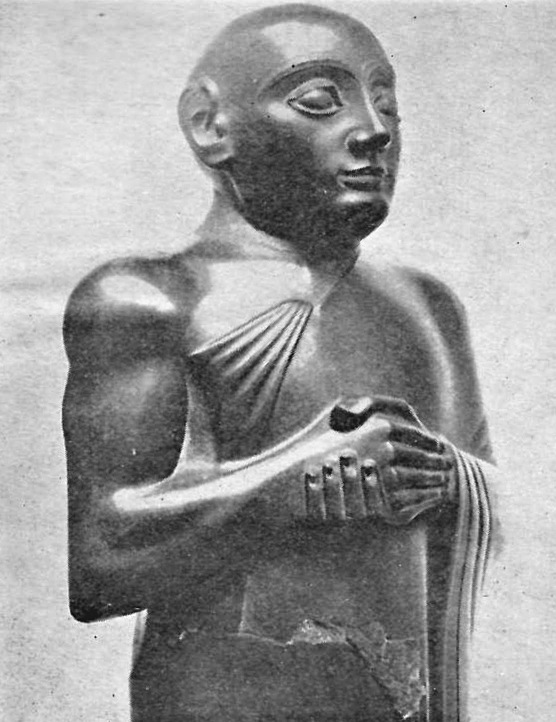
4. Stone statue of the Sumerian Gudea, ruler of the city of Lagash, Tello; belonging to 2100 BC; taken from the book “The Ancient Art of the Middle East”
Then, Sykes refers to his travels in Bashagard and Sarhad (located in southern Baluchestan): that he saw dark-colored men there, and considers it probable that black people may have inhabited these regions (from the northern shores of the Persian Gulf to India), and he brings in the view of Hall, who believes that the black inhabitants of Elam and Sumer were branched from these very peoples, and cites in confirmation the opinion of Dieulafoy and de Morgan: that both traveled in Elam and conducted thorough investigations on site, and agree that the inhabitants of the plain of Susa (who are themselves originally native there) were also black.
. . . . . . . . . . . . . . .
Considering this view of Childe: that the material culture of the end of the fourth millennium of Mohenjo-daro (in the Indus) is comparable to the medieval period of any European city, Will Durant asks himself: Are the inventions and discoveries peculiar to pre-Sumerian civilization not the outcome of local advances on Mesopotamian soil? And must one consider it the result of inspiration from the Indus? If so, did the Sumerians themselves come from India, or at least from regions near the Indus sphere of influence and culture?
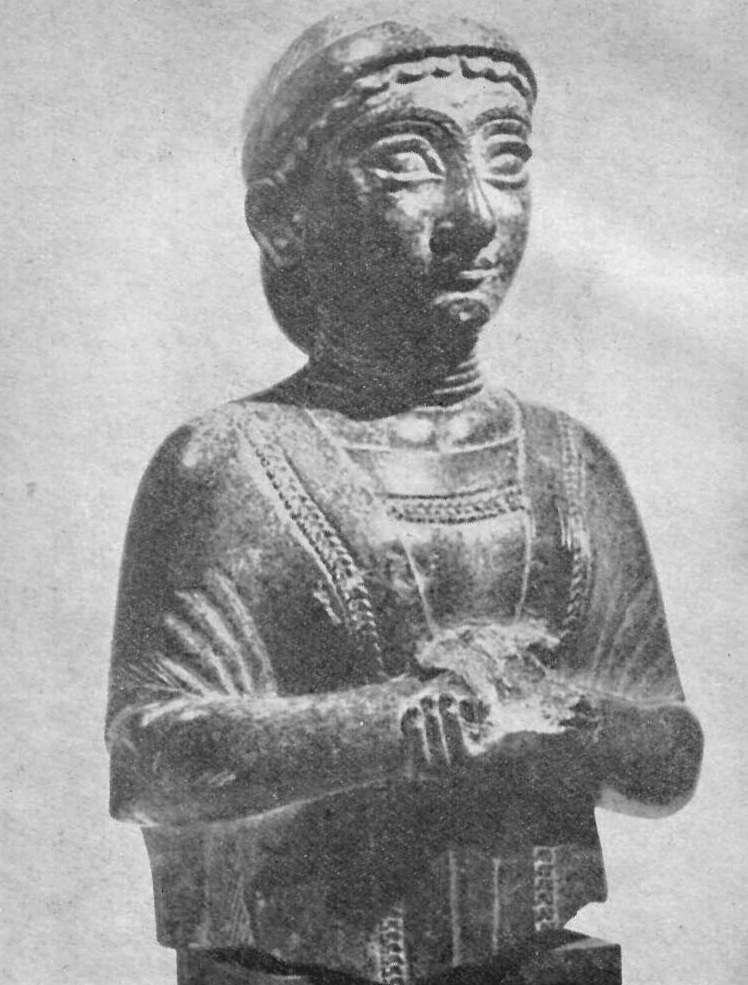
5. A Sumerian woman (Neo-Sumerian) found at Lagash, Tello; held in the Louvre Museum; taken from the “Encyclopedia of World Art”, volume nine
Sykes writes that in the records, they are recorded as the black-headed people, and their original homeland was mountainous, because they depicted their gods standing on a mountain, and it is also evident from their early dwellings and settlements (which were wooden) that the said land was forested and wooded.
There is a verse in the Book of Genesis: (And it came to pass, as they journeyed from the east, that they found a plain in the land of Shinar, and they dwelt there) chapter 11 – verse 2 – which undoubtedly relates to the Sumerians.
. . . . . . . . . . . . . . .
With the help of other researchers, we become acquainted with a people known as Dravidians (in southern India), whose traces they follow from the regions of the Indus and Baluchestan to Mesopotamia.
Durant, in the fourth chapter of the first book of his “The Story of Civilization”, writes:
At the time when the Aryans invaded the land of India, the Dravidians were a cultured people and adventurous merchants who navigated the seas and had even reached Sumer and Babylon.
Henry Field (in “The Anthropology of Iran”), quoting Deniker, writes that the Brahui tribe of Baluchestan was dark-skinned and of the Dravidian race, and the Brahui language is also of the Dravidian language type.
. . . . . . . . . . . . . . .
In addition to these discussions and theories, another highly authentic document exists that makes the Sumerians properly known to us and reveals their true face, and recounts for us their worldview regarding the events around them, and in this way, we can understand the nature of the region in which they lived.
This authentic document consists of their discovered writings, which comprise a series of literary, philosophical, and social poems that Samuel Kramer compiled under the title “From the Tablets of Sumer”, and a Persian translation of it is also available.
Kramer writes in this book that in none of the Sumerian poems is there any explicit reference to the date of their migration toward Mesopotamia, and it is probable that the Sumerians poured into the western regions of Iran from beyond the Caucasus and the Caspian Sea.
After noting that (the pre-Sumerian period began with agriculture in villages), Kramer writes: The current prevailing view is that migrants from southwestern Iran brought the said civilization with them to southern Mesopotamia.
. . . . . . . . . . . . . . .
In one of the Sumerian poems, an explicit reference is made to their complexion and the color of their head and face as follows:
. . . . . . . . . . . . . . .
I will return the people to their settlements.
In the cities, they will build places for the divine laws.
They will lay the bricks of our houses in clean places.
A clean place that is for our commands.
. . . . . . . . . . . . . . .
After (An) the god of heaven.
And (Enlil) the father of all the gods.
And (Enki) the god of water.
And (Ninkharmak) the mother goddess.
Created the black-headed people, vegetation grew from the earth.
Animals, the four-footed beasts of the plain, were skillfully created.
. . . . . . . . . . . . . . .
In another Sumerian poem, mention is made of a time when the Sumerians were naked, did not know clothing, and had no houses. They had not domesticated animals, and did not know how to farm. Until, upon the people’s plea, the gods made clear to them the way to carry out these matters and endowed them with bounties:
. . . . . . . . . . . . . . .
After, atop the mountain, earth and heaven.
The god of heaven (An) caused the birth of (the Anunnaki) his followers.
Since (Ashnan) the god of grain had not been created and had not been born.
Since (Uttu) the god of clothing had not been created.
There was neither ewe nor lamb, neither goat nor kid.
. . . . . . . . . . . . . . .
Since (Uttu) had not yet opened eyes upon this world.
And the vegetal crown and throne had not been established.
And (Sumugan) the god of the plain, had not come into existence.
Because they (the Anunnaki) did not know how to eat bread and wear garments.
With their mouths like sheep they ate grass and drank water from the ditch.
In those days, in the creation workshop of the gods, and in their house (named Duku), Lahar (god of the flocks) and Ashnan were created.
. . . . . . . . . . . . . . .
In those days, Enki says to Enlil: O Father Enlil
Let Lahar and Ashnan (who were created in Duku) descend to earth.
Lahar and Ashnan, descended from Duku.
The sheepfold, Enki and Enlil built for Lahar.
They gave Lahar abundant plants and grasses.
For Ashnan they built a house.
And gave Ashnan the plow and the wooden comb.
. . . . . . . . . . . . . . .
This verse tale (a brief excerpt of which has been presented here as necessary) must naturally pertain to a period of acute lack of water and vegetation, and the time of living among caves and foothills (which compelled the people to yearn for a better life and to obtain their necessities from the gods), and with the fulfillment of the Sumerians’ needs (through the gradual assistance of nature) as they attained water and grain, built folds and storage storehouses, and finally settled definitively in a place, the opportunity arose to compose in verse the story of their arduous life during the time of their residence in past places (on the basis of their own allusions to the mountains) and their familiarity with the affairs of life, and also to set into verse their thoughts regarding the world of creation, the will of the gods, and their mercies toward the Anunnaki (servants and creatures).
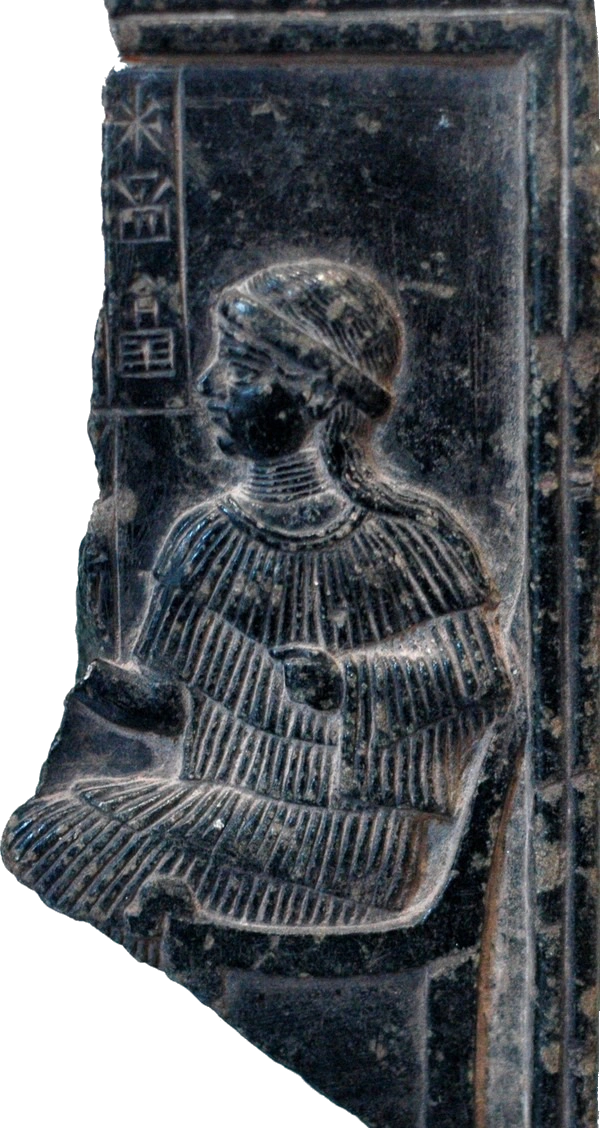
6. The goddess Ninsun (Neo-Sumerian); taken from the “Encyclopedia of World Art”, volume nine
There is also another poem in the book “From the Tablets of Sumer” in which the type of clothing is discussed, and the designs on the artifacts discovered from the Sumerians also recall and corroborate the content of this poem.
. . . . . . . . . . . . . . .
Her heroic warrior brother (Utu).
Says to the pure (Inanna): Sister
Let the shepherd choose you as wife.
(You, who have adorned yourself with ornaments) why are you unwilling?
. . . . . . . . . . . . . . .
The shepherd will not take me as wife.
He will not put his beautiful garment upon me.
Its soft wool, will not cover me.
I who am a maiden, will become the wife of the farmer.
(The farmer who grows abundant plants.
The gardener who grows abundant grain).
. . . . . . . . . . . . . . .
In any case, with the help of these few remarks and other Sumerian poems, one can find a way to the memories of the distant past, and their original dwelling place, upon the gentle, far-bounding steed of imagination.
One can never believe that these people of the plain (the newly dried plain of Sumer), founding their early civilization in the third millennium BC alongside the people of Elam (who had established their civilization from around the fifth or fourth millennium), with the people of Sumer having been in close contact with them, could have ignored and disregarded their thought, failed to learn from them methods of agriculture, house construction, garment making, ways of eating and drinking, and the taming of animals, and should speak of thoughts, yearnings, and philosophies of a time and place that had no compatibility or connection with this territory of theirs; or that all these desires, learnings, and hardships should have arisen in this very newly dried place from the time of their arrival in the third millennium BC alongside the Elamites.
Samuel Kramer too, despite all his strictness in examining differing theories and opinions, while determining the antiquity of Sumerian history, could not refrain from accepting the end of the fourth millennium BC (when they entered southern Mesopotamia).
Three examples of the Sumerians under numbers (4 – 5 and 6) are given for further information and familiarity with their general appearance.
Jalil Ziapour, Director of the Museum of Anthropology