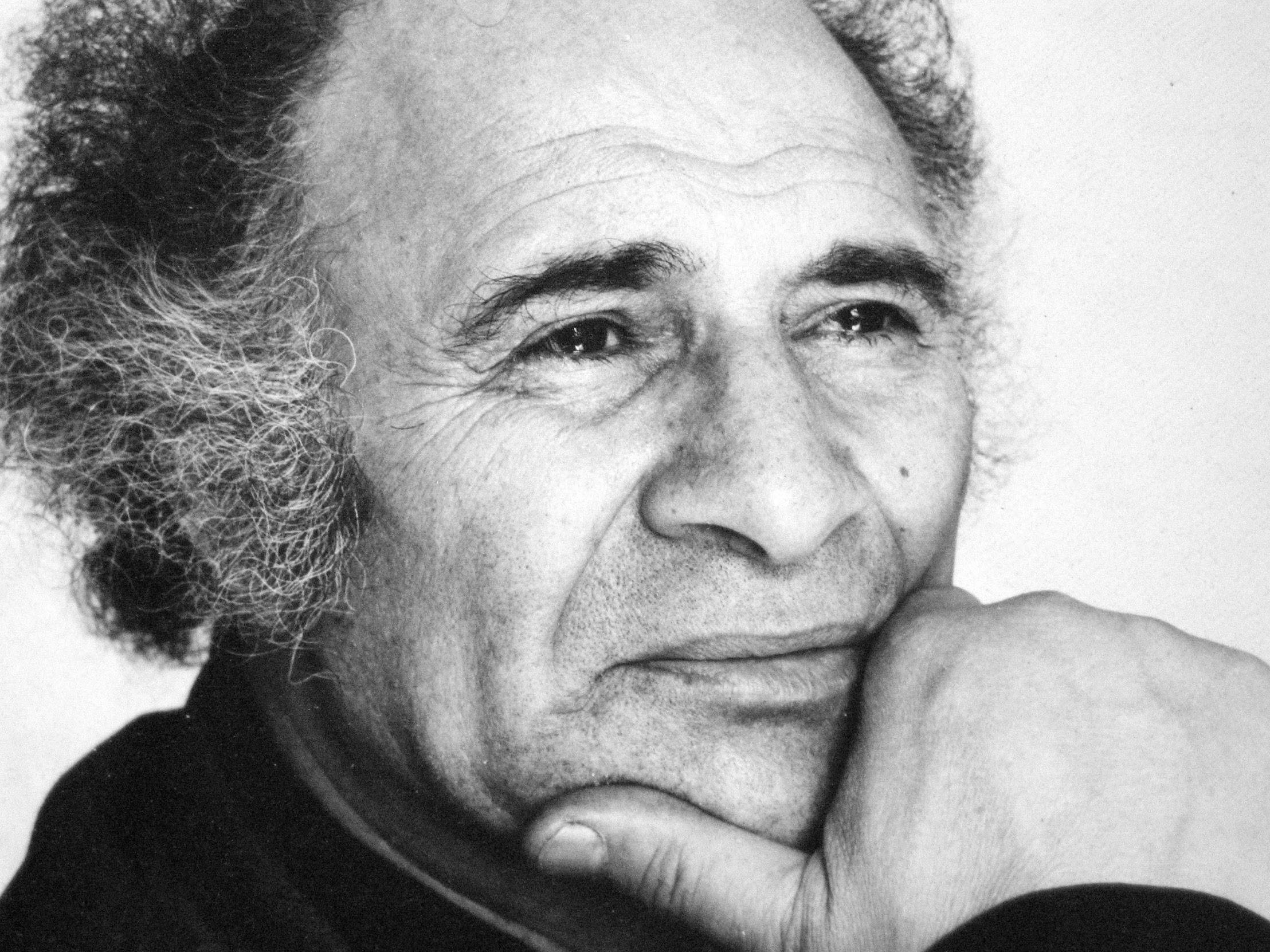
Master Jalil Ziapour — Father of Modern Iranian Painting
Master Jalil Ziapour was born on 25 April 1920 in the port city of Bandar Anzali. After completing his early schooling in his birthplace, he set out for Tehran in 1938 to pursue the studies he loved. On his arrival he sat the entrance examinations in music and earned the required standing; and so, in his very first steps toward learning, he began with the art of music.
The Master said of this: «Not long after I began at the Conservatory of Music studying composition, the Belgian masters who ran the conservatory gave up their posts and returned to their own country following a decision of the government of the day. Responsibility then passed to “Colonel Vaziri,” and since the composition course no longer existed at the conservatory, I gave up music — against my inner wish — and turned instead to the traditional decorative arts.»
Study in the Fine Arts
After entering the old School of Fine Crafts (Sanāye’-e Mostazrafeh) and studying illumination, carpet design, miniature, tilework and Persian painting, Ziapour was admitted in 1941 to the Faculty of Fine Arts at the University of Tehran. With great enthusiasm he studied interior design, decoration, painting and sculpture, and in 1945–46 he completed his bachelor’s degree, ranking first and receiving a first-class cultural medal.
Study in France
That same year, on a scholarship from the French government and through the University of Tehran, he travelled to France for advanced postgraduate study (se perfectionner) and was enrolled by the French state at the École Nationale Supérieure des Beaux-Arts in Paris (the Beaux-Arts).
Pursuing knowledge with an energy and effort beyond description, Ziapour resolved to obtain permission from the French government and, with an official letter of introduction, to enrol also at the state academy of the Grande Chaumière — so that, beyond his principal subjects (painting and sculpture), he could simultaneously take up such fields as art history, stylistics, the history of civilization, sociology, the study of motifs, and costume.
Return to Iran and the Fighting Rooster
 Jalil Ziapour, who had studied at the finest school of his day — the very cradle of art at that time — under masters such as Suverbie in painting and Niclousse in sculpture, each among the foremost theorists of the art world, finally returned to his homeland in 1949 after earning a doctorate in art. To awaken minds to the new art in its contest with the old, he and three friends founded a society called «Khoroos Jangi» (the Fighting Rooster) and published a magazine under the same name.
The Master said of this:
«After my return to Iran I realized that our art was far removed from the world, and that our image-making and painting were a hollow imitation. A struggle therefore had to be waged — a struggle between an obsolete reverence for the past and a traditionalism cut off from the realities of the age — and this called for careful planning. So I founded a society and named it the Fighting Rooster, because the beautiful, colourful bearing of the rooster is close to painting, and the bird is itself a symbol of combat and struggle. I also chose a motto for the society, from Farrokhi Sistani:»
«The tale of Alexander has grown old and passed into legend — / bring forth new words, for the new has a sweetness all its own.»
Thought and Artistic Legacy
After his return to Iran, with resolute steps and an inquiring, thoughtful eye — now a rich and powerful master — Jalil Ziapour drew back the veil on Iran’s authentic culture and gave Iranian art a fresh vision in a new garb. After much research and the necessary reflection, he set down his artistic theory and ideology under the title «The Abrogation of the Theories of the Past and Contemporary Schools» and began to enlighten minds. He was a pioneering painter, an informed critic and the standard-bearer of a movement that emerged, head held high, from the straits of its time under the most difficult cultural conditions. With more than half a century of dedication to Iranian art, over a hundred cultural, artistic and social lectures in public and private gatherings, the creation of artworks, the writing of many books of research, compilations and articles, interviews, and the holding of senior and governmental posts, he is among those luminaries whom the published art books and journals have regarded as a companion to Nima and Hedayat on the path of innovation. For his use of geometric forms and of a decorative art drawn from Iranian sources, and for the divisions he made in the manner of Cubism — setting down, for the first time, a new design in Iran’s modern art — the Master has been named «the Father of Iranian Painting».
Jalil Ziapour’s paintings have a personal manner, free of imitation; by the acknowledgement of the leading figures of this field, each of them is reckoned not merely a national cultural asset but a national treasure.
Teaching and Final Years
Out of the love he bore for the young and for students, in 1953, at the request of the country’s General Office of Fine Arts, Master Ziapour founded the conservatories of visual arts for girls and boys in Tehran, and also prepared the groundwork for establishing the Faculty of Decorative Arts.
 For more than half a century Ziapour strove for momentum in modernism, for turning away from imitation, and for attention to inspiration, breadth of vision, and the comparison of works in order to elevate artistic thought. Even in his later years he was forever striving to master the knowledge and learning of the day; and despite an illness brought on by the passing years, he continued — with an indescribable energy and strength — to teach at many faculties and universities, among them the faculties of dramatic and decorative arts, the University Complex of Art, Tarbiat Modares University and Alzahra University, supervising and guiding students at the bachelor’s, master’s and doctoral levels.
At last this wise and learned man — whose precious presence was a treasure to the people of art — on a long, cold Yalda night, on 21 December 1999, passed beneath the earth and, at the age of 79, bade this mortal world farewell, to begin, without doubt, the pursuit of knowledge in the world beyond.
May his soul be joyful, his memory honoured, and his path forever trodden.